
Thai Bourse Sounds Opening Bell for Asia’s Inclusive Economy
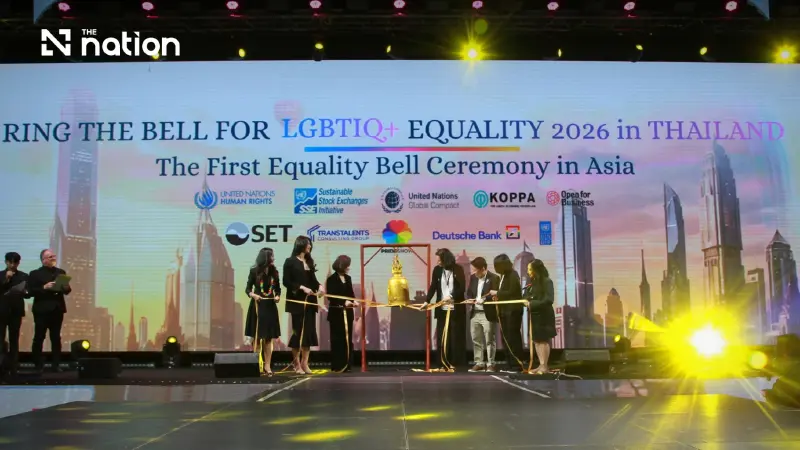


By becoming the first bourse in Asia to ring the bell for LGBTIQ+ equality, Thailand proves that human rights and high finance make a powerful match
- The Stock Exchange of Thailand (SET) became the first bourse in Asia to join the global "Ring the Bell for LGBTIQ+ Equality" initiative, publicly linking human rights with financial market strategy.
- The initiative frames inclusivity as a key economic driver, citing data that inclusive countries attract 4.5 times more foreign direct investment and that exclusion costs Thailand's economy up to 121.8 billion Baht annually.
- The SET is sending a regulatory signal for listed companies to adopt measurable and auditable inclusion metrics, providing tools like the UN's LGBTIQ+ Standards Gap Analysis to facilitate this change.
- This financial commitment supports Thailand's broader national strategy, including its recent legalization of marriage equality and its bid to host WorldPride 2030, to become a leading "rainbow economic hub" in Asia.
By becoming the first bourse in Asia to ring the bell for LGBTIQ+ equality, Thailand proves that human rights and high finance make a powerful match.
Move over, traditional corporate suits—the trading floor just got a vibrant, history-making upgrade. At the Pride Show 2026 expo on Saturday, the Stock Exchange of Thailand (SET) officially rang its opening bell for the global "Ring the Bell for LGBTIQ+ Equality" initiative.
Surrounded by advocates, UN representatives, and institutional giants like Deutsche Bank, the SET made history as the very first stock exchange in Asia to join this global movement.
While the energy felt like a celebration, the underlying message was serious financial business. The message from the podium was unmistakable: inclusivity is no longer just an HR checkbox or a seasonal corporate social responsibility campaign.
In 2026, diversity is a material economic asset, a magnet for foreign capital, and a fundamental pillar of modern market resilience.
Pannavadee Ladavalya Na Ayudhya, SET Senior Executive Vice president and chief people officer, emphasised that because "sustainable business are people," markets are naturally at their strongest when everyone is given the opportunity to fully contribute.
She noted that respect for human dignity is a vital foundation for "attracting talent, fostering innovation, strengthening competitiveness, and supporting sustainable economic growth," which directly reflects the bourse's core vision of becoming a trusted gateway to inclusive opportunities.

For years, diversity, equity, and inclusion (DEI) campaigns have been treated as "nice-to-have" ethical gestures. However, the data presented at the forum shifted the conversation from social sentiment to hard, cold cash.
According to data from the Open for Business coalition, countries with legally enshrined, inclusive laws attract a staggering four point five times more foreign direct investment (FDI) than non-inclusive markets.
In a global economy where asset managers screen stringently for environmental, social, and governance (ESG) metrics, a country’s social progressive policies directly correlate with its financial competitiveness.
Conversely, prejudice carries a heavy economic penalty. The cost of excluding the LGBTIQ+ community from the formal economy creates a massive regional drag. A combined one point four seven per cent of annual GDP is lost across Southeast Asian nations (including Indonesia, Malaysia, the Philippines, Singapore, and Vietnam) due to systemic workplace exclusion.
For Thailand alone, this exclusion drains an estimated fifty-one point eight billion to one hundred and twenty-one point eight billion Baht every single year. This represents lost productivity, restricted talent pools, and uneven economic mobility—capital that a forward-thinking capital market can begin to reclaim.
The SET's bell-ringing event does not exist in a vacuum; it is the financial anchor of a broader national momentum. In January 2025, Thailand made history as the first country in Southeast Asia to legally recognise marriage equality.

Now, backed by the Thailand Convention and Exhibition Bureau (TCEB), Bangkok is aggressively bidding to host WorldPride 2030. The global LGBTIQ+ economy represents an estimated four point seven trillion dollar market, making it the third-largest economy on the planet behind the US and China.
Nikki Phinyapincha, founder of TransTalents Consulting Group, pointed out that while this massive figure is usually framed through consumer spending, the real priority is integrating untapped talent "from the informal labour sector to the boardroom."
She added that Thailand's recent legislative milestones and its WorldPride ambitions can elevate the nation to the absolute forefront of Asia's rainbow economic hub.
When the SET rings the bell, it signals to international asset managers that the country's entire financial infrastructure is ready to lead that structural shift.

Despite the optimism on the trading floor, the corporate landscape reveals a significant disconnect between boardroom intent and operational reality. The Thailand Workplace Equity Report 2026, published by TransTalents Consulting Group, highlights a stark corporate contradiction.
On one hand, a resounding eighty-one percent of surveyed organisations openly admit that DEI is absolutely critical for attracting and retaining top-tier professional talent. On the other hand, more than half—fifty-two per cent of these entities—confessed they currently have zero formal metrics or tracking systems in place to measure workplace equity.
This is exactly why the SET’s public commitment matters. With fifty-eight per cent of executives anticipating that DEI metrics will be fully integrated into audited ESG reporting within the next two years, the bourse is sending a clear regulatory signal.
Listed companies can no longer rely on vague corporate statements; inclusion must become measurable, reportable, and auditable.
To ensure the historic bell ring translates into real-world change, the SET and its UN partners are providing listed companies with actionable homework.
Enterprises are being urged to utilise the free, confidential UN LGBTIQ+ Standards Gap Analysis Tool at lgbtiq.unglobalcompact.org. The online platform allows businesses to assess their current corporate policies against international human rights benchmarks, pinpointing exactly where they stand on workplace non-discrimination and supply chain equity.
Moreover, this event fires the starting gun on a structured, multi-year collaboration running through 2030. Over the next four years, the SET will pioneer capacity-building initiatives for corporate governance, develop standardised disclosure frameworks for Sexual Orientation, Gender Identity, Expression, and Sex Characteristics (SOGIESC), and fund economic research to solidify Thailand's competitive edge.

Reflecting on this momentum, Katia Chirizzi, deputy representative of the UN Human Rights Regional Office for South-East Asia, observed that Thailand has a unique window to build on its marriage equality successes.
By bringing the financial sector on board, she noted that the bell ring sends a powerful message that businesses must actively eliminate discrimination and ensure that LGBTIQ+ people "belong — fully and equally — in every sphere of economic and public life."
Ultimately, the forum proved that human dignity and market strength rise together. For the modern investor looking to bulletproof their portfolio, investing in a market that embraces its entire talent pool isn't just socially conscious—it is the smartest financial play in the room.
