
Philips prioritises healthcare tech to ride industry’s growth momentum
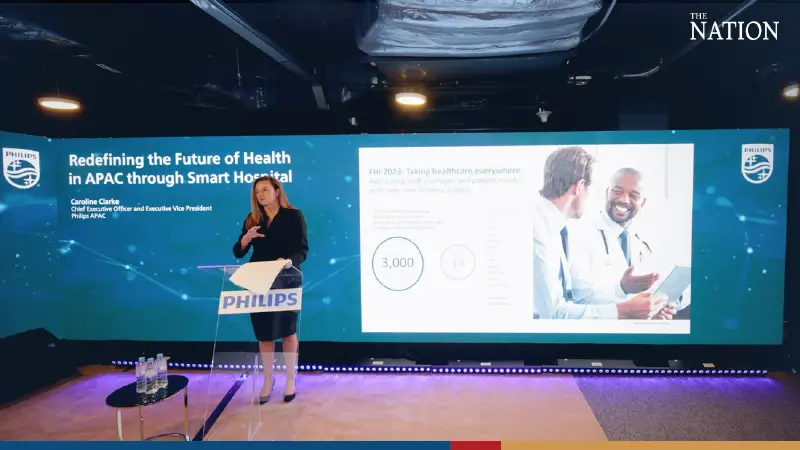


Royal Philips, a global leader in health technology, plans to focus on improving its supportive technology and maintenance services in order to be a part of the healthcare industry's growth, the company’s top executive in the Asia Pacific (Apac) said.
The company announced its expansion strategy as it released its largest global study on the Future Health Index 2023 (FHI) in late July.
The study highlighted that health technologies, including information technologies, are required to make healthcare more accessible beyond hospital walls.
Philips’ CEO for Apac and executive vice president, Caroline Clarke, pointed out that healthcare has been primarily delivered in centralised facilities such as hospitals for decades. The latest report shows that Apac's healthcare leaders are making bold changes as they navigate unprecedented staff and financial challenges.
Digital health tech
"We are seeing a shift in Apac towards a distributed model of care delivery that uses smart and connected digital health technologies and data to bring care closer to patients, at home or in the community, to where they are, anytime, anywhere,” she said.
The current healthcare landscape has presented Philips with a promising opportunity to sustain its growth and become one of the world's leading health tech companies, she said.
Therefore, rather than simply providing comprehensive high-tech devices and equipment for diagnosis and treatment, Philips sees itself as a long-term strategic partner for medical providers and hospitals, Clarke said.
Software and maintenance
Philips has broadened its services to include software technologies such as data collection and processing, as well as medical device and equipment maintenance, she added.
The movement will allow Philips to assist hospitals worldwide in embracing new care models to improve efficiency, health outcomes, and working methods, Clarke noted.

According to the FHI 2023 report, 66% of healthcare leaders and younger healthcare professionals in the Apac region believe they are well equipped to work effectively with new care delivery models, and 63% believe care will be delivered in a more environmentally friendly and sustainable manner.
These beliefs outperform the global averages of 59% and 57%, respectively.
Meanwhile, the study reveals a positive impact on employee morale and retention. Around 58% of the region's healthcare professionals believe the new care delivery models will improve work-life balance, while 56% believe it will contribute to higher levels of job satisfaction than traditional healthcare models.
Other significant advantages include improved patient education, increased efficiency (eg, shorter waiting times, more patients seen), collaboration with local communities to improve population health, and more technologically advanced healthcare.

Virtual care
Mark Burby, head of sales and solutions Asia Pacific Health Systems, Philips Asia Pacific, said that there is currently a lot of investment happening in the healthcare industry, which is one of the most stable and long-term industries.
He said the majority of the investment is focused on digital health technologies and the expansion of virtual care to more areas of the healthcare ecosystem.
Besides, the region's healthcare leaders are also transitioning to a distributed healthcare model that prioritises anytime-anywhere care outside of hospital walls by expanding virtual care to more areas of the healthcare ecosystem other than diagnostics.
He then cited an FHI study, which found that 48% of Apac healthcare leaders are currently investing in digital health records. In addition, nearly 74% of healthcare leaders intend to invest in artificial intelligence (AI) over the next three years, primarily to predict outcomes, provide clinical decision support, and integrate diagnostics.

Top technologies
Meanwhile, cloud-based technology to support access to information from any location, technology solutions that connect with out-of-hospital settings, and workflow technology such as digital health records, are the top three technologies regarded by those Apac leaders using or planning to use digital health technology to relieve the impact of staff shortages.
Building more hospitals is not a sustainable solution to the rising demand for healthcare services, which is already plagued by staff shortages, limited budgets and accessibility issues, Burby said.
"So, as a company, we definitely see the healthcare and health tech industries as a major growth industry for us. And the other thing is that we felt we were in a very unique position to address that opportunity because of some of the things that are unique to us in terms of our strong drive for innovation and our long history in the healthcare industry. We also have been innovating our strong partnerships in this industry for many years," he said.
This long-term strategic partnership approach, he explained, definitely makes Philips more competitive because it's a different approach to customer engagement.
The collaboration allows customers to truly share their issues and challenges with Philips, letting them know that the company is more open to resolving their issues and challenges.

High demand
"Of course, it aids Philips in gaining customer loyalty," he said, adding that the approach has resulted in Philips growing in the high double digits year after year while still having some difficulties meeting current demand.
"We must ensure that we are doing everything possible to meet the demands. It's not just about having the right equipment, but also about having the right people and partners, and looking at new growing markets and alternative ways in which we can support our partners and help customers meet rising demand," he noted.
He assured that the partnership with Philips allows hospitals to plan for the future without being limited to the vendor's technologies. As a result, hospitals will have more options and flexibility in planning for new care models, and they will be able to investigate where they need to innovate and invest.
Meanwhile, he added that the growing investment in healthcare to bring health services directly to people's homes provides a good opportunity for Thailand's private sector and startups.
He pointed out that there is a huge opportunity, and that due to the uniqueness of Thai culture and language, some foreign overseas solutions are not necessarily suitable for the Thai market.
The most recent AI skill is currently exploding to develop solutions that will enable this transformation. So, there is a great opportunity there, not only in terms of application but also in terms of service delivery model, Burby said.
"Other companies, in addition to Philips, will need to be involved in re-engineering clinical processes, other business processes, and ensuring connectivity. The necessary investments and infrastructures are in place to provide access to patients' homes in remote towns and villages," he noted.
Meanwhile, when asked what Thailand should do to strengthen the country's entire healthcare ecosystem, he smiled and simply said that Thailand only needs a consistent healthcare policy that is unaffected by political changes.
