
Thai Juice Giant Malee Targets 55% Own-Brand as it Drives Regional Expansion
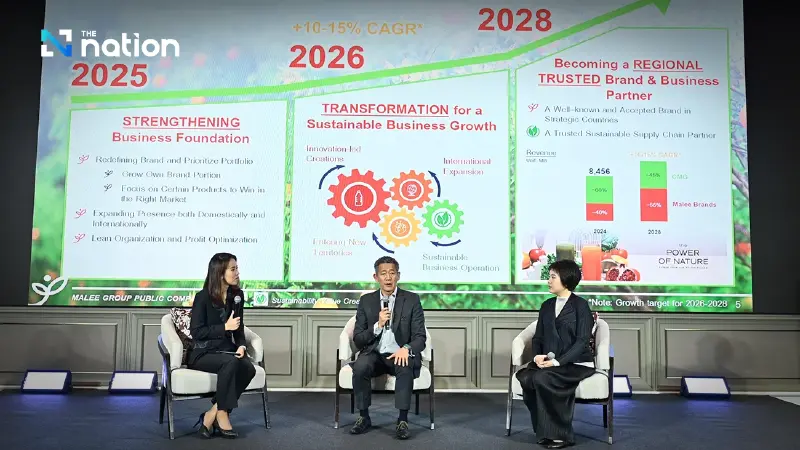


Thai beverage firm plans 10-15% annual growth through 2028, banking on functional drinks and expansion in China, Middle East
- Thai beverage company Malee plans to increase its own-brand products to 55% of total revenue by 2028, up from the current 35%, to boost profit margins.
- The company's regional expansion will focus on four key markets starting in 2026: China and South Korea (for coconut water), and the Middle East and Indonesia (for premium juices).
- To support own-brand growth, Malee is shifting its product development from traditional juices to functional health beverages with proprietary ingredients.
- These strategies are part of a plan to achieve 10-15% average annual growth through 2028 and transform into a "Global Well-being Company".
Thai beverage firm plans 10-15% annual growth through 2028, banking on functional drinks and expansion in China, Middle East.
Malee Group plans to increase its own-brand portfolio from 35% to 55% of total revenue by 2028 as the Thai beverage manufacturer attempts to transform itself from a traditional fruit juice producer into what it calls a "Global Well-being Company".
The publicly listed firm, which has held the leading position in Thailand's premium fruit juice market for 47 years, unveiled its three-year strategy on Monday, targeting average annual growth of 10-15% through aggressive international expansion and a shift towards functional health beverages.
Chief executive Ekarin Pinij told reporters that 2025 serves as a foundational year focused on back-end operations and market preparation, with international expansion intensifying from 2026.
The company reported operating revenue of 3.82 billion baht for the first half of 2025, down from the same period last year. Ekarin attributed the decline to unrest in Cambodia and Myanmar, along with a global economic slowdown.

Four-market focus
International sales currently account for 40% of Malee's business across more than 30 countries.
From 2026, the company will concentrate on four key markets to drive what it describes as "leapfrog growth":
North Asia: China and South Korea will focus primarily on coconut water. Malee Coco reportedly holds the number one position in South Korea's offline coconut water market.
Middle East: The company plans to expand beyond current markets in the UAE and Kuwait into Saudi Arabia, Jordan and Qatar, targeting demand for premium fruit juices.
Indonesia: A joint venture facilitates distribution across the populous market, with premium fruit juice highlighted for growth.
Malee has appointed Chinese actor Zhang Linghe as regional brand presenter for Malee Coco to boost recognition across Asia.

Functional beverages drive margin strategy
The portfolio shift towards own brands aims to secure higher profit margins.
Senior vice president for marketing Ruangrat Wongsuwanlert said product development would move beyond "delicious and refreshing" fruit juices to encompass functional health benefits.
Key innovations include Power Plant drinks featuring Innogus, a proprietary blend of prebiotics and probiotics that recently won an innovation award in Seoul and Shanghai.
Another product, Malee Coco with Bi-Os, uses a company-developed ingredient designed to help reduce blood sugar levels.
Central to this strategy is MAS (Malee Applied Science), the company's innovation centre, which develops proprietary ingredients, sells components to external cosmetics and supplements firms, and upcycles production waste in line with environmental targets.
Market headwinds
Ekarin acknowledged a "heavy" and "severe" year for many companies in 2025. The executive said disruptions from unrest in Cambodia and Myanmar, combined with the global slowdown, had impacted the company's performance in the first half.
He expressed confidence the situation would resolve soon, noting the company's diversified presence across 30 countries provides a buffer against regional disruptions.

Thailand's ready-to-drink fruit juice market is valued at approximately 12 billion baht, growing at 2% annually.
The premium segment, where Malee maintains market leadership, is worth roughly 4 billion baht.
Coconut water represents the strongest growth driver in the broader beverage sector.
Regarding US tariffs of approximately 19% on agricultural and dairy products imported into Thailand, Ekarin said the rate matched those imposed by neighbouring countries, leaving Malee at no competitive disadvantage.
He cited the company's portfolio diversification across dairy and non-dairy products as insulation against import shocks.

Co-packing continues
Despite emphasising own-brand growth, Malee remains committed to its contract manufacturing business.
The company operates three factories: two in Thailand producing juice and milk products, and one in Ho Chi Minh City, Vietnam, handling juice and carbonated drinks. Combined capacity stands at approximately 749 million litres.
Current utilisation runs at 60% of total capacity. Ekarin said the remaining 40% would be sufficient to support the company's growth plans through 2028.
The company is investing heavily in automation, technology and IT systems to reduce reliance on manual labour and lower long-term costs. This focus has already improved gross profit margins compared with previous years, according to Ekarin.
Malee has integrated environmental, social and governance principles into its strategy, including solar roof installations, energy source changes and sustainable packaging initiatives. The company has also launched a new corporate culture branded "TOP" – Teamwork, Ownership and Purposeful leader.
The overall ready-to-drink coconut water market outlook remains positive, with research indicating significant room for expansion in consumer adoption.
Malee anticipates favourable conditions for raw material sourcing, with efficient back-end management and weather conditions expected to support stable agricultural input costs.
