
Unilever Thailand Turns Domestic Stagnation into a Global Export Play


The FMCG giant is doubling exports to 60-plus countries, courting 35 million tourists, and targeting pet owners and the ‘slow-ageing’ market to find growth where others see stagnation
- To overcome a sluggish domestic economy, Unilever Thailand is repositioning its operations as a global manufacturing and export hub under the strategy "Make in Thailand for the World."
- The company plans to double its exports from the current 100 million products, shipping items made in Thailand to more than 60 countries.
- This export strategy is supported by a local R&D center in Bangkok that develops products specifically engineered for hot, humid conditions, which are well-suited for global markets.
- Alongside exports, the company is targeting niche domestic growth by focusing on 35 million annual tourists, the "slow-ageing" demographic, and pet owners.
The FMCG giant is doubling exports to 60-plus countries, courting 35 million tourists, and targeting pet owners and the ‘slow-ageing’ market to find growth where others see stagnation.
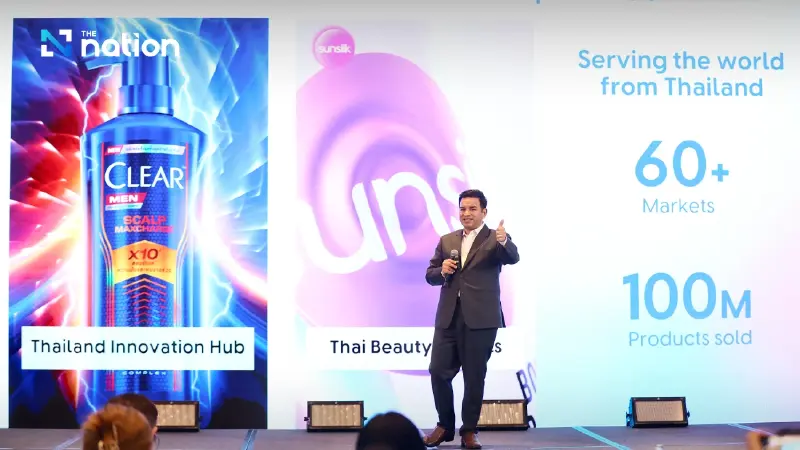
When Unilever Thailand’s chief executive Aseem Puri takes the stage at a press conference, he does not speak like a man worried about a sluggish domestic economy. He speaks like one who has found a way around it.
With Thailand’s consumer confidence under pressure from rising import costs and subdued household spending, the British-Dutch consumer goods giant is reorienting its Thai operation around four interlocking bets: aggressive export growth, niche demographics, supply chain resilience, and deep digital investment.
Together, they amount to the most ambitious strategic pivot the company’s Thai arm has attempted in its 94-year history in the kingdom.

‘Make in Thailand for the World’
Thailand, Puri argues, should be understood not as a market of 70 million consumers but as a foreign-exchange-generating manufacturing platform. Unilever already ships Thai-made products to more than 60 countries, including Australia, China, Japan, South Korea, and markets across Europe and North America.
The company says it has exported over 100 million products from Thailand to date and intends to double that figure.
“We want to help earn forex dollars for Thailand,” Puri said at a press briefing in Bangkok on Tuesday. “This generates employment. It creates more manufacturing, more technology and more capacity in Thailand to serve the world.”

The export push is underpinned by innovation developed within Thailand. Unilever’s Bangkok R&D centre, which employs 98 scientists — the majority women — has launched 30 new products this year alone. Products engineered for hot, humid conditions, the company contends, tend to travel well.
The Hidden 100 Million
The domestic market, too, is larger than the census suggests. Unilever counts Thailand’s effective consumer base at roughly 100 million by adding 35 million annual tourists to the resident population.
The company has launched dedicated projects with retailers to identify the skincare and haircare needs of inbound visitors, many of whom are ill-prepared for the intensity of the local climate.
Two further growth pockets stand out.
The first is what Unilever calls the “slow-ageing” segment: Thais who invest heavily in skincare, supplements, and fitness.
Rather than treating Thailand as an ageing society, Puri prefers to call it an “anti-ageing society” and is building premium product lines to match.
The second is Thailand’s rapidly expanding base of pet-owning households, estimated at between seven million and ten million, alongside a growing cohort of single-person homes — groups that mainstream FMCG portfolios have historically underserved.
Holding the Line on Price
The geopolitical backdrop complicates all of this. Conflict in the Middle East has pushed crude oil prices higher, squeezing margins on home care and cleaning products dependent on petrochemical derivatives and plastics.
Unilever’s response has been to lean on its global procurement scale — sourcing raw materials across multiple regions to limit supply-chain exposure — and to deploy biotechnology to reduce production costs.

Puri said there had been no product shortages on Thai shelves through March, April, and May — a claim that would represent a meaningful competitive advantage as smaller manufacturers struggle with spot-market volatility.
On the consumer side, the company is absorbing cost increases rather than passing them on, while running promotions of up to 50 per cent through government subsidy schemes across 75,000 retail outlets.
It is also riding a structural shift in purchasing behaviour: Thai consumers are increasingly buying in larger pack sizes and refill formats to secure better unit pricing, a trend the company is actively encouraging.
AI and the Digital Frontier
Underpinning the strategy is a substantial bet on digital channels and artificial intelligence. Unilever says it now works with more than 100,000 content creators in Thailand, producing roughly 3,000 pieces of social media content per day.
The company uses AI to mine e-commerce reviews, social media comments, and lifestyle data for product insights, cutting the time from concept to shelf from more than a year to as little as three months.
E-commerce now accounts for 25 to 30 per cent of Unilever’s Thai sales depending on the category. New products are increasingly launched online before being pushed into physical retail.

A Century in the Making
Unilever Thailand is approaching its centenary — the company was established as Siam Industries in 1932 — and Puri is keen to frame the current moment as a strategic inflection point.
The parent company has been acquiring wellbeing and supplement brands globally, and Puri confirmed that some of those portfolios are under consideration for a Thai launch.
Whether the export-led strategy delivers the forex gains the company promises will depend on factors outside Bangkok’s control — not least the trajectory of oil prices, trade tariffs, and global retailer appetite for Thai-made FMCG.
But for a company that says 90 per cent of what it sells in Thailand is also made there, the “Make in Thailand for the World” slogan is less a marketing line than a statement of existing capability.
“I am very confident,” Puri said, “that as we finish 100 years, Unilever will be here for another 100 years as well.”
