
Thailand Becomes Regional Leader in Energy Transition, ABB Study Finds


Strong strategic planning, clear legal frameworks, and rising investment in data centres and renewable energy projects are bolstering the country’s climate goals
- An ABB study identifies Thailand as a regional energy transition leader due to its resilient strategic plans and clear regulatory framework, which provide stability and attract long-term investment.
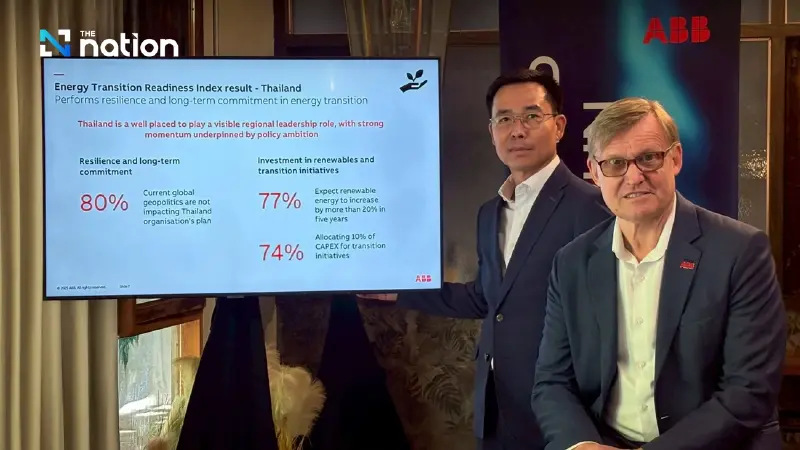
- The country shows a strong commitment to renewables, with 77% of its energy leaders expecting to increase renewable energy use by more than 20% in the next five years, aligning with national goals.
- Thailand's progress is accelerated by high confidence in technology, with 69% of leaders viewing AI and automation as key enablers, and significant financial commitment from organizations.
Thailand is cementing its position as a leading force in Asia’s energy transition, backed by resilient strategic plans and a clear regulatory framework, according to a new study by ABB.
The country's strong commitment is attracting significant investment in key projects, including energy-intensive data centres.
The findings from the ABB Energy Industries division Asia Pacific Energy Transition Readiness Index 2025 reveal that a remarkable 80 percent of energy leaders in Thailand say their transition plans remain on track despite global geopolitical shifts, a clear signal of the country's strategic stability.
The industry survey, based on responses from 4,085 energy leaders across 12 markets in the Asia Pacific region, assessed 20 indicators across four key pillars: Strategy, Technology & Infrastructure, Finance, and Talent.
The results for Thailand highlight robust momentum, driven by national climate goals and growing confidence in AI and automation.
Thai energy leaders are particularly optimistic about renewables, with 77 per cent expecting their organisation’s use of renewable energy to increase by more than 20 per cent within the next five years.
This aligns with the country’s carbon neutrality and net-zero ambitions, as well as the draft Power Development Plan (PDP2024), which targets a 51 percent share of renewables in total power generation capacity by 2037.

According to the study, foreign investors, particularly those in large-scale, long-term projects like data centres, which require massive amounts of energy and have a payback period of 20 years or more, prioritise stability above all else.
This includes clear laws, policies, and a stable long-term economic and political environment.
Anders Maltesen, President of ABB’s Energy Industries division, Asia, said that long-term certainty is key for investors.
"If investors know that the market conditions and regulations will be stable for the next 20 years, they view it as a low-risk investment. Even if returns are not very high, they are stable and predictable, which is what this group of investors wants, unlike the volatility of a merchant market found in some other countries," he said.
In the meantime, long-term renewable energy power purchase agreements (PPAs), often spanning 20 years, are widely seen in many markets as a strong signal to foreign investors seeking a stable, sustainable energy source to power their 24-hour operations.
The decision of major tech firms like Microsoft and Amazon to invest in renewable energy themselves or partner with local investors underscores this demand.
Government support is a critical factor in attracting this investment.

The report also found that 65 percent of Thai energy leaders see technology as a key accelerator for the transition.
Optimism around AI and automation is particularly strong, with 69 percent viewing them as key enablers, buoyed by Thailand’s national push for digitisation and a new 25 billion baht AI strategy.
With 74 percent of organisations planning to allocate over 10 per cent of their capital expenditure to energy transition initiatives, coupled with this technological optimism, Thailand is well-placed to strengthen its role as a leader in Asia Pacific’s energy transition.
