
Thailand and Indonesia trail ASEAN as political instability stifles growth
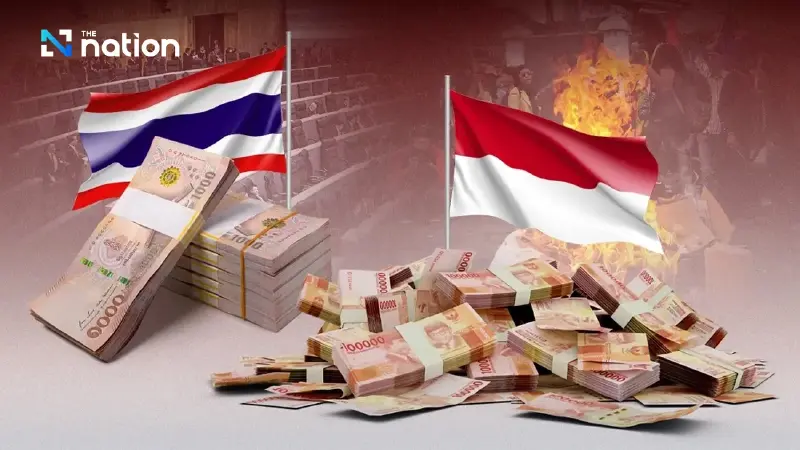


Political turmoil drags Thailand and Indonesia to the bottom of ASEAN’s growth, while Malaysia, Vietnam and the Philippines surge ahead.
While Malaysia, Vietnam and the Philippines enjoy strong economic momentum fuelled by domestic demand and robust private investment, political uncertainty has pushed Thailand and Indonesia to the bottom tier of ASEAN’s growth league.
At a time when political volatility is reshaping the region, several ASEAN countries are facing unprecedented challenges with direct impacts on their economies.
Yet, neighbours such as Malaysia, Vietnam and the Philippines are demonstrating sustained strength, with steady expansion in exports and private sector activity. By contrast, Thailand and Indonesia are at a crossroads, where political turbulence has slowed growth that was once expected to accelerate.
Malaysia, Vietnam and the Philippines emerge as economic frontrunners
Malaysia’s economy remains resilient, supported by solid domestic demand and rising household incomes. Private investment has been climbing steadily since 2021, particularly with the backing of state-linked firms.
Infrastructure projects — notably the Johor–Singapore Special Economic Zone — are providing further stimulus.
Vietnam’s GDP surged by 7.5% in the first half of the year. Although global analysts, including MIA Asia, warn that excessive growth may risk a credit crisis reminiscent of 2010–2012, Vietnam’s infrastructure push — worth over US$1.4 trillion in the past five years — has helped address funding bottlenecks and driven both private sector expansion and stock market growth.
The Philippines, meanwhile, continues to post robust export figures despite external headwinds such as US tariff hikes. Strong performance in electronics and electrical manufacturing has kept the economy on track, with Maybank raising its 2025 export growth forecast to 12.3% from an earlier 9.9%.
Indonesia’s economy on a knife edge
A housing allowance of more than US$3,000 for every member of Indonesia’s parliament has spiralled into the most violent protests the country has seen in decades, leaving multiple people dead.
Among the victims was a motorcycle taxi driver killed when a police armoured vehicle rammed into him.
Homes of several policymakers, targeted by public anger, have been ransacked and looted — including that of Finance Minister Sri Mulyani Indrawati.
The turmoil sent Indonesia’s stock market and the rupiah tumbling by as much as 3.6% before partially recovering, forcing the Bank of Indonesia to intervene to stabilise the currency and reassure investors.
Prolonged political unrest could weigh heavily on tourism and investment, despite the government backing down on several controversial policies and scrapping parliamentary perks under fire. Anti-government demonstrations, however, continue to spread nationwide.
Radhika Rao, senior economist at DBS, told The Business Times: “If the government’s reforms and compromises are seen as insufficient, public discontent could further erode demand in consumption, tourism and investment.”
Some analysts believe that palm oil tax exemptions and lower import tariffs to the US compared with China and India may soften the blow. Yet, Indonesia’s economic growth this year is still forecast to remain below 5%.
For now, the country’s economy hangs by a thread, with political uncertainty threatening to magnify external economic headwinds at any moment.
Thailand: the ‘sick man’ of ASEAN
Thailand’s Constitutional Court’s decision on August 29 to suspend Paetongtarn Shinawatra as prime minister has paved the way for a minority government led by Anutin Charnvirakul. But concerns remain that this will bring only temporary stability, as opposition parties have demanded the House be dissolved and new elections held within four months of Anutin’s policy statement to parliament.
Analysts Chua Hak Bin and Erica Tay of Maybank told The Business Times that Thailand’s border closures with Cambodia and Myanmar could hurt tourism and cross-border trade worth more than 570 billion baht.
They added that disruptions to supply chains, particularly the outflow of migrant workers returning home amid border conflicts, could leave Thailand facing labour shortages.
“Political volatility will weigh on Thailand’s manufacturing, services and construction sectors,” they warned.
The Thai stock market, usually resilient to political turbulence, has tumbled sharply. Since the start of the year, the Stock Exchange of Thailand (SET) Index has dropped 9.7%, with over US$2.5 billion in capital outflows.
Bank of Thailand governor Sethaput Suthiwartnarueput told Bloomberg on September 3 — the day Anutin declared his candidacy for premiership — that political gridlock would increase economic risks.
“If the passage of the budget bill is delayed, the Thai economy could face significant downside risks,” he said, adding that GDP growth forecasts would be revised down from 2% to 1.7% for 2026.
The cases of Indonesia and Thailand highlight how political uncertainty has become a key risk factor for ASEAN’s economies.
While neighbours such as Malaysia, Vietnam and the Philippines press ahead with infrastructure investment, industrial expansion and rising exports, Thailand and Indonesia are mired in conflict — both domestic and cross-border — eroding investor and consumer confidence.
Restoring political stability swiftly is now the central task for Anutin’s government, widely seen as the key to unlocking Thailand’s latent economic potential and returning the country to a path of sustained growth.
