
Thailand Finalizing US Trade Deal as Economy Faces Headwinds, Commerce Minister Warns
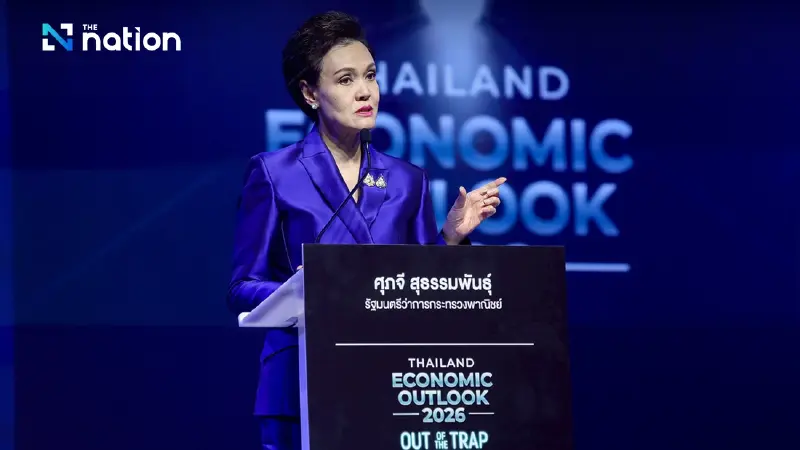


Minister Suphajee Suthumpun outlines urgent reforms as GDP growth projected to fall below 2%
- Thailand's Commerce Minister announced the country is finalizing the technical details of a reciprocal tax agreement with the United States by the end of the current quarter.
- The minister warned this is crucial as Thailand's economy faces significant headwinds, with GDP growth projected to slow dramatically to just 1.8-2.3%.
- Economic challenges are compounded by six consecutive months of deflation, a rapidly aging population, and a strengthening currency that hurts export competitiveness.
- The U.S. trade deal is part of a broader government strategy to combat the economic slowdown, which also includes pursuing new free trade agreements with the EU and South Korea.
Thailand is working to finalize technical details of its reciprocal tax agreement with the United States by the end of the current quarter, Commerce Minister Suphajee Suthumpun announced Thursday, as the kingdom grapples with slowing economic growth and six consecutive months of deflation.
Speaking at the "Thailand Economic Outlook 2026: Out of Trap" seminar hosted by Krungthep Turakij newspaper, Minister Suphajee revealed that the government is focusing on completing rules of origin and value content specifications for the 19% reciprocal tax rate previously negotiated with Washington.
"The U.S. is a crucial trading partner, accounting for approximately 1.9 trillion baht in exports," the minister said, emphasizing the importance of cementing the bilateral trade framework amid global economic volatility.
Economic Crisis Looms
The minister painted a sobering picture of Thailand's economic trajectory, warning that GDP growth this year is projected to reach only 1.8% to 2.3%—a dramatic decline from approximately 5% in 2018.
"The growth of our country has been continuously slowing down," Suphajee said. "If we don't do anything, we will surely be stuck in the loop because this year we probably won't exceed 2%."
Adding to concerns, Thailand has recorded negative inflation of -0.7% for six consecutive months, raising the specter of deflation. The minister stressed that urgent demand stimulation measures are needed to reverse this trend and restore purchasing power.

Demographic Time Bomb
Thailand's transition to a "complete aging society" is compounding economic challenges, the minister noted.
The population has declined for four to five consecutive years and is rapidly approaching "Super Aging Society" status, reducing both domestic consumption and workforce availability.
This demographic shift, combined with a strengthening Thai baht driven by capital inflows from emerging markets, is eroding the country's export competitiveness relative to regional peers.
Government Response: Short and Long-Term Strategies
To address immediate economic distress, the Ministry of Commerce has implemented the "Half-Half Plus" (Kon La Khrueng Plus) stimulus program to boost domestic spending. The ministry is also organizing over 1,300 "Blue Flag Fairs" this year to help citizens reduce living costs.
In a move that could directly benefit expatriates and middle-class Thais, the ministry has partnered with 11 private hospital chains covering over 300 locations to introduce pharmaceutical price transparency.
The initiative, which allows patients to see drug prices before purchase and choose whether to buy from hospitals or standard pharmacies, is expected to save the public over 30 billion Baht while reducing overcrowding in public hospitals.

Trade Expansion and Structural Reform
Beyond the U.S. deal, Minister Suphajee announced that Thailand aims to finalize Free Trade Agreements with the European Union and South Korea by year-end or early next year. The recent FTA signed with EFTA—covering Switzerland, Iceland, Norway, and Liechtenstein—will serve as a benchmark for the broader European negotiations.
Thailand currently has 14 signed FTAs covering 18 countries, providing tariff benefits that the minister urged businesses to fully utilize.
Looking to long-term structural reform, Suphajee emphasized the need to transform Thailand's economic model from supply-driven to demand-driven production, particularly in agriculture.

"We should change the production method, whether it's agricultural products or consumer goods, to be demand-driven, not supply-driven," she said. "We cannot plant rice like everyone else and suffer price pressure."
The minister outlined Thailand's strategic pivot toward a "Value Economy," leveraging the country's geographic position at the center of Indochina, its biodiversity, and emerging opportunities in wellness tourism, medical services, and innovative food production.
"Thailand must focus on value-based growth," Suphajee said, pointing to the country's potential to become a regional Wellness Hub and Future Food hub by integrating knowledge and innovation into traditional strengths.

Navigating Global Headwinds
The minister acknowledged that Thailand faces multiple external pressures, including geopolitical tensions, deglobalization trends shifting trade away from multilateral agreements toward bilateral deals, and stringent environmental requirements such as carbon border adjustment mechanisms.
"The current economic and trade environment is highly volatile due to geopolitics and regulatory changes, requiring rapid adaptation by businesses," she said.

To better navigate these challenges, the Ministry of Commerce is investing in digital infrastructure, including a Trade Intelligence System capable of forecasting supply, demand, and prices, as well as launching the "MOC Fondue" platform to simplify public access to government services.
The minister concluded by emphasizing that achieving economic success requires collaboration between government and the private sector, with businesses capitalizing on emerging opportunities while the government builds confidence through policy implementation.
