
Thai Trade Negotiators Accelerate Crucial FTA Talks with the EU


Bangkok pushes to finalise a Free Trade Agreement, reporting 'good progress' on investment and financial services after the seventh round in Brussels
- The 7th round of Thailand-EU FTA negotiations in Brussels yielded significant progress, with key advances made in areas such as capital movement, financial services, and market access.
- With talks at a critical juncture, both sides have agreed to intensify discussions between formal rounds to resolve major outstanding issues like market opening levels, intellectual property, and agricultural standards.
- To help accelerate the agreement, negotiators are actively engaging the European private sector, holding a seminar to provide updates and gather feedback on the ongoing talks.
The Department of Trade Negotiations (DTN) is moving swiftly to implement the policy directive from Commerce Minister Suphajee Suthumpun to accelerate the Free Trade Agreement (FTA) talks with the European Union (EU).
Chotima Iemsawasdikul, Director-General of the DTN and Thai Chief Negotiator, confirmed that the Thai team attended the 7th round of the Thailand-EU FTA negotiations in Brussels, Belgium, from September 29 to October 3, 2025.
The negotiations saw "continued good progress," with key advances made in:
Capital Movement: Concluding agreements that will facilitate cross-border investment flows.
Financial Services: Establishing regulations to promote transparency and stability within the financial sector.
Progress was also reported on mutual market access, covering the trade in goods, trade in services, investment, and government procurement.
Several other issues, including trade remedies, State-Owned Enterprises (SOEs), the automotive annex, and competition, are nearing conclusion, with only technical details remaining.

Chotima stated that the talks have reached a critical juncture where both sides must find common ground on major outstanding issues to finalise the agreement.
These issues include the level of market opening for goods and services, government procurement, agricultural product standards, intellectual property protection, and digital trade.
Both sides have agreed to intensify intersessional discussions (talks between formal rounds) to maximise progress and prepare for future negotiating rounds.
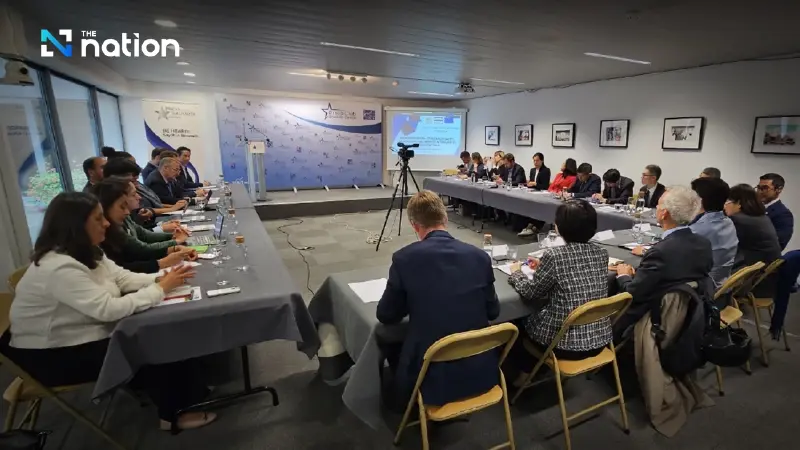
Furthermore, the two Chief Negotiators co-hosted a seminar titled Navigating Global Trade Uncertainty: Unlocking Mutual Benefits in Thailand-EU FTA Negotiations on September 30.
The event, organised by the Thai Trade Office in Brussels, updated European private sector representatives—including those from food and beverage manufacturing, automotive, services, and technology—on the negotiations and solicited their feedback.
The negotiators emphasised the importance of the FTA as a tool for creating a close partnership amid global trade uncertainty, exchanging views on business facilitation, market access, and government procurement provisions within the proposed agreement.

The EU is currently Thailand's 4th largest trading partner, behind China, the US, and Japan.
For the first nine months of 2025 (January–September), trade between Thailand and the EU totalled $29,622.02 million, marking a 1.77% increase year-on-year.
Thai exports to the EU rose by 7.50% to $17,275.88 million, while imports from the EU decreased by 5.30% to $12,346.14 million.
Key Thai exports include computers and components, gems and jewellery, and air conditioners. Major imports from the EU include machinery, pharmaceutical products, aircraft, and chemicals.
