
AOT Shifts Strategy to Prioritise Core Aviation Revenue Amid Post-Pandemic Transformation


Thai airport operator targets return to 60-40 aeronautical-commercial split as it invests billions in hub infrastructure
- Airports of Thailand (AOT) is shifting its business strategy to prioritize core aeronautical revenue over commercial income, citing an unbalanced revenue structure as a long-term risk post-pandemic.
- The company aims to restore its historical revenue mix of approximately 60% from aviation services to better cover the high costs of safety standards and maintain dividends.
- This strategic pivot is supported by major infrastructure developments at Suvarnabhumi and Don Mueang airports, focusing on "smart investment" to increase revenue-generating capacity.
- The restructuring is also designed to boost investor confidence, which has already seen a positive response with increased foreign investment in AOT.
Airports of Thailand (AOT) is undertaking a sweeping transformation of its business model, pivoting away from commercial revenue to refocus on core aeronautical services as it seeks to establish itself as a genuine regional aviation hub.
Acting managing director Paweena Jariyathitipong revealed the strategy at the "Thailand Economic Outlook 2026: Out of the Trap" seminar on Thursday, acknowledging that whilst passenger numbers have rebounded strongly post-pandemic, the company's revenue structure has become dangerously unbalanced.
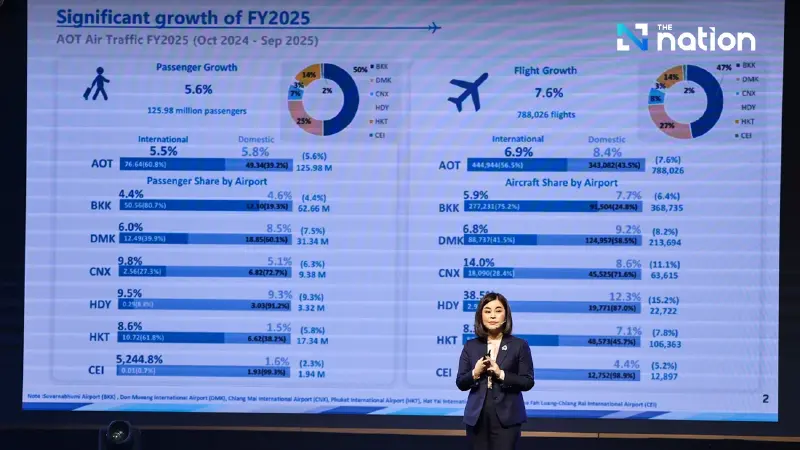
AOT's six airports—Chiang Rai, Chiang Mai, Don Mueang, Suvarnabhumi, Hat Yai, and Phuket—handled 125 million passengers in the last fiscal year, representing 5.6 per cent growth and accounting for 86 per cent of Thailand's total air traffic. Flight volumes surged 7.6 per cent to 788,000 operations.
However, Paweena warned that the current revenue mix threatens the organisation's long-term viability.
Before 2016, AOT derived roughly 60 per cent of revenue from aeronautical services and 40 per cent from commercial operations.
The company successfully boosted non-aeronautical income to approximately 50 per cent in recent years, but changing traveller spending habits have since eroded these gains.
"We are an airport, we are the 'aero' side, we are not a department store," Paweena stated, signalling the company's determination to restore the historical revenue balance.

The pivot is essential to cover the substantial costs of maintaining world-class safety standards whilst preserving dividend payments.
The transformation encompasses major infrastructure developments at both Suvarnabhumi and Don Mueang airports under a philosophy AOT terms "smart investment"—prioritising value and revenue-generating capacity over simply minimising costs.
At Suvarnabhumi, which saw 4.6 per cent passenger growth with international travellers comprising 70 per cent of traffic, AOT has abandoned the previous Sacri 2 terminal concept.
The revised masterplan instead expands the South Terminal to reach a target capacity of 120 million passengers annually, whilst providing adequate space for maintenance, repair, and overhaul (MRO) facilities and cargo operations.
The East Expansion project, focused on landside improvements to enhance passenger comfort and flow, awaits Cabinet approval following completed designs.
Don Mueang, which grew 7.5 per cent, will not be developed as a transit hub. Instead, it will focus on "door-to-door" operations for medium-haul international arrivals, with plans for a new international terminal and the remodelling of Terminals 1 and 2 for domestic services.
Paweena emphasised that the transformation also targets investor confidence. Foreign investors notably increased their AOT holdings in July following briefings on the revenue restructuring plans.

The company aims to maintain an attractive price-earnings ratio to compete with rival airports across the region for international investment.
AOT projects continued growth of 6–7 per cent in both passengers and flights for the coming year, though expansion remains constrained by global aircraft manufacturing capacity, with new aircraft deliveries requiring two to three years from order.
