
TNSC confident exports to grow 5% in 2025 despite Q4 slowdown
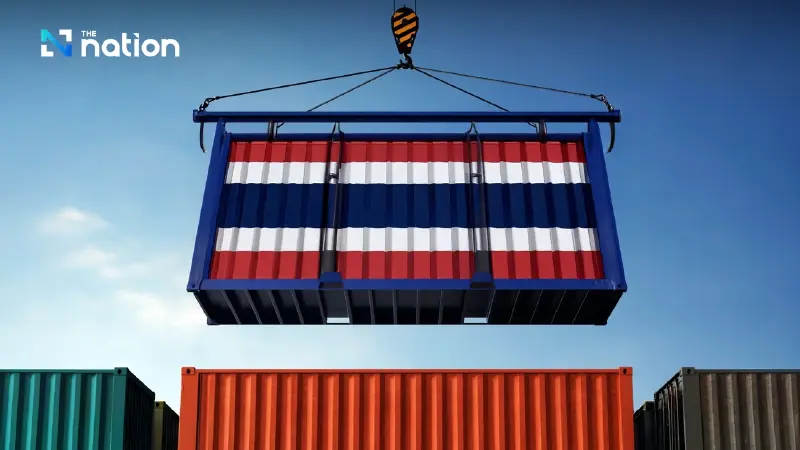


The Thai National Shippers’ Council remains confident exports will grow 5% in 2025 despite a Q4 slowdown caused by Trump tariffs and the strong baht, urging the government to stabilise the currency and review the draft Labour Protection Act amid fears of higher production costs.
Thanakorn Kasetsuwan, chairman of the Thai National Shippers’ Council (TNSC), reported that Thailand’s exports in the first seven months of 2025 (January–August) totalled US$223.18 billion, marking a 13.3% year-on-year increase.
Excluding oil-related products, gold, and military supplies, exports still grew 4.7%, reflecting continued recovery across several sectors.
Imports during the same period reached US$224.88 billion, up 11.3%, resulting in a trade deficit of US$1.7 billion for January–August 2025.
Thanakorn said export growth is expected to continue in the fourth quarter, particularly for poultry, coffee products, automotive components, and electrical and electronic goods. However, some sectors, including garments, finished vehicles, food products, and rubber, are forecast to see a contraction.
He noted that overall export figures for the final quarter are likely to remain flat or show a mild decline, partly due to a high base effect in 2024 when exports surged before the imposition of “Trump tariffs”. Although the new US tariffs have begun to slow shipments, Thailand remains competitive as it faces an average rate of 19%, similar to that imposed on rival exporters.

Freight costs have also fallen toward the year’s end, providing some relief to exporters.
Despite the slowdown, the TNSC remains confident that exports for 2025 will grow by about 5%, supported by strong expansion in the first two quarters of the year.
Looking ahead to 2026, Thanakorn said export performance should stay robust, provided the government moves ahead with measures to stabilise the baht, ease labour shortages, and reduce financial costs for SMEs.
Thanakorn expressed concern over the baht’s rapid appreciation, which he said has eroded Thailand’s export competitiveness compared with regional rivals.
He noted that as of September 2025, the baht had strengthened by 5.31% since the start of the year, while the Vietnamese dong weakened by around 3%, giving Vietnam’s exporters a cost advantage.
The TNSC has called on the Bank of Thailand (BOT) to investigate the causes behind the baht’s unusual strengthening. Private sector representatives have suggested that abnormal gold exports might be distorting the inflow of US dollars.
“Thailand may be serving as a transit point for these transactions,” Thanakorn said. “The inflows appear large, but the dollars never actually leave the country, it’s unclear what kind of money this is. It could even be part of the grey economy. The government and BoT must look into this seriously.”
He reiterated that exporters consider a desirable exchange rate to be around 33–34 baht per US dollar to maintain competitiveness.
Thanakorn also highlighted several risk factors that could affect Thailand’s exports in the remainder of 2025 and into 2026, including:
- The US reciprocal tariff measures have increased global economic volatility and exposed structural weaknesses in international trade.
- The strong baht, which remains higher than most regional currencies and continues to weaken exporters’ price competitiveness.
- Limited access to financing for SMEs, particularly those lacking collateral, which restricts their ability to expand or tap new markets.
- Shortages of raw materials for export-oriented industries, as domestic agricultural output remains insufficient and import restrictions persist.
- Misuse of re-export privileges, where low-quality or non-standard goods are shipped under Thai export quotas, damaging Thailand’s trade reputation.
Kongrit Chantrik, Executive Director of TNSC, outlined seven key proposals for the government and relevant agencies to urgently implement in order to support exporters, stabilise the economy, and reduce business costs.
1. Stabilise the baht
Maintain the baht’s stability in line with regional currencies and help businesses manage exchange-rate risks at reasonable hedging costs.
2. Reduce business costs
Lower overall operating expenses, including interest rates, bank lending rates, labour and energy costs, and delay the implementation of new fees or business-related legislation that could raise expenses.
Kongrit urged the government to review the draft Labour Protection Act, which he said could raise business costs by up to 16%. He called for private sector participation in the legislative review process to ensure the law is balanced and considers employers’ ability to absorb rising costs without triggering higher consumer prices.
“We are very concerned about the draft Labour Protection Bill,” Kongrit said. “Most business operators oppose it. This afternoon (October 10), the council will submit a petition to the House Speaker for further consideration.”
He also emphasised that minimum wage adjustments should follow the established tripartite wage committee mechanism.
3. Accelerate budget disbursement and FTA expansion
Speed up budget approvals and disbursements to stimulate the domestic economy, increase funding for trade-promotion activities abroad, and expand FTA negotiations with key trading partners.
The TNSC also proposed the creation of an SME investment fund that allows the government to co-invest with small private firms and repurchase the state’s shares once those firms become financially stable.
4. Resolve logistics bottlenecks
Address chronic logistics issues, especially congestion at Laem Chabang Port, by setting out a clear operational plan with private-sector input.
5. Ensure fair competition on imports
Strengthen oversight of import pricing, taxation, and e-commerce trade to ensure consumer safety and fair competition for domestic businesses.
6. Prevent misuse of export privileges
Tighten inspections to stop the misuse of Thai export certification by companies re-exporting low-quality or non-standard goods to third countries.
7. Promote transparency and digital governance
Continue good governance policies by enhancing digital government systems, enacting laws to support digital administrative processes, and strengthening anti-corruption measures to ensure efficient and transparent budget management.
