
Global trade faces major shift as Trump readies 100% tariffs on China
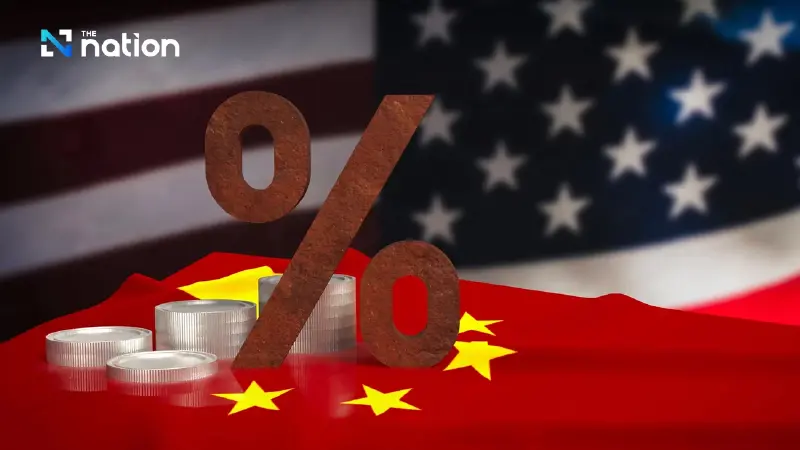


Trump’s plan to impose 100% tariffs on Chinese imports from November 1 could spark a new trade war, slowing global growth and deepening Thailand’s trade deficit with China.
Global trade is bracing for disruption after US President Donald Trump announced a plan to impose 100% tariffs on Chinese imports starting November 1, 2025. The move threatens to upend supply chains worldwide and reshape economic dynamics across Asia.
Aat Pisanwanich, an independent economist specialising in international trade and ASEAN markets, told Thansettakij the measure is highly likely to take effect, despite Trump’s earlier remark that the US was not trying to destroy China. That comment briefly lifted markets, but his latest stance signals continued pressure on Beijing.
“The driving force behind the 100% tariff plan is China’s control over processed rare earth exports, which are vital to the US tech industry. China dominates 90% of the global rare earth supply,” Aat said.
Aat warned the 100% tariffs could mark the start of a new trade war unless leaders reopen dialogue. A key indicator will be the upcoming summit in South Korea later this month, where there is still no sign Trump will meet Chinese President Xi Jinping.
“Currently, the US already imposes tariffs of around 51% on Chinese goods. Raising that to 100% effectively doubles the burden, significantly affecting industry, consumption and inflation in the US,” he noted.
China, however, has been preparing. September exports rose 8%, driven by diversification to Asia, ASEAN, Africa and Latin America. However, exports to the US plunged 10%, due not only to tariffs but also to overlapping measures such as port fees imposed on Chinese vessels and bans on semiconductor-related products.

If the new tariffs take effect on November 1, Aat outlined three major consequences:
- Global trade slowdown – The World Trade Organisation (WTO)’s 2025 trade growth forecast of 2.4% could fall to 1.5–1.9%.
- US economic hit – US GDP could drop from 1.8% to between 1.0–1.3%, as higher input costs push inflation and curb consumer spending.
- China slowdown – China’s GDP could shrink by 0.5–1%, with exports to the US potentially falling from US$435 billion in 2024 to around US$200 billion — a 50–75% plunge.
For Thailand, the impact could be severe. The trade deficit with China could surge from 1.6 trillion baht in 2024 to nearly 2 trillion baht if Chinese exports to Thailand rise 30% as Beijing redirects shipments.
During the first eight months of 2025, Thailand’s deficit with China already reached 1.37 trillion baht and may hit 1.7 trillion baht by year-end.
“If Chinese goods are shut out of the US, China will flood regional markets. This could hurt Thai manufacturers directly,” Aat said.
“While Thailand’s exports grew by 13% in the first eight months and could expand by more than 5% this year, next year will be difficult due to the US’s 100% tariff on Chinese goods and domestic political uncertainty.”
Some Thai industries may benefit from the shift. Thai exports that could replace Chinese goods in the US market include automobiles, electronics, and processed foods.
However, sectors that rely on Chinese imports for re-export — such as chemicals, plastics, electronic components, rubber, and machinery parts — could see weaker demand.
“Thailand must adapt quickly to this new trade war,” Aat concluded. “Even if Thailand is not directly targeted, the structural impact on the global trading system will be felt here. We must diversify export markets and enhance competitiveness to stay ahead.”
