
Thai Exporters Brace for Q4 Slump as US Tariffs Hit and Shipping Costs Plummet
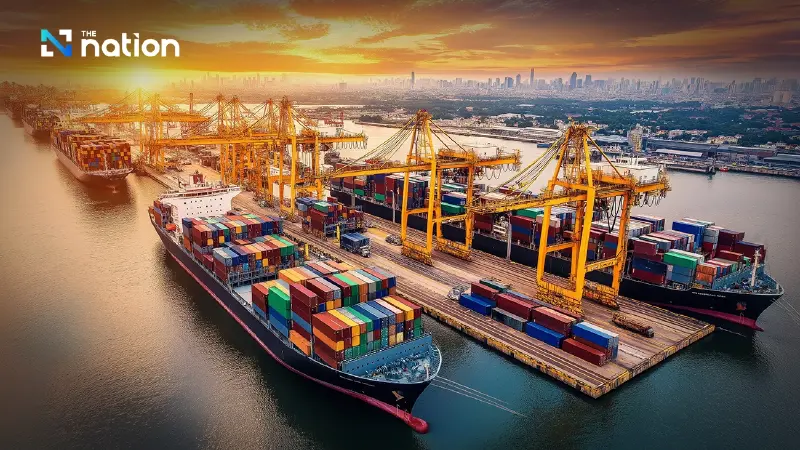


Freight rates tumble on trans-Pacific routes, signalling a sharp slowdown in global demand, compounded by fears of a 100% US tariff on Chinese goods
- Thai exporters are bracing for a significant downturn in the fourth quarter due to a new 19% US tariff on Thai goods, which has made them more expensive and reduced demand.
- A sharp drop in global orders has caused shipping container rates to plummet by over 30%, a development industry experts see as a warning sign of a global trade slowdown.
- The slump is compounded by high inventories held by trading partners and weak demand from the US and Europe, with sectors like agriculture and rubber experiencing steep declines in export value.
Thailand’s export sector, the main engine of its economy, faces a significant downturn in the final quarter of the year, despite posting high growth of 13%—reaching $223.175 billion—in the first eight months of 2025.
This earlier growth was largely attributed to Thai exporters rushing goods to the US market ahead of the Reciprocal Tariffs imposed by US President Donald Trump starting 7 August.
Now, both the public and private sectors predict a marked slowdown.
The US has erected a new 19% tariff wall on Thai goods, making them more expensive, while trading partners hold large existing inventories, further crippling demand for Thai products.
Shipping Rates Collapse
Visit Limlurcha, vice chairman of the Thai Chamber of Commerce, told Thansettakij that US and global orders are trending downwards, a fact starkly reflected in the logistics sector.
Container bookings have thinned out, and shipping lines have drastically cut prices.
Rates on the Asia to US West Coast route plummeted by over 30% in September, averaging just $1,400 per 40-foot container, down from more than $2,000. East Coast rates also fell to around $2,400 per container.
Many carriers are intensely competing on price, with some offering rock-bottom rates of $1,350 per container to attract volume.
To halt the price slide, operators have announced blank sailings (cancelled voyages) exceeding 17% for October.
“While falling freight rates reduce short-term costs, economically, it is a warning sign of a global trade slowdown,” Visit stated.
He noted that weak demand from key markets (US and Europe), combined with a strong Thai baht and high energy costs, is squeezing exporter profit margins.
Agricultural and Rubber Sectors Struggle
The agricultural and food export sector has been particularly hard hit, with a -6.8% contraction in the first eight months. Exports of rice, tapioca, processed chicken, and canned seafood all declined.
Visit believes the sector would be fortunate to match last year’s total value of 1.63 trillion baht.
Luckchai Kittipol, Honorary president of the Thai Rubber Association, reported that rubber exports fell by 7.7% in volume and a steep 29% in value over the same period.
He attributed this to the strong Baht and price drops following the US tariff announcements. Full-year volume is expected to fall by about 10%, with value dropping by 25%.
Conversely, Chukiat Opaswong, Honorary president of the Thai Rice Exporters Association, remains optimistic, forecasting total rice exports of 8 million tonnes—above the initial 7.5 million tonne target—thanks to Thai rice being price competitive at an average of $330 per tonne.
Electronics and Auto Industry Outlook
In contrast to the commodity sectors, Dr Sampan Silapanad, president of the Thai Electronic and Computer Employers' Association, forecasts Thai electronics exports will grow by 30% this year, maintaining momentum due to the global up-cycle in high-tech components.
In the automotive sector, Toyota Motor Thailand expects its production to remain stable at 537,000 units, with exports projected at 336,000 units (a slight 1% decrease).
US-China Tariffs Threaten Global Trade
The World Trade Organization’s projected global trade growth of 2.4% for 2025 could drop to as low as 1.5%–1.9% if US President Donald Trump follows through on his announcement to impose a 100% tariff on Chinese goods starting 1 November.
Assoc Prof Dr Aat Pisanwanich, an expert in international economics, warned that the biggest domestic risk for Thailand would be a worsening trade deficit with China, which could soar from 1.6 trillion baht to 2 trillion baht if China redirects 30% of its high-tariff goods to the Thai market.
However, Dr Aat noted that Thai industries could see both gains and losses:
Potential Beneficiaries: Thai exporters of vehicles, electrical appliances, and processed food could benefit by substituting highly-taxed Chinese goods in the US market.
Negatively Impacted: Thai exports of raw materials to China for processing, such as chemicals, plastics, electronic components, and rubber, could see a reduction.
