
IMF Forecasts 'Fragile' 3.2% Global GDP Recovery in 2025
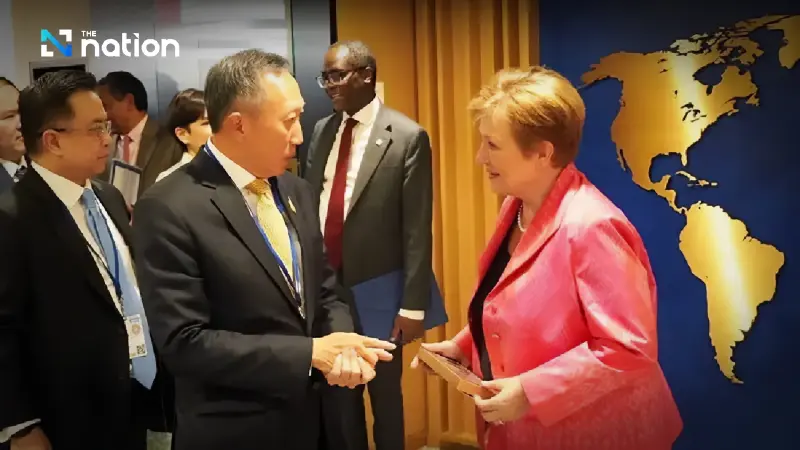


Thai Deputy Finance Minister Vorapak Tanyawong Reports on World Bank-IMF Meetings; Georgieva Warns AI Boom Risks 'Divergence'
- The International Monetary Fund (IMF) has maintained its global economic growth forecast for 2025 at 3.2%.
- This recovery is described as "fragile" and "underwhelming," as it is threatened by significant structural challenges and high geopolitical uncertainty.
- Major downside risks to the forecast include escalating trade tensions, a potential AI technology bubble, China's economic fragility, and high public debt in many countries.
- While AI technology presents a significant upside potential for growth, the IMF warns it also risks increasing economic divergence between and within nations.
Thai Deputy Finance Minister Vorapak Tanyawong Reports on World Bank-IMF Meetings; Georgieva Warns AI Boom Risks 'Divergence'
Vorapak Tanyawong, Thailand’s Deputy Minister of Finance, has revealed the key outcomes of the 2025 Annual Meetings of the World Bank and the International Monetary Fund (IMF) in Washington D.C.
The IMF maintains its global economic growth forecast for 2025 at 3.2%, but Vorapak stressed that this represents a state of "fragile recovery" still confronted by significant structural challenges and high geopolitical uncertainty.
The global economy has shown "notable strength" in the first half of the year, defying fears of a sharper slowdown.
However, IMF Managing Director Kristalina Georgieva cautioned that the outlook remains underwhelming.
"We are stuck in this around 3 per cent growth right now," Georgieva said, noting that while the global economy has "shown such resilience in the face of uncertainty and profound transformations," medium-term prospects remain weak.
The growth figure is deemed insufficient by the IMF to fully compensate for the impact of previous slowdowns or to meaningfully reduce the income disparities between nations.
On global trade, Vorapak noted that while US tariff measures have created pressure, the overall effect is expected to be “limited.”
Georgieva acknowledged the US trade measures but welcomed the fact that most countries have so far avoided escalation.
"The rest of the world has not followed so far. Out of 191 members of IMF, we have seen only 3 moving more forcefully on tariffs — US, China and Canada," she stated.
Nonetheless, the situation is seen as eroding business confidence and hindering a faster economic acceleration.

Five Major Downside Risks
The IMF is particularly concerned about five downside risks that could pull global growth below its current forecasts:
Trade Tensions: A severe escalation of trade conflicts could reduce global output by as much as 0.3%.
Technology Bubble Risk: Intense investment in the technology sector, particularly Artificial Intelligence (AI), could lead to a speculative bubble. This risk might force central banks to raise interest rates, causing volatility in global financial markets.
China's Economic Fragility: China’s reliance on exports, coupled with ongoing issues in its property sector, remains a critical vulnerability. Georgieva warned that China has reached a "fork in the road" and must resolve its real estate issues and strengthen social safety nets.
Fiscal Constraints: Many countries are burdened by high public debt and have failed to build adequate 'fiscal space,' leaving them exposed to a prolonged high-interest rate environment.
Pressure on Central Banks: Demands to loosen monetary policy prematurely could undermine the credibility of efforts to control inflation, creating future risks.

AI and Trade Offer Upside Potential
Despite these headwinds, the IMF sees clear upside potential if risks are managed effectively.
Vorapak noted the IMF's position: "The IMF points out that AI technology holds enormous potential to boost global productivity, provided we can manage the risk to prevent it from turning into a bubble."
Georgieva quantified this potential boost: "AI will contribute to growth, somewhere between 0.1 to 0.8 per cent. This is significant. To extract that growth from AI, it would be very significant for the world.”
However, the IMF chief warned of the uneven nature of this boom.
"The risk we see is that we may end up in a world where there is increased productivity, but it is also a source of divergence within countries and across countries," she cautioned, emphasising that "preparedness really matters. It is happening fast, so we don't really have much time."
Vorapak concluded that the world is currently at a critical inflection point defined by 'Trade' and 'Technology.'
He reiterated the IMF’s call: "The policy decisions made today, particularly concerning trade and technology, will determine the direction of global economic growth for years to come, making macroeconomic risk management absolutely vital for all nations."
