
Commerce minister insists rare earth MOU with US non-binding, China ready to cooperate
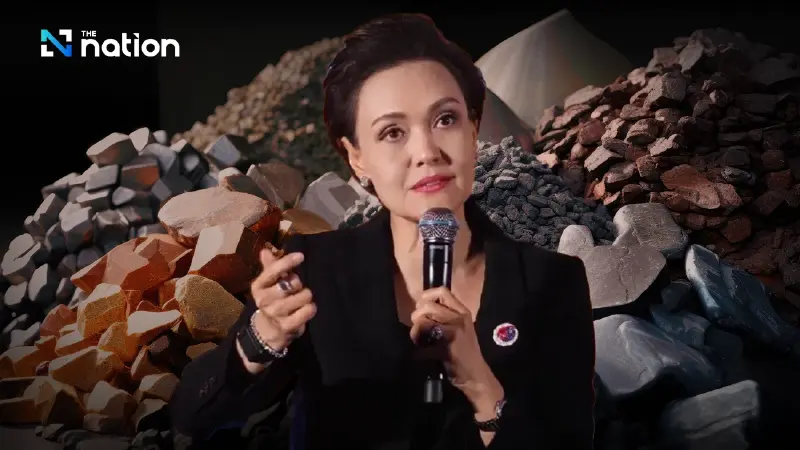


Commerce Minister Suphajee Suthumpun affirms Thailand’s rare earth MOU with the US has no legal obligations and can be revoked; China has also expressed interest.
Commerce Minister Suphajee Suthumpun on Monday confirmed that the memorandum of understanding (MOU) on cooperation in critical minerals between Thailand and the United States was thoroughly reviewed by the Cabinet and the Council of State before being signed, and that it carries no legal obligations and can be cancelled by either party at any time.
Speaking at the 47th ASEAN Summit in Kuala Lumpur, Malaysia, Suphajee explained that the initiative originated from a US proposal conveyed via Thailand’s Foreign Ministry, which carefully examined the matter before approval.
“This MOU does not contain any binding commitments. It focuses on knowledge transfer and supply chain cooperation, not on investment obligations. There are no legal or financial commitments, and everything is clearly stated in the document,” she said.
The minister stressed that all rare earth-related projects must comply with Thailand’s environmental and mining laws and are not exempt from any legal frameworks.
“This agreement could help us gain knowledge about our role in global supply chains. Other countries — nine so far — have signed similar MOUs, each with different terms. The Thai government has ensured that ours is legally non-binding and purely cooperative, which could benefit future trade negotiations,” she said.
Suphajee also dismissed any geopolitical implications, affirming that the MOU does not compel Thailand to take sides between the US and China.
“China controls about 90% of the world’s rare earth supply. We currently have modest resources, but we may find more in the future. Signing with the US doesn’t prevent us from signing with China. It’s not a trade deal like an FTA — it’s about cooperation, and Thailand can work with both sides.”
She reiterated that Thailand must maintain open and balanced trade relations.
“Thailand is not a large economy; we rely on both China and the US. China is our top trading partner for both imports and exports, while the US is our leading export market. We can cooperate with both without special conditions. There’s no cause for concern — we simply need to explain our stance to China if discussions arise.”
Suphajee noted that Thailand and China remain in dialogue, and the MOU with the US does not preclude future cooperation with Beijing.
“Before this meeting, the Chinese ambassador reassured us that there’s no need to worry. Some rare earth elements have military applications, but others are used in normal commercial trade,” she said.
She also emphasised that Thailand’s rare earth trade volume is still minimal and that there are no legal or contractual obligations stemming from the MOU.
“As China is our biggest trading partner, we must maintain balance while also exploring new markets. Otherwise, if we depend on just one side, we’ll have no flexibility in our trade policy.”
On environmental concerns, Suphajee acknowledged regional issues such as cross-border pollution from rare earth mining in neighbouring countries and assured that Thailand is treating this as a priority issue.
“Thailand has already imposed restrictions on importing agricultural products from countries causing pollution. The government is also drafting a Clean Air Bill, showing its strong environmental commitment. This matter must be managed with long-term oversight,” she said.
