
Foreign Analysts: The US gains advantage over ASEAN as 0% tariffs offer little benefit
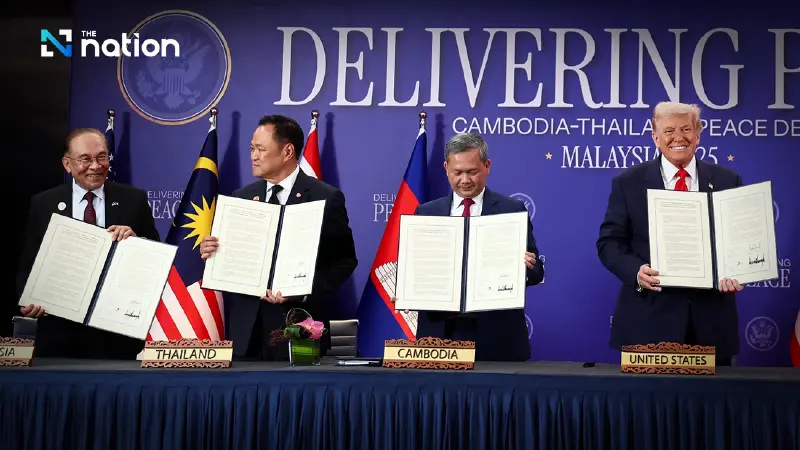


ASEAN nations may receive minimal benefits from latest "trade agreement" between the US government and the ASEAN member countries compared to what the US stands to gain, giving it an advantage over ASEAN
Economists led by Nicole Gorton-Caratelli and Tamara Mast Henderson stated in their research report that the trade agreement between the US and four ASEAN countries may not significantly reduce the tariffs ASEAN faces when exporting goods to the US, due to three key factors:
Narrow Tax Exemptions
If the negotiations continue to rely on the narrow list of tariff exemptions originally proposed by the US, the agreement will not be able to reduce customs duties that ASEAN has to pay.
Cambodia's Deal Signals 'Bad Omen'
The framework of the trade agreement refers to a list of products that might be exempt from tariffs, based on a set of items previously disclosed by the US in September. This means that any tax relaxation ASEAN countries will receive will be limited to this existing list, similar to what Cambodia has already received. This could be seen as a "bad omen," as ASEAN countries may end up with similar results.
Limited Coverage of Goods
Many items on this list are already tariff-exempt or have restrictions that make the benefits insignificant. For example, tax exemptions apply only to civilian aircraft parts. Another key point is that these items are not ASEAN's main exports that generate significant income. Therefore, reducing tariffs on this list does little to ease the tax burden for the region's core exports.
Even if the US agrees to remove customs duties on all items on the announced tariff exemption list, the relief would apply to only a small proportion of ASEAN’s exports. Bloomberg Economics estimates that the tax exemptions will cover less than 4% of the value of imports from each country. For instance, Malaysia at 3%, Thailand at 3.5%, and Vietnam at 2.7%.
What Does the US Gain? What Does ASEAN Gain?
Economists have labelled these agreements "one-sided," with "clear costs and ambiguous benefits" for ASEAN.
The trade deals with Cambodia and Malaysia, along with cooperation frameworks with Thailand and Vietnam, all promise to "open the way" for US products to access ASEAN markets, particularly in agricultural goods, energy, aviation, and critical minerals.
Allowing US goods easier access is seen as a "threat" to ASEAN's domestic industries, which are already being affected by US trade tariffs.

A comparative graphic of US imports from China and ASEAN countries shows that after the US began imposing its first round of tariffs in 2019, imports from ASEAN have overtaken those from China.
Conversely, the US has only offered a "reciprocal tariff exemption" for certain groups of products, which critics argue is highly limited, and many of these items are not key industries for ASEAN's major exports.
Malaysia Gains Little from 0% Tariff
Analysts point out that the trade agreement between the US and Malaysia is clearly imbalanced, with Malaysia making many commitments but receiving unclear benefits in return.
Besides tariff reductions, several agreements also involve commitments to purchase significant amounts of goods from the US, nearly $150 billion, including semiconductors, electronic components, data centres, and aerospace equipment.
The White House has also stated that the US Treasury Department and the Central Bank of Malaysia are working on a "memorandum of understanding on currency policy" to support fair economic relations.
Deborah Elms, a trade policy expert, said Malaysia agreed to make "many difficult concessions," including eliminating tariffs on US goods and implementing other US policies. This has led to questions: "What did they get in return?" which remains a mystery.
Barclays Plc analysed and estimated the benefits Malaysia would receive from the US tariff exemptions. They predict that the exemptions would cover exports to the US worth approximately $12 billion, or about 2.8% of Malaysia’s GDP, with the majority of this amount subject to restrictions or conditions.
In other words, only around $1 billion of Malaysia’s exports will receive a genuine 0% tariff exemption, which represents just 0.2% of GDP. Some argue that Malaysia gains very little from the 0% tariff exemption.
How Much Bargaining Power Does ASEAN Have?
However, economists suggest that the US government’s particular interest in "critical minerals" could be an opportunity for Malaysia, Thailand, and Vietnam to leverage their bargaining power in future negotiations to secure better deals.
