
Commerce Ministry launches plan to curb false origin claims on US exports, to inspect 8,000 RVC certificates monthly
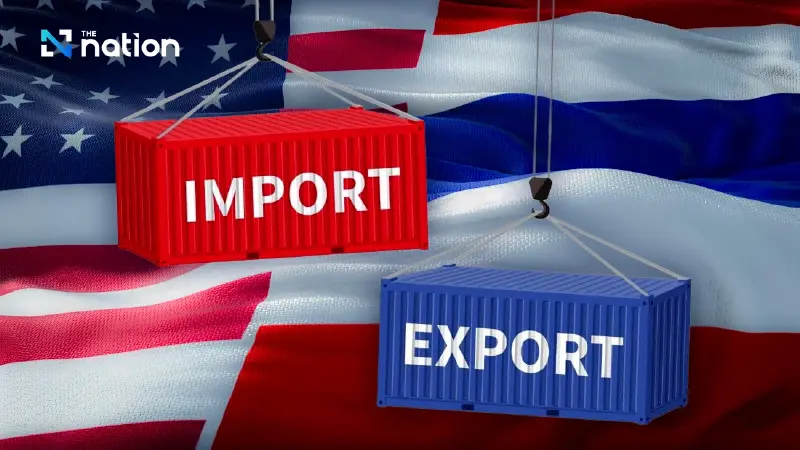


Thailand’s Commerce Ministry intensifies checks on exports to the US, introducing AI audits and financial support to prevent false origin claims under the 19% reciprocal tariff.
Thailand’s Ministry of Commerce has unveiled a major plan to combat false origin claims in exports to the United States, following the implementation of Washington’s 19% reciprocal tariff on all Thai exports since July 31, 2025. Officials warned that any shipments found to have falsified their country of origin through transshipment could face tariffs of up to 40%.
According to a report from Government House, the Economic Cabinet has approved the ministry’s measures to safeguard Thailand’s export market and prevent violations of US rules of origin, which are now being more strictly enforced. The plan will soon be submitted to the Cabinet for final approval.
The US is Thailand’s second-largest export market, accounting for 18% of total export value, or around US$55 billion annually, making it critical to the country’s economy. Washington is also shifting its rules of origin criteria from “substantial transformation”—based on production processes—to “regional value content” (RVC), which determines origin by the percentage of domestic materials used in production.
Under the Commerce Ministry’s “RVC-Up: Boost Thai Local Content, Expand US Market” programme, to be implemented from the fourth quarter of 2025 through 2026, about 6,000 exporters are expected to benefit from the initiative. The project consists of three core components:
1. UP System – AI-powered verification
The Department of Foreign Trade will use artificial intelligence to verify product origins more accurately and efficiently. As the sole agency authorised to issue certificates of origin for exports to the US, it will see its workload surge from 90 cases per month (each taking about three days) to 8,000 cases per month, potentially extending verification time to an average of 24 days. The ministry will allocate 12.9 million baht from the emergency budget for system development to handle the increased demand without disrupting exports.
2. UP Knowledge – Training and consultation
This initiative will enhance exporters’ understanding of the US’s new rules of origin through consultations, training sessions, and seminars in collaboration with the Federation of Thai Industries (FTI), the Thai Chamber of Commerce, and the Thai National Shippers’ Council (TNSC).
3. UP Fund – Low-interest financial support
To help businesses adapt, the programme will provide low-interest loans to exporters who increase their domestic material content. This will be carried out jointly with the Fiscal Policy Office, the Finance Ministry, and financial institutions, with an initial budget of 7.6 million baht allocated from the government’s emergency fund for the 2026 fiscal year.
The Commerce Ministry said these coordinated measures aim to protect Thailand’s US export market, ensure compliance with international trade rules, and support domestic industries in strengthening their supply chains amid stricter global trade scrutiny.
Monitoring nominee businesses involved in illegal operations
Another measure focuses on monitoring nominee businesses and foreign operators who violate Thai laws, which could be another channel used by foreign companies to falsely claim Thai origin for goods exported to the United States.
On October 22, the Prime Minister issued an order establishing the Committee on the Management and Resolution of Illegal Foreign Business Operations. The committee is tasked with formulating urgent policies and measures to integrate efforts among agencies in preventing and suppressing illegal foreign trade and business activities. It also directs government departments, state enterprises, and other state agencies to perform their duties within the bounds of the law and in coordination with the committee.
The private sector has also been asked to cooperate in implementing these urgent measures, tracking progress across relevant agencies, and raising public awareness to foster understanding of the situation. The committee has the authority to appoint subcommittees, working groups, or assign relevant officers as needed.
The authorities will focus on investigating high-risk legal entities suspected of nominee structures — companies where shareholding arrangements are complex or deliberately obscured to conceal the true owners. This includes examining attempts to evade Thai law through the use of accounting or legal firms to facilitate registration, and identifying cases where Thais unknowingly act as nominees, potentially facing criminal liability.
Investigations will also be carried out under the Foreign Business Act B.E. 2542 (1999), which limits the powers of enforcement. Information provided by related parties may not always reflect the true nature of these hidden business operations. To improve accuracy, the investigation process will follow four key stages:
Step 1: Data screening
The Department of Business Development (DBD) will use the Integrated Business Analysis System (IBAS) to identify at-risk companies. The system analyses business behaviour trends of entities where Thais hold at least 51% of shares jointly with foreign investors, particularly in businesses listed under the Foreign Business Act.
Step 2: Information compilation
Authorities will gather detailed profiles of company directors, registered capital, and shareholders, mapping connections between Thai shareholders and the companies in which they invest. The analysis will also extend to related companies that may fall into nominee-risk categories, including those established by the same founders or those who acquired shares from previous shareholders.
Step 3: Financial traceability
The DBD will forward information to the Anti-Money Laundering Office (AMLO) to trace financial movements and transactions of Thai shareholders involved. The objective is to verify whether share payments or investments were legitimate or indicative of nominee activity. This examination covers three situations:
- Shareholders at the company’s founding.
- Shareholders following capital increases.
- Shareholders acquiring shares through transfers.
Step 4: Legal action
If wrongdoing is confirmed, the findings and evidence will be forwarded to the Royal Thai Police or the Department of Special Investigation (DSI) for further investigation, prosecution, and arrests of offenders under the Foreign Business Act B.E. 2542 (1999).
