
Suphajee champions ‘3 builds, 4 policies’ to navigate global geopolitics
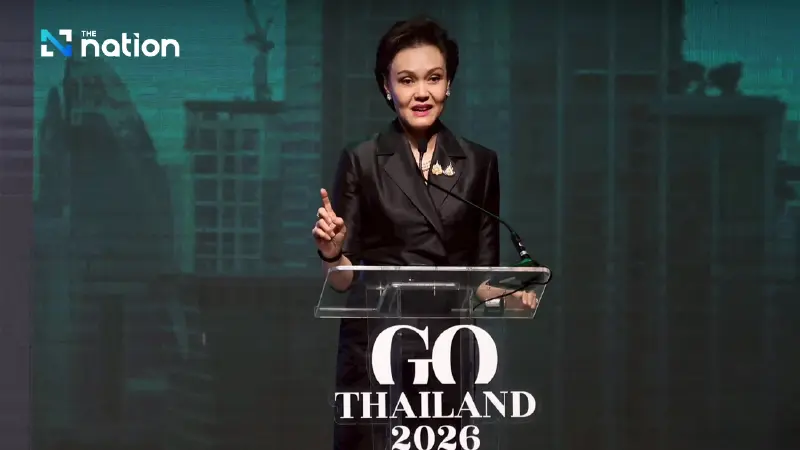


Commerce Minister Suphajee champions the ‘3 builds, 4 policies’ strategy and promotes “Team Thailand” to strengthen neutrality, attract FDI, and expand into new markets.
- Commerce Minister Suphajee Suthumpun has outlined a strategy of '3 builds' and '4 policies' to help Thailand navigate global challenges such as deglobalisation, decarbonisation, and digitalisation.
- The '3 builds' refer to three strategic roles: building balanced relations with global power centres, building connections to new markets, and building risk diversification across supply chains.
- The '4 policies' consist of a proactive strategy to expand markets and secure trade agreements, a reactive strategy to address trade barriers, a policy to support the domestic SME base, and a focus on stabilising trade through food security.
During the "Go Thailand 2026: Beyond Survival" event hosted by Thansettakij on Tuesday (December 2), Commerce Minister Suphajee Suthumpun discussed the challenges and opportunities of Thai trade in the context of a new, more complex global environment. She emphasised the necessity of adapting and adopting both proactive and reactive strategies.
Suphajee highlighted the importance of considering trade and foreign policy together. She emphasised that in today’s world, relying solely on the domestic market is no longer feasible. The global context must be taken into account when negotiating trade agreements.
She explained that the world is facing four critical challenges, all of which are related to trade, which she categorised under the "D" themes:
- Deglobalisation: In the wake of the Covid-19 pandemic and geopolitical tensions, many countries have increasingly turned to self-reliance. The global supply-demand model, which worked in the past, may now lead to survival challenges.
- Decarbonisation: Driven by the effects of global warming, particularly in Europe and the West, policies are now being introduced that require businesses to prove their production, processing, and transportation processes do not contribute to climate change. If Thailand does not adjust, it will face difficulties in trading with these countries.
- Digitalisation: The shift towards digitalisation and the rise of AI presents new opportunities previously inaccessible. However, it also brings challenges. If Thailand does not swiftly harness the potential of digital capabilities, it risks falling behind in the global marketplace. Trade must embrace technology to increase accuracy and efficiency.
- Demographics: Developed nations and those with advanced economies are experiencing population declines. Thailand has faced a steady population decrease for the past four years and has now fully entered an ageing society. The birth rate has fallen below the death rate, resulting in a reduction in domestic consumption, which diminishes the internal economic drive.
Amid these challenges, there are opportunities that Thailand must seize, particularly in positioning itself within a multipolar world. While the United States and China remain major trading partners— with the US playing a significant role in global GDP and China being the top importer and exporter— the emergence of multiple power centres presents an opportunity for Thailand.
"Thailand holds an advantage as it is seen as a 'non-threatening' country that can engage in trade negotiations with all parties. Many countries are now seeking to reduce their dependence on China or the US and are increasingly turning to Thailand for bilateral trade talks," she said.
As a result of this strategic positioning, in the past eight months (January-August 2025), Thailand has experienced a historic inflow of Foreign Direct Investment (FDI), with investment applications increasing by 30% and the value rising by over 90%.
Furthermore, the new era of trade is entering the age of friend-shoring, where countries rely on trusted friends instead of depending on traditional globalisation. Thailand must position itself as a trusted partner.
At the same time, Thailand should implement trade protection measures, both tariff and non-tariff, to safeguard domestic entrepreneurs and farmers.
Suphajee outlined four key strategies to reverse the trade game:
- Shift from "trade partner" to "strategic ally": Thailand must change the perspective from being a "trade partner" to being an "ally" creating mutual benefits. This involves shifting from a trade deficit to a surplus by highlighting the export products of Thailand, such as chemicals and mid-range goods, which can be used by India to manufacture and sell to third-party countries. This transforms trade deficits into surpluses within the broader supply chain.
- Strengthen ASEAN cooperation: Intra-ASEAN trade remains only at 20%. If ASEAN countries trade more among themselves, it will reduce shipping costs and allow for greater use of existing tax benefits. With a population of over 700 million people, ASEAN offers vast potential. Regional cooperation will enhance negotiating power with the rest of the world.
- Leverage Thailand’s strategic location: Thailand is centrally located in Southeast Asia, with transport routes running north-south and east-west passing through the country. By utilising this position, Thailand can become a logistics hub and a bridge to connecting Asia, strengthening its role in the changing global context.
- Unify with “Team Thailand”: The government (all ministries) must work together and speak with one voice to present what Thailand excels at. In addition to the government, the private sector, such as the Joint Standing Committee on Commerce, Industry and Banking, the Stock Exchange of Thailand, the Thai Bankers' Association, and the agricultural sector, must collaborate as a single team to create national benefits.

The Ministry of Commerce has identified three main strategic roles in navigating the new global trade order:
- Achieving balance in relations with all global power centres.
- Connecting and expanding to find new markets and trading partners.
- Diversifying risk across markets, products, and supply chains.
These strategies are further broken down into four key policies:
- Proactive strategy: Expand existing markets and enter new ones. This involves finding new markets and expanding old ones using new products or methods. Accelerate Free Trade Agreements (FTA) and Business Matching efforts. For instance, accelerate FTA negotiations with South Korea and the European Union (EU), while using business matching to enter new markets like India and Saudi Arabia.
- Reactive strategy: Engage with the US on non-tariff measures. While negotiations are temporarily stalled, Thailand is using this period to build consensus domestically between the government and the private sector. The goal is to increase the number of Thai products in the US’s Annex 3 list, which are exempt from tariffs. Currently, only around 800 Thai products are on this list, out of 1,900 total items. By expanding this list, Thailand can reduce tariff barriers.
- Support for the domestic base: Focus on the development of SMEs, M-SMEs, and Micro-SMEs through digital advancements (inventory management, accounting) to facilitate easier access to funding. Collaboration with Small and Medium Enterprise Development Bank is critical.
- Stabilising trade: Focus on food security, not just food sales. This enhancement allows Thailand to gain bargaining power and sell products at premium prices. For example, Thailand has signed a food security agreement with Singapore, guaranteeing 100,000 tonnes of rice.
Suphajee concluded that all these efforts are about fostering cooperation. The government builds trust, the private sector creates opportunities, and the people will ultimately benefit.
“When trade works, the economy moves forward. When the economy moves forward, Thailand grows. Together, we will go beyond survival," she concluded.
