
Thai Minister Fears US Trade Talks Will Stall Over Cambodian Border Conflict
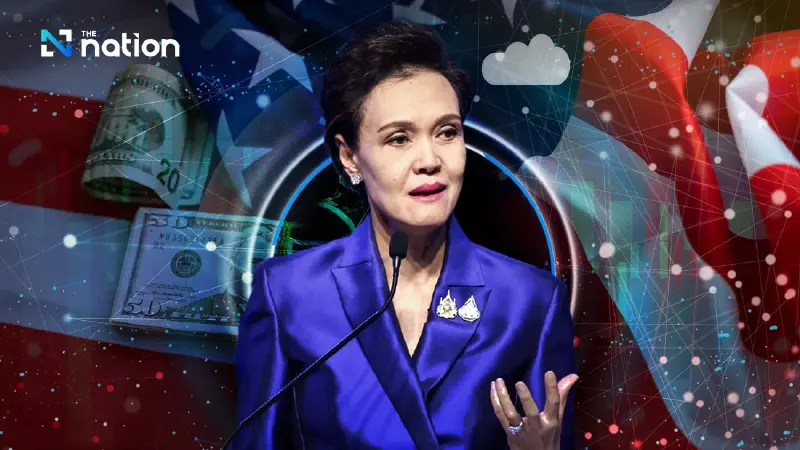


Private sector warns government to swiftly clarify that Thailand did not initiate border violence to safeguard crucial tariff negotiations
- Thailand's Commerce Minister fears the ongoing military conflict with Cambodia could prolong and stall crucial tariff negotiations with the United States.
- The Office of the US Trade Representative (USTR) has formally requested a temporary suspension of the trade talks until the border situation is resolved.
- The Thai private sector is urging the government to swiftly clarify to the US that Thailand did not initiate the violence, believing the border issue has now become a condition for negotiations.
Private sector warns government to swiftly clarify that Thailand did not initiate border violence to safeguard crucial tariff negotiations.
Thailand’s Commerce Minister Suphajee Suthumpan has voiced concerns that the ongoing military clashes on the border with Cambodia could prolong tariff negotiations with the United States, potentially missing the target deadline of 2025.
The development follows a request from the Office of the US Trade Representative (USTR) to temporarily suspend the talks.
Suphajee, however, maintained that she is "not worried" personally, arguing that Thailand was neither at fault nor the aggressor in the latest conflict.
Despite the USTR’s request to halt discussions until the situation is resolved, the Thai government insists on continuing negotiations through all available channels, although it has not yet received a reply from Washington regarding its latest communication.
The minister added that the key immediate impact of the uncertainty is not tariffs, which remain at the 19% retaliatory rate imposed on Thailand, but the "uncertainty" hanging over the trade relationship.
The escalation of the border conflict, which reignited on 7th December 2025, has had a devastating effect on cross-border trade.
The Commerce Minister reported that the value of trade with Cambodia has plummeted by over 99%, owing largely to the closure of checkpoints earlier in the year.
The private sector confirmed the severe economic fallout.
Kriengkrai Thiennukul, chairman of the Federation of Thai Industries (FTI), noted that the economic downturn has been compounded by the mass evacuation of hundreds of thousands of Thai citizens from border areas, halting livelihoods in agriculture and manufacturing.
He estimated the loss to border trade at 99.5%—almost equivalent to a permanent shutdown.
Dr Pipat Luengnaruemitchai, chief economist at Kiatnakin Phatra Financial Group (KKP), stressed that while the direct impact on the overall Thai economy is small—exports to Cambodia are only 2-3% of total exports—the indirect consequences are concerning.
"The greater worry is that this exacerbates the Thai economy under the current challenges," Dr Pipat stated.
He noted that the border conflict, occurring simultaneously with recent severe flooding, is negatively affecting the country’s tourism atmosphere and foreign investor confidence during the high season.
Both the FTI and the Thai Chamber of Commerce have urgently called on the government to act decisively.
Poj Aramwattananont, chairman of the Thai Chamber of Commerce, affirmed the private sector's stance against violence but supported the government's right to protect Thai sovereignty against what he termed Cambodia's continuous breaches of international agreements.
The primary request from the business community is for the government to swiftly and clearly communicate to the international community, particularly the United States, that Thailand was not the initiator of the recent border violence.
The FTI’s Kriengkrai warned that the USTR’s move to pause talks signals that the border issue is now a condition for negotiations.
In response, the government has announced measures to aid affected border entrepreneurs, including offering liquidity loans and tax-free transfers for machinery for those who had invested in Cambodia.
