
IMF Chief Prescribes Capital, AI and Labour Reform as Path to Faster Global Growth
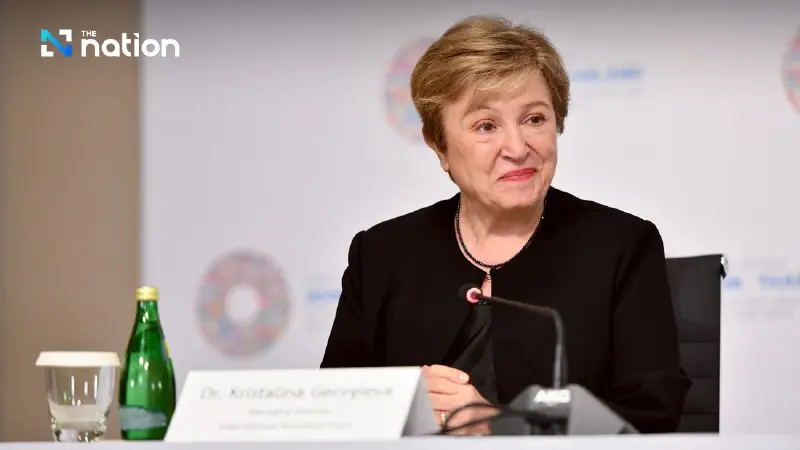


Georgieva builds on Thailand’s Finance Minister’s remarks to outline a three-point global blueprint for lifting productivity — and leaves Bangkok impressed by its canals and temples
- IMF Managing Director Kristalina Georgieva recommends deepening capital markets to provide businesses with access to equity and risk capital, moving beyond traditional bank lending to spur innovation.
- She identifies harnessing Artificial Intelligence (AI) as a second pillar for growth, citing its potential to significantly boost productivity, particularly in regions like Asia.
- The third step involves labour reform to equip workers with skills for a changing economy and removing bureaucratic barriers ("red tape") to encourage private investment.
Georgieva builds on Thailand’s Finance Minister’s remarks to outline a three-point global blueprint for lifting productivity — and leaves Bangkok impressed by its canals and temples.
When asked how Thailand could restore international confidence in its economic prospects, Finance Minister Dr Ekniti Nitithanprapas pointed to infrastructure investment, human capital development and the application of digital and artificial intelligence technologies as the country’s principal levers of growth.
It was a response that prompted the International Monetary Fund’s managing director, Kristalina Georgieva, to offer a broader prescription — one she said applied not just to Thailand, but to the entire world.
Georgieva opened by setting the global scene.
The world, she explained, is growing more slowly than it did before the Covid-19 pandemic. Average global growth, which ran at around 3.7 to 3.8 per cent in the pre-pandemic era, has since slipped to approximately 3.2 to 3.3 per cent. The root cause, she argued, is a persistent shortfall in productivity growth.
“If we want to see faster growth, we have to focus on what are the obstacles to productivity growth,” she said.
Against that backdrop, she outlined three concrete steps that countries — Thailand among them — could take to lift their economic potential.
1. Deepen Capital Markets
The first recommendation centres on broadening access to capital, with a particular emphasis on moving beyond traditional bank lending. Georgieva called for a deepening of capital markets and a greater role for equity investment, arguing that businesses — from individual entrepreneurs to large corporations — need access to risk capital, not merely loans, if they are to grow at pace and innovate with confidence.

2. Harness Artificial Intelligence
The second pillar is the adoption of artificial intelligence as a driver of productivity. The IMF’s assessment, she noted, suggests that Asia alone could see productivity gains of up to one percentage point if countries move decisively to embrace AI. This chimed directly with Dr Ekniti’s earlier remarks, in which the minister highlighted digital transformation and AI adoption as central to Thailand’s strategy for upgrading the competitiveness of its workforce and economy.
3. Mobilise Labour and Remove Barriers to Private Investment
The third element involves ensuring that labour and capital are deployed to their full potential. On the labour side, Georgieva stressed the importance of equipping workers with the skills needed to adapt swiftly to a rapidly evolving economy. On the capital side, she called for the elimination of red tape that impedes private investment, arguing that unnecessary bureaucratic obstacles hold back businesses of every size.
“There is no red tape,” she said, describing the ideal environment in which private investors — operating within the proper rules — can scale their activities without friction. “From the individual to the big company, they can grow faster.”

She added that the questions raised at the press conference — about how to revive growth — would sit at the very heart of discussions at the forthcoming IMF and World Bank Annual Meetings.
“Your question is going to be right at the centre, not just for Thailand, but for the whole world,” she said.
A City That Charms — and a Fish Worth Envying
Georgieva closed on a distinctly warmer note, sharing personal reflections from what she described as her fifth visit to Bangkok. The city, she said, struck her as “dynamic, green, clean and welcoming,” and she expressed confidence that the international delegations attending the Annual Meetings would enjoy it as much as she had.
She singled out a tuk-tuk ride through the streets of the capital as a highlight and recounted a charming observation she had made beside one of Bangkok’s canal temples: that the fish in the waters next to the temple are never caught, never cooked, and never eaten — a cultural tradition she found deeply moving.
“If I were to be reborn as a fish, I want to be a fish next to them,” she told the gathered press, drawing laughter from the room.
It was a fitting end to a press conference that ranged from the technical to the personal — and one that underscored the IMF’s view that Bangkok, and Thailand more broadly, has much to offer both as a host and as an emerging model for navigating the challenges of a slower-growth world.
