
Thailand Eyes Global ‘Safe Haven’ Status as BOI Pivots to Secure Production Base Amid Middle East Conflict
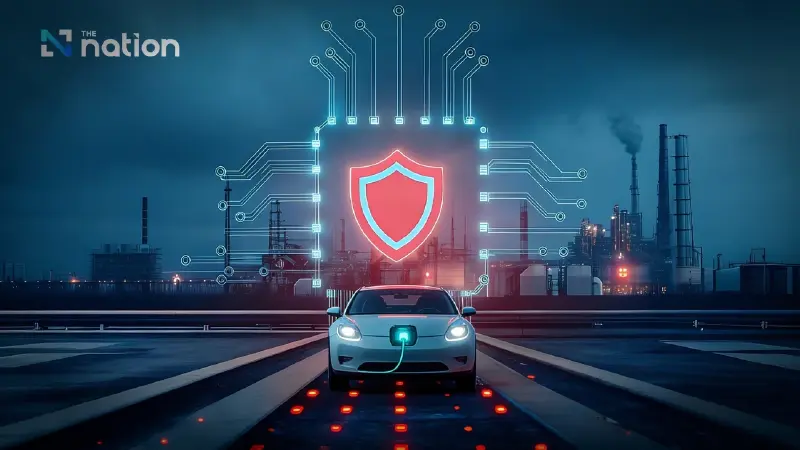


Investment chief Narit Therdsteerasakdi fast-tracks EV, semiconductor, and clean energy agendas to position Thailand as a stable jigsaw in the new world order
- Amid global instability, particularly the Middle East conflict, Thailand's Board of Investment (BOI) is positioning the nation as a "Safe and Secure Production Base" for companies seeking to de-risk their supply chains.
- The strategy involves fast-tracking key industrial policies to bolster the electric vehicle (EV), semiconductor, and clean energy sectors.
- Thailand is leveraging its existing strengths, including its dominance in hard disk drive production and its status as Southeast Asia's largest EV manufacturing hub.
- To attract investment, the BOI is streamlining approval processes with a "Fast Pass" system and implementing measures to cultivate and attract high-skilled talent, especially for the semiconductor industry.
Investment chief Narit Therdsteerasakdi fast-tracks EV, semiconductor, and clean energy agendas to position Thailand as a stable jigsaw in the new world order.
The Thailand Board of Investment (BOI) is moving to transform regional instability into economic opportunity, positioning the kingdom as a "Safe and Secure Production Base" for multinational firms fleeing geopolitical volatility.
As the conflict in the Middle East drives up global energy and logistics costs, Thailand is pitching its stability to investors looking to de-risk their global supply chains.
Narit Therdsteerasakdi, secretary-general of the BOI, stated that the current global tensions are not merely short-term disruptions but are becoming embedded in a "New World Order."
In response, Thailand is highlighting four core pillars of security—Food, Energy, Supply Chain, and Human Security—to prove its indispensability to the global economy.
A Critical Link in Global Supply
Thailand already holds a dominant position in several key sectors that the BOI intends to leverage:
Supply Chain: The kingdom produces 70-80% of the world’s hard disk drives and ranks first in ASEAN for Printed Circuit Board (PCB) production.
EV Hub: Thailand has cemented its status as the largest electric vehicle (EV) production hub in Southeast Asia and the largest outside of China.
Human Security: The nation’s established reputation as a regional medical and wellness hub is being framed as a key asset for multinational workforces.
Fast-Tracking the Industries of the Future
To maintain this momentum, the BOI is preparing to present three urgent agendas to the new government. Central to this is the EV 3.5 policy, which seeks to ensure continuity in subsidies across all segments while pushing for "localisation"—the use of domestic parts—to strengthen the existing manufacturing base.
In the technology sector, a comprehensive Semiconductor Strategy is nearing full implementation.
High-profile investments are already underway, with Analog Devices set to open its largest design centre in Thailand later this month, and Infineon Technologies expected to complete its new facility by the third quarter of 2026.
Recognising the "exponential" energy demands of the digital economy, the BOI is also pushing for a Direct Power Purchase Agreement (Direct PPA) for green energy. This measure aims to supply 2,000 megawatts of clean electricity specifically to support the rapid expansion of Data Centres and Artificial Intelligence (AI) industries.

Cutting Red Tape and Cultivating Talent
To resolve infrastructure bottlenecks, the BOI is launching a "Fast Pass" system in collaboration with eight partner agencies. This initiative aims to reduce approval times by 20-50%, with 16 pilot projects worth over 170,000 million Baht already successfully processed.
The human element remains a priority, with the BOI aiming to produce 80,000 semiconductor professionals within five years. To attract international experts, the agency is considering easing "90-day reporting" requirements and transitioning certain work permits into "Work Visas" for high-skilled talent.
"If we have the people and a robust supply chain, the new industries entering Thailand today will not be short-term guests," Narit concluded. "They will become the foundation of our new economy for the next decade."
