
Thailand, US move ahead on reciprocal trade deal, says Suphajee
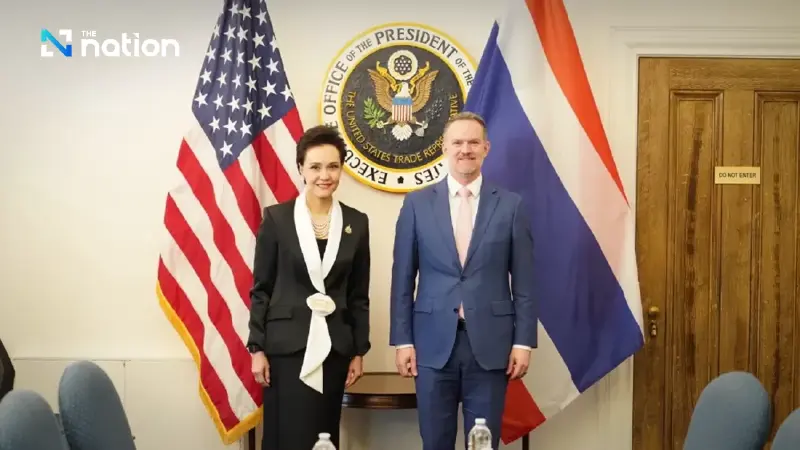


Suphajee says Thailand and the US will speed up reciprocal trade talks as Bangkok seeks tariff relief and deeper investment ties.
Deputy Prime Minister and Commerce Minister Suphajee Suthumpun said Thailand and the United States have agreed to move forward with talks on a reciprocal trade agreement after discussions with senior US trade officials.
Suphajee made the remarks after meeting US Trade Representative Jamieson Greer and Deputy US Trade Representative Rick Switzer on Monday (May 4).
She said the talks were constructive and reflected the shared intention of Thailand and the United States to accelerate negotiations on the Agreement on Reciprocal Trade (ART), so that progress can be made and the talks concluded as soon as possible.
The agreement is aimed at strengthening confidence in the economy and investment, while reducing pressure from possible US trade measures against Thailand.
The US side placed importance on rebalancing trade and opening opportunities for Thailand to take a more proactive role through expanded investment in the United States in sectors where both countries have shared potential, such as processed agriculture and energy.
The talks also covered imports of US goods in categories that Thailand needs but is still unable to produce domestically.
Thailand confirmed its readiness and informed the US side of plans by Thai private-sector companies to expand investment in the United States. The response from the US side was positive, and the issue is regarded as an important element of cooperation that both countries can move forward with in a concrete manner.

Suphajee said Thailand also used the opportunity to push several key issues, particularly a proposal for the United States to exempt Thai products that it cannot produce domestically from tariffs.
She said the US side showed an open attitude and was ready to consider the issue further, reflecting flexibility and a willingness to seek mutually beneficial solutions.
On the reciprocal trade agreement talks, Thailand explained to the US side that it attaches importance to a negotiation outcome that would make the agreement genuinely practical.
The US side expressed understanding and said it was ready to hold discussions on both a clear implementation timeframe and the details of the agreement on various issues. This would help Thailand carry out its internal procedures more efficiently.
The United States also expressed interest in Thailand playing a larger role in increasing the proportion of US raw materials used in supply chains.
Thailand and the United States agreed to speed up the negotiations, with the aim of concluding the key substance of the agreement as soon as possible. The move is intended to reaffirm Thailand’s status as an important strategic trading partner of the United States and reduce the risk of future tariff measures.
In addition to the latest visit, the Commerce Ministry will arrange for a Thai delegation to travel to the United States to provide explanations and answer questions before the Office of the US Trade Representative on issues related to the Section 301 investigation from May 13-14, 2026.
According to the Department of International Trade Promotion (DITP), Thailand is among the countries under investigation in two areas: structural excess capacity and the enforcement of import bans on goods produced using forced labour.
The move is aimed at creating a proper understanding of Thailand’s trade and production structure.

Suphajee discusses investment ties with Tammy Duckworth
Suphajee said that during her visit to the United States, she also held talks with US Senator Tammy Duckworth. The two sides exchanged views on economic cooperation, investment and opportunities to upgrade supply chains between Thailand and the United States.
The US side proposed cooperation in several high-potential sectors, including clean energy and carbon-reduction technologies, small-scale nuclear energy technology, food innovation, public health cooperation and the baby food industry. These are sectors in which Thai private companies have shown interest.
Both sides also agreed to promote cooperation between private companies, educational institutions and US government agencies, particularly in Illinois, which has strong potential in energy, technology and advanced agriculture.
The cooperation is aimed at expanding investment and creating added value in supply chains over the long term.
Thailand also sought support in sending a positive signal to the US administration that Thailand is ready to serve as a reliable strategic partner and to promote tangible trade cooperation.
“This discussion reflects the confidence and shared commitment of Thailand and the United States to elevate economic relations in a stronger and more concrete manner,” Suphajee said.
“Thailand is ready to work closely with the United States to ensure that negotiations on the reciprocal trade agreement produce mutual benefits in a balanced and sustainable way over the long term.”
US remains Thailand’s second-largest trading partner
In 2025, the United States was Thailand’s second-largest trading partner, with total trade worth more than US$93.65 billion.
Thai exports to the United States were valued at US$72.51 billion, covering key products such as computers, rubber products, gems and jewellery, automobiles and air conditioners.
Thailand imported US goods worth US$21.14 billion, including crude oil, machinery, aircraft and parts, chemicals and electrical machinery.
Thailand recorded a trade surplus with the United States of US$51.36 billion.
