
Thai poultry exports face crisis over China ban and conflicts
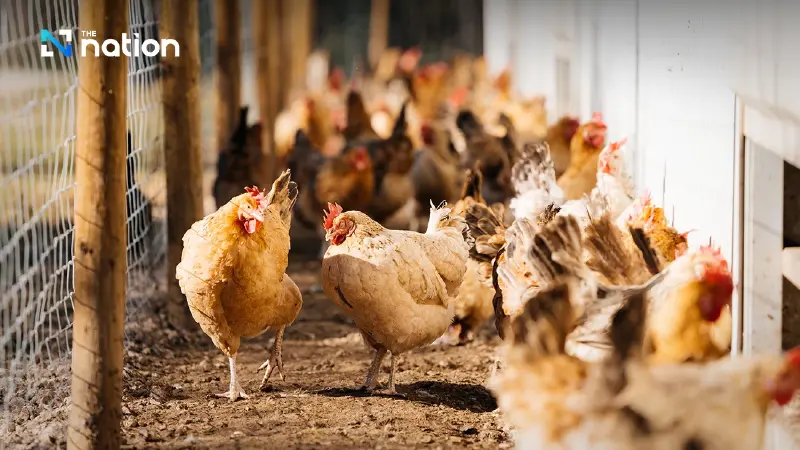


Thailand's chicken exports are declining due to China suspending several processing plants and impacts from the Middle East war, raising concerns over costs.
- China has suspended poultry imports from a majority of Thai processing plants (from 22 down to 5) due to stricter standards and suspicions over production certificates, expected to cut exports to that market by over 50%.
- The Middle East conflict has blocked exports to that region and significantly increased shipping costs to Europe by forcing detours around the Cape of Good Hope.
- The crisis is compounded by conflict-related consequences, including higher oil prices, increased animal feed costs, and a shortage of plastic for packaging.
- These combined factors caused Thailand's chicken exports to drop by 2% in January and February, with significant declines projected for the entire year.
Kukrit Areepakorn, manager of the Thai Broiler Processing Exporters Association, revealed that the export situation and prices of chicken are currently declining due to two main reasons: China suspending exports from 17 processing plants, and the Middle East war.
For China, Thailand previously exported from 22 processing plants, but currently can export from only five.
This is because China has increased the strictness of its production standards and hygiene inspections for export plants.
The Department of Livestock Development is currently negotiating the matter.
The reason China increased its strictness is a result of its expanded domestic production capacity, in line with the government policy to reduce imports.
Although domestic demand is expanding, current chicken prices in China, particularly chicken feet, are expensive.
Therefore, if domestic production capacity is insufficient and prices rise abnormally, it is expected that Thailand will be allowed to export again.
This is because Thai producers themselves have not reduced their production capacity and can export immediately upon receiving orders.
War exacerbates production costs
Regarding the impact of the Middle East war, it has prevented Thailand from exporting to this market.
Oil prices are higher, and transport cannot pass through the Strait of Hormuz, meaning Thai chicken exports to the UK and European Union markets must detour around the Cape of Good Hope, which has a longer distance and more expensive freight rates.
Reduced crude oil production in Middle Eastern countries has also caused a plastic shortage, leading to packaging problems.
Furthermore, drought and transport issues have caused the prices of animal feed ingredients to increase, including both corn and soybean meal.
All these factors resulted in Thailand's chicken exports during January and February dropping by 2%.
The overall export picture for the entire year will also decline accordingly when compared to 2025, when Thailand exported 1.3 million tonnes worth THB156 billion.
Exports to the Chinese market, which were 100,000 tonnes, will decrease to only 40,000 to 50,000 tonnes this year.
For the Middle East market, from previously exporting 20,000 tonnes, it is expected that no exports will be possible this year.
The EU market is at 170,000 to 180,000 tonnes, while the UK is at 200,000 tonnes and requires prices to be raised according to freight costs.
Malaysia is at 110,000 tonnes.
Japan, where Thailand exports the most at 500,000 tonnes or about 40% of export volume, currently has an issue with a shortage of plastic packaging.
Concerns over stagnant domestic consumption
However, the current factory-gate price of live broilers has decreased from THB43 to THB44 to THB39 to THB40 when compared to the same period last year.
This is due to domestic consumption remaining poor, coupled with the recent end of the Songkran festival, during which consumers had high expenses and had to set aside some income to pay for school fees.
Meanwhile, the increased transport rates have resulted in retail broiler prices being expensive.
Sarawut Thowsakul, an advisor to the National Fisheries Association of Thailand, said that from the problem of rising oil prices, despite the government subsidising the fishing group at a rate of THB36.50 per litre, it is still considered high when compared to the previous rate they used to receive at THB17 per litre.
This has forced 40% of the 6,000 fishing boats to dock.
After this, if oil prices still do not drop, it is expected that an additional 20% will dock.
The suitable oil rate should be THB30 per litre.
If it is higher than this, it is expected that up to 70% of Thai fishing boats will have to dock, and this will force seafood prices to increase according to costs.
However, because the Songkran festival has currently ended, going outdoors for recreation is less frequent, causing overall fishery product prices to decrease.
The prices of fish delivered to restaurants and fish for making meatballs and surimi have dropped by 10%.
For example, grouper dropped from THB350 per kilogramme to THB300, and seabass dropped from THB150 per kilogramme to THB130.
Fish meatballs dropped from THB60 per kilogramme to THB50.
Squid sized 8 to 10 pieces per kilogramme dropped from THB350 per kilogramme to THB110, while the size of 30 to 40 pieces per kilogramme is priced at THB130 to THB110.
Call to dismiss DLD chief over THB20 billion loss
Winaroj Supsongsuk, Permanent Secretary of the Ministry of Agriculture and Cooperatives, received a complaint letter from Nopparut Worachitwutthikun, a former core leader of the White Pigeon 2006 group, addressed to Suriya Juangroongruangkit, Minister of Agriculture and Cooperatives.
The letter demanded the transfer and investigation of the Director-General of the Department of Livestock Development, alleging negligence over the poultry export issue to China, which could violate Section 157 for dereliction of duty.
Nopparut said that recently, Suriya ordered the transfer of the Director-General of the Department of Royal Rainmaking and Agricultural Aviation, even though he is due to retire on Wednesday (September 30).
Regarding the deep reasons, he declined to get involved.
Similarly, the DLD Director-General will also retire on Wednesday (September 30).
Therefore, when the DLD Director-General faces complaints, Suriya must take action no differently from the transfer of the Royal Rainmaking Director-General to set the same standard.
Currently, poultry exports account for 22% of Thai meat export value, or almost THB30 billion a year.
The industry is facing a severe crisis after Chinese authorities reduced the number of processing plants permitted to export from 26 to four, meaning 22 plants were suspended.
China warns production capacity does not match certificates
The main cause comes from inspections by Chinese agencies, which found suspicions that the production capacity did not match the certificates issued by the DLD, and there were observations that there might be falsely claiming the origin of poultry from other countries that Chinese authorities do not buy.
This resulted in China ordering the suspension of 22 plants in Thailand since Friday (August 1, 2025).
"Even though Chinese authorities have sent warning letters to Thailand to urgently fix the flaws multiple times, the latest on Monday (March 9), there has been no progress. The damage that occurred throughout the past eight months affects 22 operators, representing a value of over THB20 billion."
If Suriya still does not urgently resolve the issue, Thailand faces a high risk of being suspended from all meat imports by China, which would affect hundreds of thousands of workers in this industry.
Therefore, an urgent decision is needed.
If they remain inactive and there is no transfer or any action taken against the DLD Director-General, the group might have to escalate its movement next week and prepare to submit the matter to the National Anti-Corruption Commission (NACC) for investigation as well.
Then, if Thai authorities remain inactive, they are ready to prepare a petition to the Chinese leader to request a delay of the ban.
