
Gastronomy Tourism Tipped to Spread Wealth Beyond Bangkok
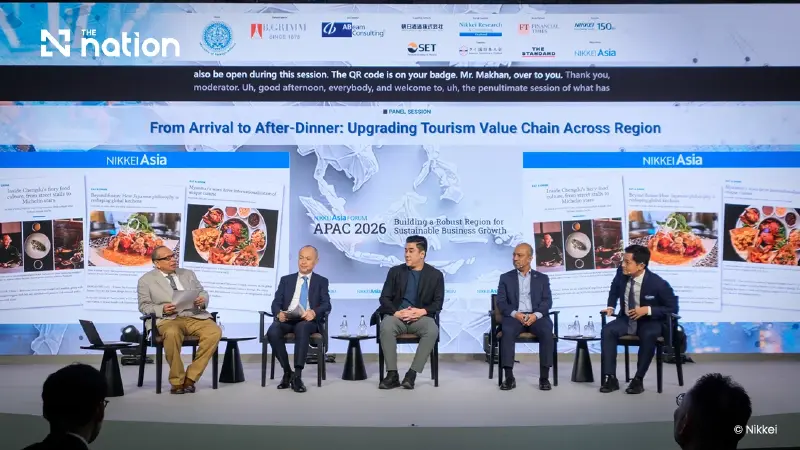


Panellists at Nikkei Asia Forum 2026 say gastronomy tourism could help spread tourist spending beyond Bangkok and Phuket across the region
- Tourism officials are promoting regional cuisine as a strategy to redistribute tourist spending away from saturated hubs like Bangkok and Phuket.
- The approach encourages travelers to visit secondary destinations by seeking out specialty ingredients and dishes in their specific regions of origin.
- This dispersal of tourists is intended to channel revenue into local farming and hospitality jobs, spreading economic benefits to communities beyond major cities.
- The strategy capitalizes on consumer trends such as a rising demand for hyper-local sourcing, verified food safety, and authentic culinary experiences.
Panellists at Nikkei Asia Forum 2026 say gastronomy tourism could help spread tourist spending beyond Bangkok and Phuket across the region.
Southeast Asian tourism officials are pushing gastronomy tourism as a tool to redistribute visitor spending away from saturated hotspots such as Bangkok and Phuket, delegates heard at the Nikkei Asia Forum 2026 on Thursday.
Speaking on a panel titled "From Arrival to After-Dinner: Upgrading Tourism Value Chain Across the Region", Noor Ahmad Hamid, chief executive of the Pacific Asia Travel Association (PATA), said national tourism bodies were increasingly using regional cuisine to steer travellers towards secondary destinations.
"It can really disperse travellers from the hotspots like Bangkok and Phuket," Hamid told the audience, citing examples such as encouraging visitors to seek out speciality ingredients, like fish sauce, in their region of origin rather than the capital. "You have to go to where it comes from — northern Thailand, right? I think in that manner it can really disperse travellers."
Hamid said the strategy served a dual purpose: showcasing local heritage while channelling tourist revenue into farming and hospitality jobs beyond major cities.

"It's not just in terms of how much is spent," he said. "It's also how we can have that access [for local communities]."
He identified three consumer trends shaping the sector alongside dispersal: rising demand for verified food safety and hygiene standards, a preference for hyper-local sourcing, and growing personalisation around dietary needs such as halal or Jain requirements.
"When you feed somebody wrong, they can get sick, or they can die," he said. "So this is very, very important."

Bangkok's Japanese food boom
The panel's dispersal debate came against the backdrop of a striking domestic trend: the rapid expansion of Japanese dining in the Thai capital, which several panellists said was reshaping the city's restaurant economy.
Jakkrit Saisomboon, chief executive of Maguro Group, said the number of Japanese restaurants in Bangkok had grown from 555 in 2007 to 2,672 by 2024, with the sector's value in Thailand now estimated at $8bn.
"This shows how Thai people love Japanese food," he said.
Jakkit said his firm's forthcoming Bangkok outlet — due to open on 28 July — would apply an omakase-grade sushi concept, typically costing diners tens of thousands of yen in Japan, to a conveyor-belt format at a fraction of the price.
"Everyone can control the budget easily," he said, adding that the model appealed strongly to families. "All the kids love the conveyor belt."

Naoya Ishikawa, a director at ONODERA Food Service Holdings, described a similar strategy of extending high-end omakase sushi credentials — his firm holds 130 Michelin stars across its restaurants — into more accessible price brackets.
"The core thinking behind this plan is our strong desire to offer the same top-tier quality to a wider range of customers," Ishikawa said.
Ishikawa added that labour shortages were pushing operators towards partial mechanisation in food preparation, reducing dependence on scarce skilled chefs.
"That helps a lot to expand the business," he said. "They don't have to rely on the chef."

Malls compete for Japanese tenants
Kazutoshi Hatasue, who oversees Japanese partnership management at retail developer Central Pattana, said Japanese restaurants had become key traffic drivers for Thai shopping centres, partly fuelled by rising Thai outbound travel to Japan — 1.2 million Thai visitors last year, he said — who sought to recreate the experience at home.
Hatasue said his firm weighed three main criteria when selecting restaurant tenants: brand awareness, "uniqueness" as a destination in its own right, and marketing capability, particularly on social media.
"Almost all customers use social media like TikTok, Facebook and Instagram," he said. "The marketing capability is nowadays very important."

Balancing authenticity against globalisation
An audience member asked whether the growing prominence of international chains risked diluting Bangkok's culinary identity. Hamid acknowledged the tension but said tourism and food industries were "always packaged together", with cuisine remaining one of the principal reasons travellers chose a destination.
Moderator Marwaan Macan-Markar, regional correspondent for Nikkei Asia, noted Bangkok's culinary standing had been reinforced by 2025 rankings showing six of its restaurants featured among the world's top 50 — more than any Asian rival except Singapore.
A live poll of the audience underlined the stakes for the wider region: 83 per cent of respondents said inbound tourism was important to sustaining Southeast Asian economies, while 78 per cent said restaurant choices influenced their own travel plans.
Panellists broadly agreed the challenge ahead was less about proving food's importance to tourism — a point they said was already well established — and more about ensuring its economic benefits reached beyond a small cluster of well-known destinations.
