
BOI holds US roadshow to attract FDI in upstream chip industry
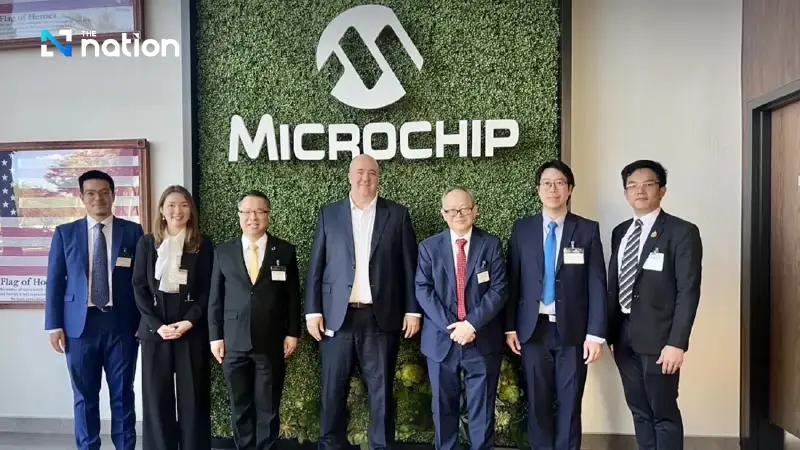


Thailand’s BOI holds US roadshow to attract upstream chip investments, signing MoU with ASU to train 80,000 semiconductor workers.
The Board of Investment (BOI) and the Ministry of Higher Education, Science, Research and Innovation (MHESI) jointly held a roadshow in the United States last week with the goal of attracting investment in Thailand’s upstream chip industry.
The roadshow took place in Arizona and California from September 8 to 12, with cooperation from the BOI Office, MHESI, and the Thai Embassy in Washington DC.
It was held under the theme “Made-in-Thailand Chip” to showcase Thailand’s potential to become a regional hub for a comprehensive chip manufacturing base.
Meetings with US chip giants
BOI secretary-general Narit Therdsteerasukdi said the delegation visited Arizona and California, both centres of the US semiconductor industry, and held discussions with more than ten global chip companies. These included Microchip, Analog Devices, Lumentum, NXP, as well as major corporations such as Qorvo, Intel, Synopsys, and Renesas.

Narit said the companies were invited to invest in Thailand’s advanced semiconductor industry, particularly in the upstream sector, covering chip design, wafer fabrication, and advanced testing.
MoU with Arizona State University
A highlight of the trip was the signing of a memorandum of understanding between MHESI and Arizona State University on cooperation to train around 80,000 semiconductor professionals within five years. The partnership will include research programmes, academic courses, personnel exchange, and the establishment of centres of excellence in Thailand.


Long-term strategy
This roadshow followed an earlier one in the US in April and aims to advance two key semiconductor goals:
- Attract at least 500 billion baht in foreign direct investment in semiconductors and advanced electronics between 2025 and 2029.
- Develop at least 80,000 skilled workers for the semiconductor industry over the same period.
The global semiconductor industry is currently valued at over US$600 billion and is expected to reach US$1 trillion by 2030, driven by growing demand for AI chips, smart vehicles, smartphones, and automated systems.

Narit noted that Thailand has served as a manufacturing base for chip assembly and testing for over 50 years. Now, he said, the country is looking to expand into the upstream sector of the industry.
Investment momentum
Between 2022 and 2024, 406 semiconductor and electronics investment projects were submitted to the BOI for incentives. These projects, worth around 600 billion baht, came mainly from the US, Japan, Europe, China, and Taiwan.

