
AI reshapes global investment as Thai stocks stay stuck in Old Economy
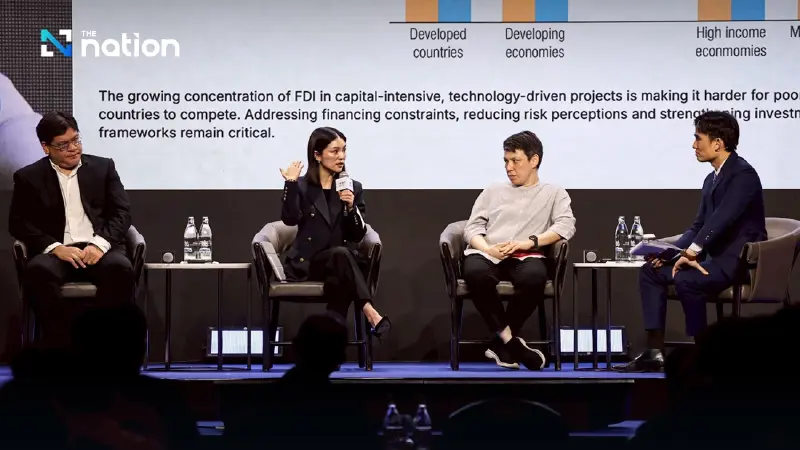


Liberator says global capital is moving towards countries with strong AI supply chains, leaving Thailand with limited gains and a subdued stock market.
- Global investment capital is shifting away from traditional factors and flowing into countries with strong AI technology capabilities, such as the US, Taiwan, and South Korea.
- The Thai stock market is underperforming and described as "trapped in the Old Economy" because it is dominated by traditional sectors like energy and banking, with very few technology companies.
- Thailand has almost no role in the global AI value chain, causing it to miss out on investment from this major trend and limiting its growth opportunities.
The investment world is entering a major turning point as global capital begins flowing into countries with strong AI technology capabilities, putting several emerging markets, including Thailand, under pressure from a new form of competition that goes beyond economics and will play out over the long term.

Watanya Bunnag, co-chief executive officer of Liberator Securities Co Ltd, told the Liberator Investment Forum 2026 that the investment world was entering a “new order” in which capital no longer moves according to traditional factors.
Instead, it is choosing countries with technological strength, geopolitical stability and the ability to become part of global supply chains.
Looking back over the past 14 years, foreign direct investment (FDI) flows have changed significantly.
Europe has been on a continuous downward trend since 2015, while the United States remained the world’s largest FDI recipient in 2024, with about US$278 billion.
East Asia and Southeast Asia have continued to grow, although momentum slowed during some periods after COVID-19.
In ASEAN, however, most investment capital has been concentrated in Singapore, while Thailand has benefited only to a limited extent.

This has left the Thai stock market in a subdued state, with the Thai stock index falling from 1,700 points to near 1,100 points, while average trading value has returned to levels close to those seen 20 years ago.
“One of the major problems is that the Thai stock market remains trapped in the Old Economy. The large-cap stocks leading the market are still in energy and banking, as in the past, while New Economy stocks remain very limited, apart from DELTA, which clearly reflects the new economic picture. In addition, many Thai digital platform companies still choose to list overseas, leaving the Thai stock market without major technology companies that could become new long-term drivers.”
Watanya said a key turning point came in 2025, when investment capital began flowing back into developed economies, particularly countries in the AI supply chain such as the United States, Taiwan, South Korea and Japan.
AI has become a magnet for global capital, with South Korea home to world-class companies such as Samsung Electronics and SK Hynix.
Japan, while not a direct leader in AI chips, is strong in industrial automation, which is an important part of future AI systems.
Thailand, by contrast, has almost no role in the AI value chain, leaving its growth opportunities from global megatrends relatively limited.
Against this backdrop, Liberator is moving ahead with an expansion of its overseas investment services to give Thai investors greater access to global markets.
It currently allows investment in the South Korean market and is preparing to open access to China and Hong Kong on Monday (June 1, 2026), with further expansion planned in several countries during the third quarter of 2026.
In an era of uncertainty driven by competition between China and the United States, investors need to diversify their portfolios and look for new opportunities globally, rather than relying only on the Thai stock market.
Liberator is also preparing to move fully into the age of AI Disruption through three main pillars: Global Reach, AI Efficiency and Personalisation.
The new services, to be launched in the second half of 2026, will cover investment in 21 countries worldwide through a single application.
These will include the United States, Europe, Japan, South Korea, Singapore and Taiwan, as well as the stock markets of Vietnam, Indonesia and Malaysia.
On AI technology, the company said it would help improve investment efficiency through key features such as AI Portfolio Advisory, which supports portfolio allocation and investment rebalancing; AI News Intelligence, which filters news specifically related to users’ stocks or assets; and AI Trading Alert, which notifies users of important investment timing.
Under Personalisation, Liberator will redesign its UX/UI to support both new and professional investors, with functions that allow users to customise the format of their experience according to their needs.
