
The growing threat of drones in the Thai-Cambodian conflict
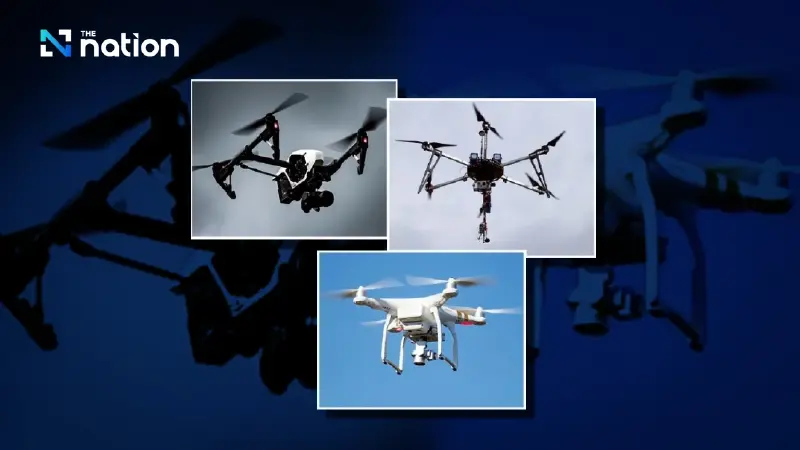


Despite the Cabinet’s recent approval for Swedish Gripen jets, experts warn Thailand is underprepared for the threat posed by Cambodian drones, urging faster action.
The Thai Cabinet has recently approved the purchase of four Gripen fighter jets, a decision made during ongoing conflict with Cambodia. This move seems unlikely to face opposition, especially after the Gripen jets significantly changed the dynamics of aerial combat by repeatedly targeting Cambodian military bases.
However, military professionals, experts, and security scholars are expressing concerns.
One military expert specialising in drone warfare noted that while the Cabinet has approved the Gripen purchase, it has not authorised the acquisition of drones—despite the current issue of Cambodian or foreign drones causing disruption.
The military has called for anti-drone systems, but the Cabinet's approval of Swedish fighter jets does not align with the modern warfare shift where drones are critical weapons, particularly as they are much cheaper than fighter jets.
Another security academic pointed out that Cambodia has no operational fighter jets, yet Thailand has not decisively overcome the situation.
It's not a full-scale war between two countries; rather, it is a series of skirmishes along the border where Thailand cannot fully utilise its superior military technology due to the lack of a formal declaration of war, leaving it at a disadvantage.
Despite Thailand having modern fighter jets in greater numbers than Cambodia, it is being disrupted by drone warfare, making military operations difficult, with air bases frequently targeted by enemy drones.
While Thailand has fourth-generation fighter jets, the enemy has no fighter jets, only drones—which are supported by China—but Thailand has not yet invested sufficiently in anti-drone technology, which is a disappointing oversight, an expert said.

As tensions escalate, the possibility of encountering weaponised drones like those used in Ukraine looms.
The Gripen jets being purchased are an upgrade, enhancing the capabilities of the previous batch, which consisted of 12 aircraft (now reduced to 11 after one crash). The new purchase will bring four additional jets to the second squadron, which will be a more modern model, the E/F series. The Royal Thai Air Force commander is expected to sign the contract in late August.
However, even with the new generation of Gripen jets, Thailand faces difficulties when confronting drones. The frightening reality of drones is that they are inexpensive, easy to produce, and capable of operating in large numbers without risking personnel. Even if shot down, the loss is minimal, and the operator can simply control a new drone or a new squadron
Drones come in various types, including surveillance drones, targeting drones, kamikaze drones (which do not carry weapons but crash into targets in large groups), armed drones, and bomb-laden drones.
Thailand is currently dealing with surveillance drones, targeting drones, and disruptive drones. Disruptive drones, which require minimal investment, can be sent in swarms to interfere with air operations.
In a prolonged conflict, armed drones might target rear areas, such as military bases, airfields, and key government buildings, similar to the Ukraine-Russia war.
Thai intelligence indicates that Cambodia uses Chinese drones, which could pose a risk for guiding drones that survey ahead and control large swarms of drones using a single navigation system.
The Thai military is already seeking solutions to address this issue, with short-term fixes in place, but longer-term strategies are needed.
These solutions include acquiring drones, developing anti-drone systems, and training personnel in drone operations and drone warfare—especially for armed drones—as a matter of urgency.
