
Government warns iris scanning for digital currency risks data breaches
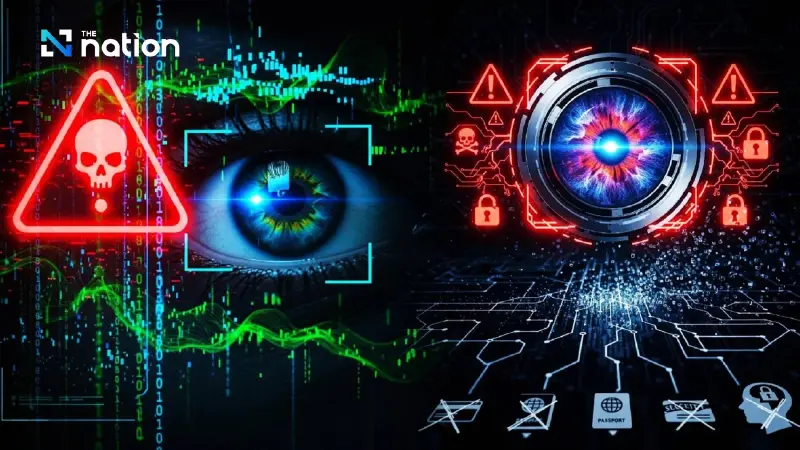


The government has warned the public against participating in schemes that require iris scans to verify identity in exchange for digital currency, citing the risk of biometric data leaks that could have long-term consequences.
Reports have surfaced of Orb devices being installed in shopping centres across several provinces to scan people’s irises. Participants were encouraged to download an application and exchange their biometric data for cryptocurrency tokens worth between 500 and 1,000 baht. The practice drew widespread attention on August 22.
According to the Thailand Consumers Council (TCC), promoters received 500 baht for each referral of new members, capped at ten referrals.

Deputy Government Spokesman Anukool Pruksanusak said on Wednesday that while technology and innovation now play an increasingly important role in business, communication, education, and security, the rapid adoption of biometric systems—such as fingerprint, facial recognition, and iris scans—comes with significant risks.
Anukool emphasised that biometric data is among the most sensitive personal information. Unlike passwords, it cannot be changed if compromised. “Iris codes are uniquely specific and difficult to alter. They can identify an individual with absolute certainty,” he said.

The risks, he explained, include:
- Data leakage: If iris codes are stolen, hackers may misuse them in the future.
- Identity theft: Iris data could be exploited to impersonate individuals, particularly in financial transactions.
- Deepfake risks: Stolen biometric data can be used to generate deepfakes for sophisticated cybercrime.
He noted that several countries, including Spain, Brazil, India and Germany, prohibit iris scans for such data collection, reflecting global concerns.
“Exchanging biometric data for small financial rewards may not be worth the irreversible damage if the information is misused,” Anukool warned.

DOPA clarification
Meanwhile, the Department of Provincial Administration (DOPA) confirmed that iris scans conducted using Orb devices are not part of its operations or those of any other state agency.
DOPA urged provincial and district officials, including subdistrict heads and village leaders, to raise public awareness and monitor such activities to prevent fraud. The department added that the Cyber Crime Investigation Bureau is currently assessing potential impacts.

Citizens who feel deceived or have evidence of wrongdoing are advised to seek assistance from their local Damrongdhama Centre at provincial or district offices, or call the hotline on 1567.
