
Cohesity pushes cyber resilience for Thailand and Asia-Pacific businesses
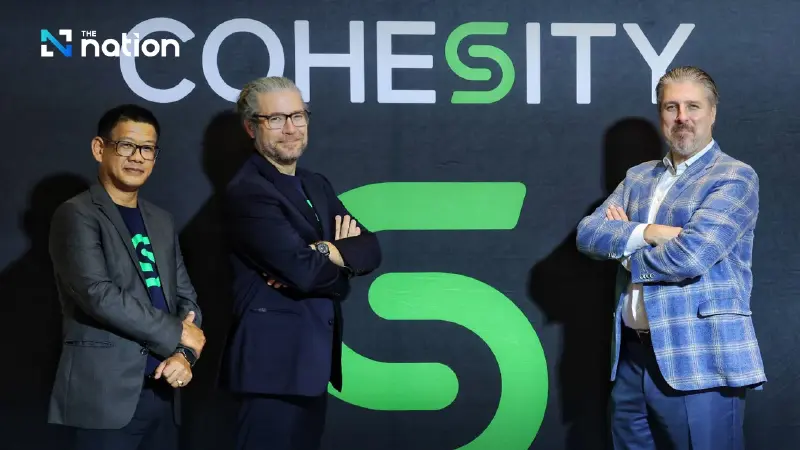


Cohesity, a global leader in AI-powered data security and cloud data management, is committed to enhancing cyber resilience — helping organisations prepare for, respond to, and recover quickly from cyber threats. The company currently operates in more than 140 countries and serves over 70 of the Global 500 companies.
In December 2024, Cohesity completed its merger with Veritas’ data protection business, propelling the company to become a market-share leader in enterprise data protection software.

Cohesity joins forces with Veritas
Kit Beall, Chief Revenue Officer (CRO) of Cohesity, said the merger aimed to create the largest and most influential AI-driven data security company in the industry — a goal that has now been achieved.
Over the past 10 months, Cohesity has focused on fully integrating the two companies, including their sales and marketing teams, and most importantly, their engineering divisions, which are now operating as a unified unit.
“We are now at a point where Cohesity can protect more workloads, data, and locations across the globe than ever before. The response from our customers and partners has been overwhelmingly positive,” he said.
“This merger also enables us to safeguard even more data for the benefit of society, as consumers’ personal information increasingly resides in cloud systems and networks.”

Urgency in tackling cyber threats
Beall emphasised the growing urgency of strengthening cyber resilience, noting that a key global lesson has emerged: no matter how robust external defences may be, hackers always find ways to breach them. Therefore, Cohesity’s most critical role is to ensure that customer data remains protected and recoverable in the event of an attack, breach, hack, or ransomware incident.
He explained that the increasing severity of cyber threats has heightened the sense of urgency across all sectors — from government agencies (military, social services, and infrastructure) to finance (banking), healthcare, transportation, and logistics.
Beall estimated that all organisations in Thailand, including state agencies and hospitals, are currently under attack, facing at least 100,000 attempted breaches each day.
Modern organisations, he stressed, must shift their mindset from traditional cybersecurity to cyber resilience — as when a threat occurs and internal networks are compromised, the ultimate line of defence lies in an organisation’s ability to recover quickly and maintain business continuity.
The role of AI and multilayered protection
Beall noted that artificial intelligence (AI) is a double-edged sword — while it enables innovation, it is also making cyberattacks easier for criminals. Cohesity’s strategy, however, is to leverage AI within its own platform to detect and block such attacks.
“If an attack cannot be blocked, Cohesity ensures that the data it protects remains secure. One of the key techniques we employ is the use of a vaulted copy — an immutable copy of data that cannot be altered, deleted, or hacked,” he explained.
Cohesity has also developed a five-step cyber resiliency framework to help customers and partners assess their current status. The framework includes: 1. Protecting all data, 2. Ensuring data is always recoverable, 3. Detecting and investigating threats, 4. Practising application resilience and 5. Optimising data risk posture.
Beall stressed that the most crucial aspect of this framework is the ability to automate and regularly test recovery readiness, ensuring that organisations can respond swiftly and restore services in the event of an attack.
The framework is built upon Cohesity’s best and most secure customer practices, which include more than 70% of Fortune 500 companies.

Supporting both on-prem and multi-cloud environments
Beall discussed the growing importance of data sovereignty, noting that governments are increasingly requiring control over how and where data is stored within their borders. To address this, Cohesity offers flexible options allowing customers to choose between on-premises data storage and cloud-based solutions.
“We recently introduced an on-prem solution called Fort Knox, a cyber vaulting and AI-powered solution designed to meet the needs of government clients who, by law, cannot store data in the cloud,” he said.
Cohesity also supports all major cloud platforms — including AWS, Google Cloud, and Microsoft Azure — through its multi-cloud capabilities, managed via a centralised console known as Helios.
This allows customers to manage their data seamlessly anytime and anywhere, regardless of where it is stored, including in on-prem data centres considered as private clouds.
Investment in the Asia-Pacific region and Thailand
Beall stated that the Asia-Pacific region is one of the fastest-growing and most important markets for Cohesity. The company already serves a large customer base in Thailand, including financial institutions, banks, airlines, government agencies, and other sectors.
I am particularly proud that our platform plays a crucial role in safeguarding data for several of Thailand’s Critical Information Infrastructure (CII) organisations, he said.
“We are increasing our investment in this region, and Thailand has shown remarkable growth and impact for the company. The main trends driving the market include the exponential growth of data volumes, the expansion of applications, and the growing need for customers to harness data for improved efficiency rather than merely storing it,” Beall added.
He also highlighted that Cohesity’s platform is designed for maximum data management efficiency, supporting green initiatives and optimising data centre space to accommodate new, high-demand applications such as AI.

Commitment to the APJ region
Cohesity reaffirmed its commitment to driving innovation across the region by appointing Greg Statton, one of the company’s AI technology pioneers, as Chief Technology Officer (CTO) for Asia Pacific and Japan (APJ). His mission is to accelerate growth and ensure the long-term sustainability of Cohesity’s business in the region.
Statton outlined his top three priorities for this year and next:
- Engage with more customers — to drive customer-led product development, as products improve most when built on deep customer understanding.
- Promote the company’s innovations — to build momentum and brand confidence, particularly in the APJ region where Veritas is well known but Cohesity remains relatively new. The goal is to position Cohesity as a brand with both strong foundations and cutting-edge innovation.
- Bridge engineering gaps — by serving as a connector between product, engineering, and customer teams, enabling faster development of new features that directly address customer needs and challenges.

New innovations unveiled at Catalyst 1
Statton discussed several innovations launched at the Catalyst 1 Data Summit, all designed to strengthen organisational cyber resilience.
- Centralised management platform: This new capability enables NetBackup customers to integrate data between NetBackup and Cohesity Data Cloud via NetBackup DirectIO, a protocol that accelerates backup and recovery. Cohesity will also expand workload coverage by adding up to 40 new connectors to DataProtect by the end of this year, helping organisations safeguard data on fully immutable systems. In addition, Google Threat Intelligence will be integrated into Cohesity Data Cloud Enterprise Edition at no extra cost to provide up-to-date threat insights.
- Fort Knox On-Premise: A cyber-vaulting solution tailored for organisations subject to data sovereignty laws, enabling full data protection while maintaining domestic control. Cohesity was the first to introduce cloud-based cyber vaulting with Cohesity Fort Knox and is now launching an on-premises version — Fort Knox Self-managed. This option offers a secure, isolated virtual vault within an organisation’s own data centre. It uses advanced obfuscation technology to conceal vault locations even if primary cluster admin credentials are compromised.
- Gaia and AI innovations: Cohesity Gaia enhances enterprise data search and utilisation, boosting both efficiency and security. Expanding from cloud to on-premises environments, Gaia supports data sovereignty requirements and helps customers unlock business value from protected data by leveraging Cohesity’s AI-driven knowledge discovery. Cohesity Gaia is now available for both cloud and on-premise deployments.

