
Cheng discusses growth and challenges at Delta Future Industry Summit 2025
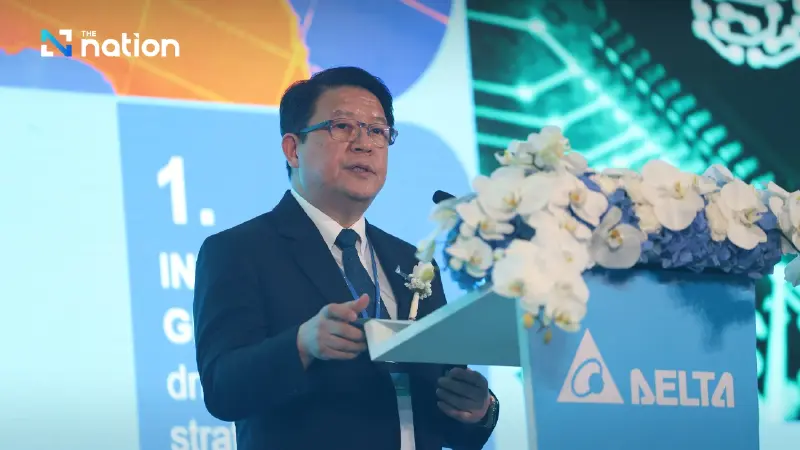


CEO of Delta Electronics (Thailand), addresses the role of AI and energy sustainability in driving industrial growth, while highlighting infrastructure challenges at the Delta Future Industry Summit 2025.
Victor Cheng, CEO of Delta Electronics (Thailand), highlighted the rapid industrial growth in the region, driven by disruptive innovations such as AI and energy sustainability, which are reshaping both industry development and operations.
During the Delta Future Industry Summit 2025 on Friday, Cheng acknowledged that, according to the IMF's October outlook, growth in the Asian region is expected to remain steady in 2026.
However, he noted that the manufacturing sector, which is seeing significant industrial activity, may face challenges due to insufficient infrastructure development.
He emphasised that infrastructure expansion, workforce upskilling, and demand stimulation—both domestically and globally—are essential to support sustained growth.
“To achieve this, we hope that businesses and policymakers can prioritise resilience by strengthening infrastructure, diversifying markets, and moving up the value chain with the help of AI,” he said.
Cheng also discussed Southeast Asia's unique position at the crossroads of industrial growth, digital innovation, and sustainable energy transitions.
Countries such as Thailand, Vietnam, Malaysia, and Indonesia are becoming key global manufacturing partners. “It's ideal time to reinforce this region's foundation and position to capture this wave of industrial development,” he said.

Digital innovation and AI: Transforming the industry
The most prominent disruptive technology today is AI, which can revolutionise manufacturing from an active to an intelligent mode.
Cheng pointed out that AI is not just a hype but a tangible tool for enhancing productivity, quality, and sustainability. By integrating AI, companies can improve productivity by up to 20%, reduce time by 15%, and cut inventory by 30%.
Delta's revenue growth of nearly threefold from $15 billion to $45 billion between 2020 and 2025—with only a 25% increase in human resources—demonstrates the impact of AI and smart automation.
Technologies like digital twins, which allow for pre-production simulations, and building automation solutions, which optimise energy use, are also pivotal. These innovations help companies increase productivity by up to 20%, improving resource management and energy efficiency.

Sustainable energy solutions for Southeast Asia's growth
The shift towards sustainable energy is critical for Southeast Asia, which faces global pressure to reduce emissions and transition to renewable energy sources.
As industrial development and data centre activities increase, energy demand is rising. Companies must balance efficiency, cost, and power reduction goals to meet these challenges.
Cheng noted that Southeast Asia's energy infrastructure is under strain, with much of the region’s infrastructure not yet ready for a rapid transition to renewable energy.
A promising solution lies in microgrids, which integrate renewable energy, smart energy solutions, and energy storage. The global market for microgrids is expected to grow to US$95 billion by 2030, offering significant opportunities for regional collaboration.
Looking ahead: Seizing opportunities for sustainable growth
To unlock the full potential of the region, Cheng urged businesses and governments to accelerate their adoption of smart automation, AI, and energy innovation. He stressed the importance of rethinking energy solutions to balance energy demand with sustainability, cost, and efficiency.
"To sustain this world, we must have sustainable smart systems that can balance cost, efficiency, and security of our energy systems," he said. "Not to mention long-term sustainability, ensuring that this growth does not negatively impact our future environment."
Cheng concluded by expressing his hope for a fruitful and successful summit, where participants could collaborate to define the next decade of industrial growth based on these transformative trends.

Delta Summit 2025 highlights AI, automation, and sustainability
Delta Electronics (Thailand), a global leader in energy management and provider of smart green solutions, successfully hosted the Delta Future Industry Summit 2025 under the theme “Transforming Industry with AI, Automation & Energy in Southeast Asia.”
The event gathered policymakers, business leaders, and experts from various industries to exchange insights on integrating AI technology, automation systems, and energy innovations. These future technologies are playing a pivotal role in transforming Southeast Asia into a more modern, sustainable, and interconnected society.
Nattapol Rangsitpol, Permanent Secretary of the Ministry of Industry, stated that Southeast Asia is entering a new era where technology and sustainability must move forward together.
“Adopting AI, automation, and clean energy technologies will elevate the industrial sector, enhancing its competitiveness and sustainability for future generations,” he said.
He added that Thailand is committed to promoting regional cooperation, developing digital talent, and building smart industry ecosystems to ensure sustainable, global growth.
Shan Shan Guo, Chief Brand Officer of Delta Electronics, delivered a special lecture on "Greening Intelligence: Charting the Future of Sustainable AI."
Citing a research report by Economist Impact, supported by Delta, she explained that advanced and energy-efficient technologies, combined with collaboration across all sectors in the industrial ecosystem, will play a critical role in driving the world towards the era of Green AI.
The report also reveals that 78% of global organisations view energy efficiency in AI systems as a priority within the next year. She further noted that grid resilience is a major challenge for the industry, as AI growth needs to be sustainable.
“Delta envisions promoting sustainable AI development by transforming the traditional AC-DC energy conversion system to a high-voltage DC system, alongside enhancing grid resilience with microgrid technology,” she said.

In addition, Delta showcased cutting-edge innovations and solutions supporting the industrial transformation towards the future, including:
- Datacenter Solutions
- Industrial Automation Solutions
- Smart Energy & EV Charging Solutions
- Building Automation Solutions
These demonstrations reflect Delta’s approach to developing buildings, factories, and digital ecosystems holistically, enhancing efficiency and sustainability across all dimensions. The showcase emphasised how modern technology and sustainability can grow together harmoniously.
