
BDI, Nation Group back ThaiLLM to boost digital sovereignty
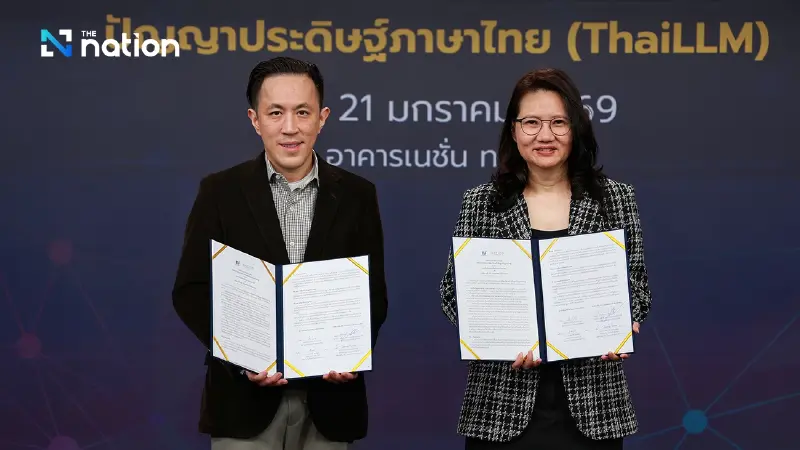


BDI and Nation Group sign an MoU to support ThaiLLM, providing Thai-language media data to help build a national AI model, strengthen digital sovereignty and develop a National Data Bank for AI.
The Big Data Institute (BDI) and Nation Group (Thailand) on Wednesday (January 21) signed a memorandum of understanding (MoU) to support the Thai Large Language Model (ThaiLLM) initiative, which aims to build artificial intelligence infrastructure for the Thai language.
The signing ceremony was held at Nation Tower in Bangkok and was presided over by Tiranee Achalakul, director of BDI, and Shine Bunnag, chief executive officer of Nation Group.
Also attending as witnesses were Soontaree Songserm, senior executive vice-president of BDI, and Warangkana Kalayanapradit, adviser to the CEO of Nation Group, along with executives from both organisations.
Tiranee said artificial intelligence had become part of everyday life for Thai people, but most AI systems were trained on vast amounts of English-language data—accounting for more than 40% of total training data—while Thai-language data represented only 0.4%. This, she said, highlighted Thailand’s lack of a language model that genuinely understands Thai context.
She added that ThaiLLM was not simply about building a language model; it was a national mission to establish “AI language infrastructure” so Thailand can develop and use AI in ways aligned with its own context. BDI will serve as a central coordinating body, integrating collaboration and helping to set standards for Thai-language AI development.

BDI is working with national research and technology organisations, including the National Electronics and Computer Technology Centre (NECTEC), the Vidyasirimedhi Institute of Science and Technology (VISTEC), the Artificial Intelligence Entrepreneur Association of Thailand (AIEAT), and the Artificial Intelligence Association of Thailand (AIAT).
The work is supported by the Digital Economy and Society Development Fund (DEF) to develop Thai-language AI infrastructure under an open-source/open-licence approach.
This is intended to enable developers, government agencies and the private sector to build on the technology widely, reduce dependence on foreign technologies, and support Thai-language AI development across diverse use cases.
The partnership with Nation Group marks the first time BDI has formally collaborated with a media organisation to advance ThaiLLM. Under the cooperation, BDI will receive Thai-language datasets from the media sector, covering news content, analysis and contextual information reflecting ongoing social, economic and public policy developments.
The data is expected to enhance ThaiLLM’s ability to learn from real-world situations and deepen its understanding of Thai society.
The collaboration is also expected to support language security and digital sovereignty, while contributing to the development of a “National Data Bank for AI”—a central foundation for collecting, integrating and managing data from multiple sectors.
This would help strengthen Thailand’s AI ecosystem and support the sustainable development of the country’s digital technology and innovation.

Shine Bunnag said AI represents a major challenge for media organisations worldwide amid rapid technological change.
He said Nation Group has continued to prioritise building AI capabilities internally, across both hardware and software, using AI tools to enhance staff capacity, manage costs and improve content production—while adhering to journalistic ethics to maintain credibility as a media institution trusted by Thai society for more than 55 years.
The collaboration with BDI is an important step in supporting ThaiLLM by contributing knowledge in news, policy and public affairs that has been verified and curated by Nation Group’s professional editorial teams, he said.
Such data would be a key driver in building an accurate Thai-language AI model that truly understands Thailand’s social and cultural context—supporting further innovation in communication and more effective public services for Thai people.
On ThaiLLM’s progress, the project has expanded into practical use among Thai large language model developers in both the public and private sectors. These include Pathumma LLM by NECTEC, OpenThaiGPT by AIEAT, Typhoon by SCB 10X, and THaLLE by KBTG.
The group has expressed interest in testing and building on ThaiLLM via the Hugging Face platform. ThaiLLM has already released an 8B-parameter base model and a 30B-parameter model, and the public is expected to be able to try the ThaiLLM Playground within January.
