
Thai Shrimp Crisis: Industry Demands 'National Agenda' to Hit 400,000-Ton Target and Seize US Market Opening
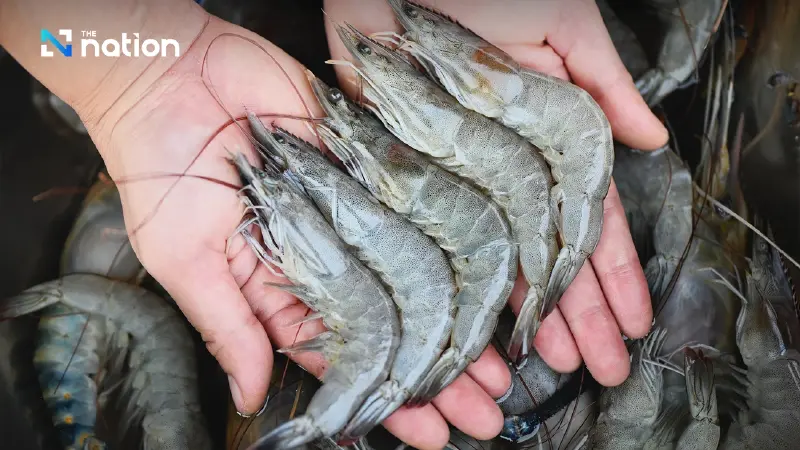


Thai shrimp producers are pressing the government to launch an urgent national plan to revitalise the sector after a 13-year slump, aiming to exploit a major trade advantage in the US next year
- Thailand's shrimp industry is urging the government to declare its recovery a "National Agenda" to boost annual production from a 13-year low of 270,000 tonnes to a target of 400,000 tonnes.
- The primary motivation is a major 2026 market opportunity in the US, created by high import tariffs on shrimp from competitor India, which gives Thai producers a significant trade advantage.
- The industry has been in a long-term crisis due to chronic diseases, price competition, and climate disasters, resulting in an estimated 650 billion baht in lost revenue over 13 years.
- Key demands include accelerating free trade agreements, reducing import duties on feed, providing low-interest loans for modernization, and increasing research funding to combat shrimp diseases.
Thai shrimp producers are pressing the government to launch an urgent national plan to revitalise the sector after a 13-year slump, aiming to exploit a major trade advantage in the US next year.
The Thai shrimp industry, once a powerful economic engine, has been stuck in a 13-year rut, with annual production stubbornly plateauing between 250,000 and 270,000 tonnes.
Now, the Thai Shrimp Association is calling for a dramatic intervention, proposing that the industry's recovery be made a "National Agenda" for 2026.
This move is deemed essential to capture a significant market opportunity arising from severe trade disruption facing India in the US market.
At its peak in 2011, Thailand’s shrimp output reached a remarkable 600,000 tonnes, generating substantial income for farmers.
Production has since plummeted due to persistent challenges, primarily chronic diseases like White Spot Syndrome and White Feces Syndrome, forcing premature harvests.

According to Ekapoj Yodpinit, president of the association, the decline following 2013 has cost the nation an estimated 650 billion baht (approx. $18.06 billion USD) in lost revenue over 13 years.
Compounding these issues are severe price competition from foreign producers and escalating climate volatility.
Ekapoj highlighted that recent "Great Floods" in the lower southern provinces, including Songkhla and Nakhon Si Thammarat, have inflicted widespread damage, representing a new level of environmental disaster risk for the sector.
The 2026 Opportunity
Despite the domestic turmoil, 2026 is viewed as a "Year of Recovery" driven by an external market shift. Global production is forecast to grow to 5.22 million tonnes in 2025, but a game-changer is emerging in the US.
India, a major global supplier, now faces US import tariffs exceeding 60%, potentially removing up to 300,000 tonnes from the US market. In sharp contrast, Thai shrimp is currently subject to a significantly lower tariff of just 19%.
"This is an unparalleled opportunity for Thai shrimp to capture a major share of the US market," Ekapoj stated.
Furthermore, strong domestic consumption, currently accounting for 15% of total production, and good pricing—up 10-15% in the first half of the year—have encouraged greater farm stocking.

The Three-Pronged Recovery Plan
To seize this opportunity, the Association is urging the government to adopt a "National Agenda" with a clear goal: restoring annual production to 400,000 tonnes and regaining the coveted 100 billion baht export value (approximately $2.78 billion USD) seen in previous years.
The proposed plan rests on a "Three Alliances" strategy: government support, production factor management, and farmer engagement. Key demands include:
Elevating Shrimp to a National Agenda: Recognizing the industry’s potential to generate over 100 billion baht (approx. $2.78 billion USD) and support two million people across 30 provinces.
Trade and Market Access: Accelerating Free Trade Agreement (FTA) negotiations with crucial markets like the European Union (EU), the UK, and South Korea. Ekapoj noted that successful negotiation with the EU alone could recover 60,000 tonnes in exports lost after Thailand's GSP privileges were withdrawn.
Cost Reduction and Modernisation: Reducing import duties on essential feed ingredients, such as soybeans, to lower costs. They also demand government-backed, low-interest loans to help farmers upgrade decades-old equipment to modern, high-efficiency motors, supporting a move towards Low Carbon Aquaculture.
Disease Resolution: Urgently increasing research budgets for government and academic bodies to systematically tackle persistent shrimp diseases.

Flood Damage and Call for Funding
The need for urgent action has been underscored by the recent floods, which Ekap called a "new disaster indicator" that requires farmers to fundamentally redesign their operations.
Initial assessments estimate the damage to the shrimp output alone at around 500 million baht (approx. $13.89 million USD), with the total cost—including destroyed ponds, lost feed and larvae, and unusable machinery—expected to exceed 1 billion baht (approx. $27.78 million USD).

The Association is preparing to submit a formal letter to the Prime Minister requesting an urgent 1 billion baht (approx. $27.78 million USD) relief and support fund.
Ekapoj clarified this fund should be used for providing essential equipment and zero-interest loans for modernisation, not cash handouts.
"We have been stuck on the 270,000-tonne problem for too long," Ekapoj concluded. "2026 is the year the market opens. We must produce enough shrimp to grab this opportunity."
