
From waste to wealth: Thai students’ invention turns oil into biofuel
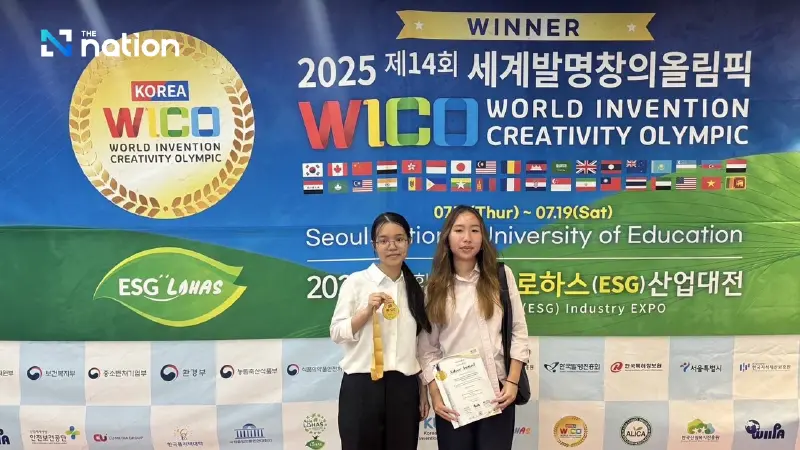


A group of young innovators from King’s College International School Bangkok has developed the Drip Drop Machine, a pioneering solution that enables street vendors and remote communities to recycle used cooking oil (UCO) while earning money in return.
- A group of students in Thailand has invented the "Drip Drop Machine" to collect and recycle used cooking oil from street vendors and communities.
- The machine provides a direct financial incentive by using smart sensors to assess the oil's quality and then dispensing payment or credits to the user, turning waste into income.
- The collected oil is channeled to recycling companies for the production of biofuel, specifically sustainable aviation fuel (SAF), creating a new supply chain for clean energy.
A group of young innovators from King’s College International School Bangkok has developed the Drip Drop Machine, a pioneering solution that enables street vendors and remote communities to recycle used cooking oil (UCO) while earning money in return.
The student-led project was spearheaded by Boonyada Sangmanee and Nichanun Subsompon, supported by team members Poramit Sangmanee and Nattheera Subsompon.
“The inspiration to introduce this innovation came from a club we set up with friends in February and March last year. At first, we didn’t have a clear goal, but everyone wanted to do something for the environment,” Boonyada explained.

Tackling oil waste with technology
Improper disposal of cooking oil remains a widespread problem in Thailand and many developing regions, where recycling services are often out of reach. The Drip Drop Machine directly addresses this issue by remotely collecting UCO, ensuring that it is safely repurposed instead of being discarded into waterways or soil.
“We often hear about singers and actors using private jets, which has sparked debate over their environmental impact. When we looked deeper into the issue, we discovered there are already regulations requiring a certain proportion of sustainable fuels to reduce these effects, which inspired us,” Boonyada explained.

Equipped with smart sensors, the machine can detect the volume of oil and test the ratio of oil to water to determine its quality.
Users simply pour their used oil into the device, which then calculates its value. If the oil meets recycling standards, the machine dispenses payment or credits linked to the user’s phone number. If not, it is drained into a separate tank for return.
“We wanted to make the recycling of used oil as easy and accessible as possible, so we decided to build it as a machine,” she said.
At present, users still need to register with their mobile number directly through the device. However, Boonyada added that an application is in the development plan to make the process even more convenient.

From waste to biofuel
Traditionally, oil recycling companies source their UCO from restaurants. By extending access to households, vendors, and rural communities, the Drip Drop Machine creates a new supply channel.
This not only benefits recycling firms but also contributes to the production of sustainable aviation fuel (SAF), a fast-growing sector as global regulations push for cleaner transportation fuels.
“From a social perspective, our machine can help generate extra income for users, raise environmental awareness and make oil recycling more accessible and convenient,” Nichanun said.
“From an environmental perspective, it increases the collection of used vegetable oil, reduces improper disposal and boosts biofuel production, making it cheaper and more widely available,” she added.

Innovation with impact
Beyond individual benefits, their vision includes deploying machines in schools to raise awareness and creating larger versions for distant communities.
“At present, the Drip Drop Machine is still our first prototype. We are about to trial it at our school, but our plan is to eventually install machines along streets with many roadside stalls, such as Banthat Thong Road, as well as in villages and communities further out to make them more convenient for users,” Boonyada said.
She noted that one of the main challenges has been measuring the oil accurately, as used oil often contains water or food residue. “To address this, we need to design a filtering system and find a way to measure moisture or water content so the value reflects the actual volume of oil,” she explained.
Future developments aim to integrate online banking and partnerships with oil recycling companies, ensuring that recycling can address environmental challenges and improve people’s quality of life in a sustainable manner.
“We believe collaborating with oil recycling companies will be mutually beneficial. We can help collect the oil, while the companies will be able to produce and sell more biofuel,” Nichanun said.
Looking further ahead, Boonyada added that credit points could be redeemed for rewards such as vouchers or local handicrafts, thereby supporting community products and culture.

Global recognition
The Drip Drop Machine has already gained international acclaim in 2025, winning a Gold Medal at the International Invention Innovation Competition (iCAN) in Canada, the Canadian Special Award by the Toronto International Society of Innovation & Advanced Skills (TISIAS), the Silver Award at the World Invention Creativity Olympic (WICO) in Seoul, and the Bronze Prize at the Korea International Youth Olympiad.
These accolades underscore not only the ingenuity of the team but also the potential of youth-led innovations to drive circular economy solutions and sustainable development.
