
Asia Celebrates Groundbreaking Solutions for Ageing Populations
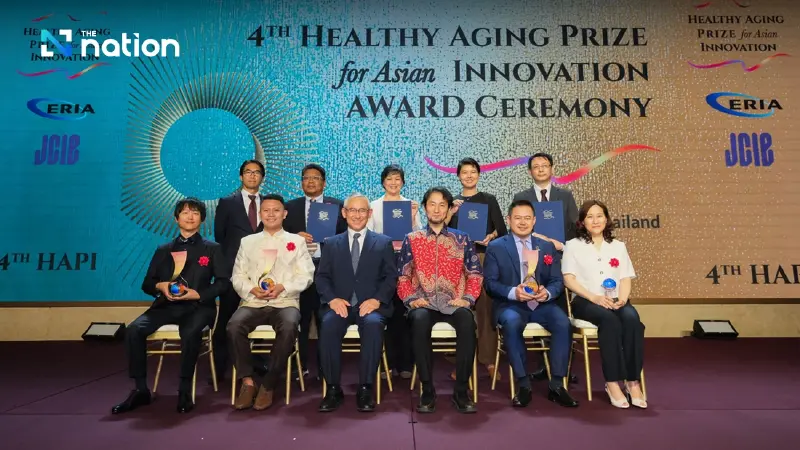


Ten pioneering projects honoured for groundbreaking solutions supporting older adults.
Ten innovative projects from across Asia have been recognised for their pioneering work in addressing the challenges of ageing societies.
The Healthy Ageing Prize for Asian Innovation (HAPI) Awards, presented on Friday (31st January), celebrated diverse approaches to supporting older adults, from digital inclusion to community-based care.
The HAPI Awards, a joint initiative of the Japan Center for International Exchange (JCIE) and the Economic Research Institute for ASEAN and East Asia (ERIA), highlight outstanding contributions to improving the healthy lives of older people.

The 4th HAPI winners hail from Japan, the Philippines, Thailand, South Korea, Singapore, and Malaysia, showcasing the region’s commitment to innovative ageing solutions.
Key Winners Showcase Diverse Strategies
Four projects stood out for their innovative approaches:
- Grand Prize for Technology & Innovation: Japan's Nurse & Craft won for "Home Nursing to Regenerate the Town," an initiative combining healthcare delivery with community revitalisation.
- Grand Prize for Community-Based Initiatives: Philippines' Padyarescue Inc. was recognised for the "Go Bike Project Ronda Kalusugan Programme," which empowers youth to provide community healthcare services.
- Grand Prize for Supporting Self-Reliance: Chiang Mai University's School of Lifelong Education won for "MEDEE Fostering Work Skills for Seniors in the Digital Era," addressing digital inclusion for older adults.
- Special Prize for Care Network Development: A South Korean team from Chung-Ang University, Summary A.I., and Jeongeup City Public Health Centre was awarded for creating an integrated care system to reach older people in depopulated areas.

The Second Prize winners further demonstrate the region's commitment to innovative aging solutions:
- Technology & Innovation: Lions Befrienders Service Association (Singapore) for their IM-OK Program
- Community-Based Initiatives: Thye Hua Kwan Moral Charities and the Agency for Integrated Care (Singapore) for their Micro-Jobs Program for Older People
- Supporting Self-Reliance: Graduate School of Medicine, Tokushima University and Beauty Life Corp. (Japan) for their Online Exercise Salon for Older People
Three organizations received Honorable Mentions for their contributions:
- Malaysian Research Institute on Ageing, MyAgeing™ (Malaysia) for their Digital Literacy Modules for Older Persons
- YoungHappy Plus Co., Ltd (Thailand) for their Online Community Platform for Urban Seniors
- Ageing Business and Care Development Centre, Thammasat Business School (Thailand) for their Ready Senior Project
Key Winners and Their Visions
Four winners have shared their gratitude and inspiring visions.

Hiroyuki Fukasawa, the Representative Director of Nurse & Craft (Japan) stated; "I want to create a society where my daughter can live happily when she is 100 years old. The project "Home Nursing to Regenerate the Town" aims to expand its model to help elderly people lead fulfilling, socially connected lives.”
Edren Llanillo, Executive Director of Padyarescue Inc. (Philippines), explained his Go Bike project's origin. He noted that he initiated the Go Bike project after losing his grandmother suddenly, and realized that the role of young people and their children is very significant in caring for elderly members of the family or community.

"Young people like me and our organization’s officers play a crucial role in harmonizing, monitoring, evaluating, and supporting all Go Bikers and Go Bike chapters in Pangasinan. It’s essential that we empower them by providing incentives, resources, and meaningful opportunities, especially as many are ageing and seeking livelihood options."
Associate Professor Nuttee Suree, Chiang Mai University (Thailand) reflected on their approach on MEDEE: "The challenge of an ageing society affects everyone, not just seniors. We must come together and collaborate to address this issue. Starting small is important, but understanding your target group is crucial."
He then encourages people who considering to address aging issue in their community to take action.

"As the Japanese proverb of Ikigai suggests, at the end of the day, you want to do what you love, what you're good at, what is needed in the world, and what you get paid for. This combination will create a sustainable sense of fulfilment that enables us to help the world together," he said.
Suhyeon Choi, Researcher at Institute for Community Care and Health Equity, Chung-Ang University, stated: "Our project aims to create a community-based platform that integrates healthcare and social welfare services. Ultimately, our goal is to create a seamless care system that allows healthcare professionals to access a patient's entire medical history."
A Collaborative Approach to Ageing
Speaking at the award ceremony, Isao Kano, President and CEO of JCIE, emphasised the importance of collaborative efforts in tackling the challenges of ageing populations.
"As you are all aware, we are facing significant challenges in the coming decades, including an ageing population and the need to sustain healthy economic development despite a shrinking workforce and growing healthcare costs," he said.
"To address these challenges, we have partnered with ERIA. Together, we are dedicated to promoting research, dialogue, and innovation in healthcare and ageing."

Asia-Pacific's Ageing Landscape
Lin Yang, Deputy Executive Secretary of the UN Economic and Social Commission for Asia and the Pacific (UNESCAP), highlighted the region's rapidly ageing population.
"The Asia-Pacific region is heading toward a demographic milestone that could reshape its social and economic landscape, with its elderly population projected to double to 1.3 billion by 2050," she said. "While this longevity should be celebrated, a significant portion of these extended years is being spent in poor health and with disability."
Yang stressed the urgency of promoting healthy ageing, particularly for women, and addressing the digital divide that often excludes older adults.
She also highlighted the economic potential of investing in elderly care, citing a World Economic Forum projection that a $1.3 trillion investment in social jobs, including care-related positions in the United States, could yield a $3.1 trillion return.
To address the challenges of ageing societies, the UN has launched the Decade of Healthy Ageing (2021-2030), aligned with the 2030 Agenda for Sustainable Development.
Regional Challenges and Opportunities
The Asia-Pacific region faces significant challenges, including a digital divide that particularly affects older adults. However, the HAPI Awards demonstrate the potential for creative, localised approaches to address these issues.
Kano stressed the importance of collaborative efforts in addressing ageing populations, noting the substantial economic potential of investing in elderly care.

Looking Forward
The awards aim to encourage knowledge sharing and highlight innovations that can be replicated across different cultural and economic contexts. As Keizo Takemi, a senior fellow at JCIE, noted, there is no one-size-fits-all solution to supporting healthy ageing.
The HAPI program serves as a platform for showcasing and disseminating innovative solutions to the challenges of ageing societies. By recognising and amplifying these initiatives, HAPI encourages knowledge sharing and collaboration across the region.
"The HAPI program's success stems from the strong partnership between JCIE and ERIA," concluded Kano. "ERIA's deep networks in ASEAN have been critical in promoting the award program, while their research expertise has helped build the intellectual foundation through longitudinal ageing studies, fostering dialogue and innovative solutions."
Through initiatives like HAPI, JCIE and ERIA are helping to ensure that Asia's ageing population can live longer, healthier, and more fulfilling lives.
For more detailed information, please visit at
1. Healthy Aging Prize for Asian Innovation: https://ahwin.org/award/
2. Japan Center for International Exchange JCIE): https://jcie.org/
3. Economic Research Institute for ASEAN and East Asia (ERIA): https://www.eria.org/
