
Neck pillow with AI helps prevent dangerous sleep disorders


Snoring is more than a nuisance – it can be an early warning of obstructive sleep apnoea (OSA), a serious condition linked to heart disease, hypertension, diabetes, stroke, and even sudden death.
Research by Thailand’s Department of Medical Services shows that 10–30% of Thais suffer from snoring at levels harmful to their health, particularly working-age adults and even teenagers who lack adequate rest.
Men over 30, people who are overweight, and those with a narrow airway structure are especially vulnerable to OSA. In severe cases, the condition can lead to acute heart failure during sleep.
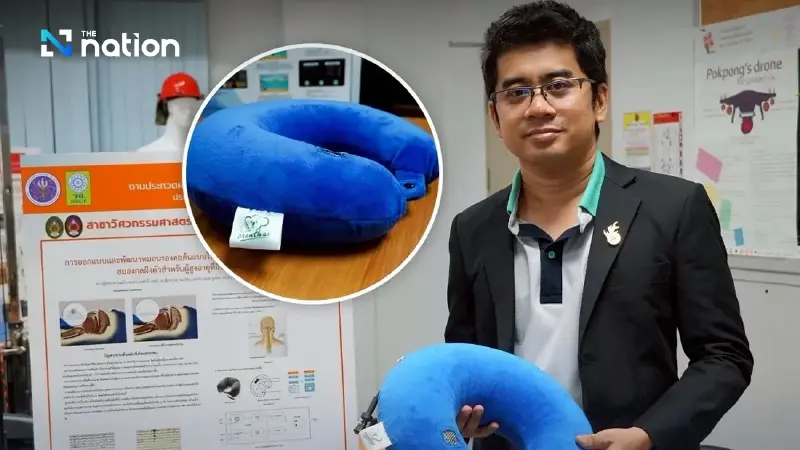
In response, Dr Patiyuth Pramkeaw of King Mongkut’s University of Technology Thonburi (KMUTT) and his research team have developed a prototype “smart pillow” designed to detect snoring and help prevent sleep apnoea.

Smart pillow prevents sleep apnoea
The device employs an embedded system capable of advanced sound processing, using frequency spectrum analysis (FFT), filtering, and machine learning to distinguish snoring from speech and background noise.
Equipped with sensitive microphones, the pillow analyses acoustic features such as fundamental frequency, amplitude, and waveform patterns in real time.
When it detects high-risk snoring, a small motor inside vibrates gently to prompt the user to shift sleeping position—interrupting the apnoea cycle without fully waking them. An app records sleep data, snoring frequency, and alerts for users and doctors to review.

Real-time snore detection and commercial potential
Patiyuth explained that the idea first emerged five years ago in an IoT classroom, when students asked how their knowledge could be applied to improve people’s lives. The initial version was a simple pillow with embedded snore sensors and a companion app.
The breakthrough came after a physician from Bang Khun Thian Geriatric Hospital suggested the technology could help patients during long journeys. This feedback transformed the concept into a wearable “smart neck pillow,” designed for use on aeroplanes, buses, and at home.

The innovation has since won awards from Thailand’s National Research Council and drew international attention at an exhibition in Geneva, where potential buyers offered up to 20,000 baht despite it being only a prototype. The research team now plans to bring the product to market with private-sector partners, aiming for a retail price of 2,000–3,000 baht to make it accessible.
Future development includes patent registration for hardware and software, expanded app features to track deep sleep and apnoea episodes, and integration into hospitals, eldercare centres, and hotels.
Patiyuth emphasised that the ultimate goal is not just technological success but delivering affordable tools that “truly change lives,” proving that impactful technology does not need to be expensive.
