
Blood tests do not require avoiding water, council says
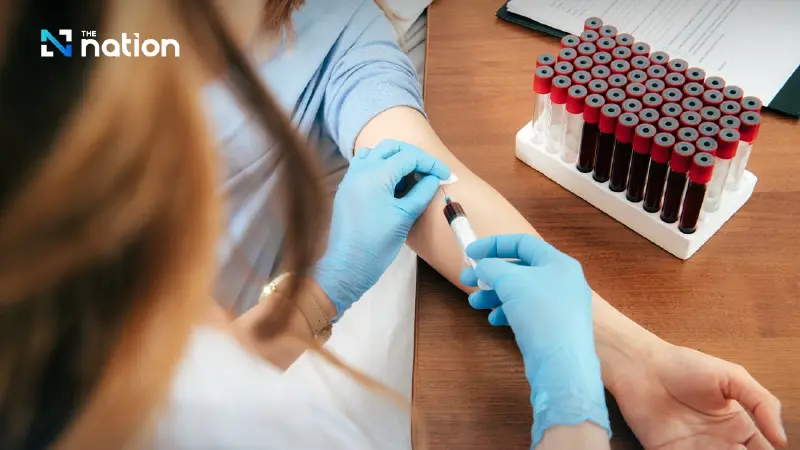


Thailand’s Medical Technology Council says patients fasting for blood tests may drink plain water normally to improve test accuracy
Thailand’s Medical Technology Council has clarified that people preparing for blood tests do not need to avoid plain water during the fasting period and may drink it as usual.
The announcement has drawn wide attention in the health sector, as many people have long understood pre-blood-test instructions as requiring them to avoid both food and water for at least eight to 12 hours.
The council’s latest guidance states clearly that people undergoing health checks “do not need to refrain from drinking plain water during fasting” and may drink it normally without a volume limit.
For years, many patients have followed the familiar instruction to “avoid water and food” before blood tests. However, recent scientific evidence suggests that avoiding plain water may do more harm than good.
One key concern is haemoconcentration, or thickened blood, caused by dehydration. This can make blood more viscous and may cause haemoglobin levels to appear 10–15% higher than they actually are. It may also push up creatinine and BUN readings, potentially leading to a mistaken impression of kidney disease.

Drinking enough water can also make blood collection easier. Good hydration helps prevent veins from collapsing, reducing pain and the chance of repeated needle insertions.
The council also noted that laboratory reference ranges are based on studies of people who were allowed to drink plain water normally. If a person becomes dehydrated from avoiding water, their test results may not be accurately comparable with standard reference values.
However, the guidance applies only to pure plain water. The water must be colourless and flavourless, contain no calories, have no added minerals or vitamins, and must not contain carbon dioxide, meaning soda water is not included.
Other drinks, including coffee, tea, fruit juice, soft drinks and vitamin-enhanced water, should still be strictly avoided as advised by doctors, as they can affect blood sugar and blood lipid results.
To bring practice in line with scientific evidence and international standards, including EFLM guidance, the Medical Technology Council has asked healthcare facilities nationwide to update their health-check instructions.
Instead of telling patients to “avoid food and water”, hospitals are advised to use clearer wording: “Avoid all food and drinks, except pure plain water, which may be consumed normally throughout the fasting period.”
The council said the change marks an important step in improving the preanalytical phase, the stage before laboratory analysis, to enhance patient safety and improve the accuracy of medical diagnosis.
