
Thailand considers Nicotine-Free Generation law to block new smokers
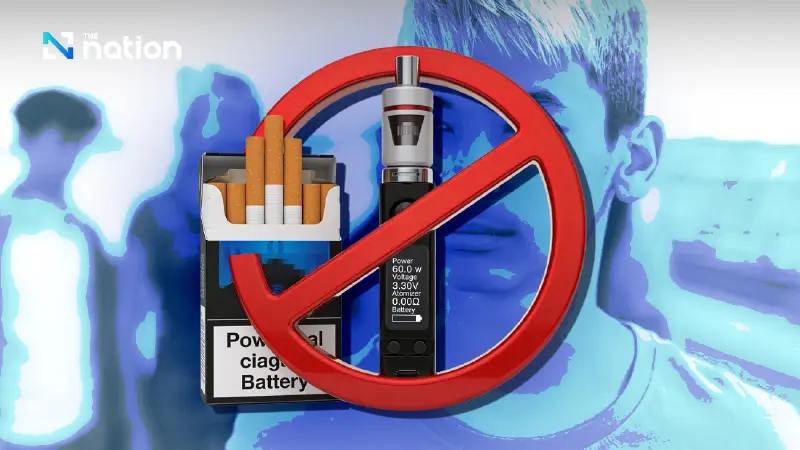


Thailand’s Public Health Ministry is studying a Nicotine-Free Generation policy that would stop children and young people born after a specified year, or within a defined age group when the law takes effect, from ever legally buying cigarettes, e-cigarettes or nicotine products.
Thailand studies generational nicotine ban
Thailand is considering a Nicotine-Free Generation law that would prevent children and young people born after a specified year, or within a specified age group when the law takes effect, from ever legally buying cigarettes, e-cigarettes or nicotine products, as the government seeks to cut off new smokers at the source.
Public Health Minister Pattana Promphat said on Thursday that the proposed policy was being studied as part of Thailand’s efforts to reduce the long-term health burden caused by smoking and nicotine addiction.
Speaking at the Ministry of Public Health on Thursday (May 28), Pattana said treating patients with smoking-related illnesses placed a heavy burden on the healthcare system, both financially and in terms of medical personnel.
He said many countries had begun adopting smoke-free or Nicotine-Free Generation policies, adding that the issue had been widely discussed internationally. Thailand, he said, was also considering the approach, but would review it carefully in all dimensions before moving forward.
Policy would target future buyers, not current smokers
Pattana stressed that the policy would not mean an immediate ban on cigarette sales or smoking.
Instead, the government could set a starting point based on age or year of birth. For example, children aged 10 or 12 when the law takes effect could become the first group permanently barred from buying cigarettes, e-cigarettes or nicotine products when they reach the current legal purchasing age.
Under Thailand’s current law, the legal age for purchasing cigarettes is 20. Pattana said a new law could specify that children in the designated age group when the law comes into force would still be unable to buy nicotine products once they turn 20.
“This measure aims to steadily reduce the number of new smokers in the future,” Pattana said. “It will not affect existing smokers, tobacco factories or current tobacco farmers.”
He said people who are already legally allowed to smoke would continue to be able to do so, but overall smoking rates would gradually decline as existing smokers grew older or quit, while new generations would be prevented from entering the market.
Ministry to study impact on farmers and industry
The Public Health Minister said the proposal would be considered carefully because it could affect many groups, including smokers, medical workers, public health budgets, tobacco farmers, tobacco factories and related businesses.
He said possible support measures for tobacco farmers and those in related agricultural supply chains could include compensation, help switching to alternative crops, educational support for their children and improved community infrastructure.
The policy is still at an early stage, with the ministry preparing to gather opinions from all sectors. Pattana said the Ministry of Public Health, the minister and the Medical Council of Thailand were open to public feedback, including concerns and recommendations from affected groups.
Asked whether the policy would be pushed through within the current government’s term, Pattana said the process had only just begun. He said speed was desirable, but careful consideration would be the priority because the issue affected many people.
Youth network urges Prime Minister to back law
The proposal has received support from the dental student network against tobacco, known as NoNoGang, and the Thai Dental Personnel for Tobacco and E-cigarette Control Project.
The groups held an awards ceremony for an art competition and launched an exhibition titled “A moment of pleasure, a lifetime of suffering! Are you sure?” to mark World No Tobacco Day 2026.
They also submitted a statement to the Prime Minister urging the government to introduce legislation moving Thailand towards a Nicotine-Free Generation society.
The proposal calls for people born after a specified year to be banned for life from legally buying all types of nicotine products, including cigarettes and e-cigarettes, in order to break the cycle of new smokers from the beginning.
Dental students warn over youth vaping
Paron Sinthaphanont, representative of NoNoGang, said the network comprised dental students from 18 institutions nationwide.
He said Thailand urgently needed to adopt a Nicotine-Free Generation policy as a new approach to tobacco control, especially as e-cigarettes and other nicotine products had spread among young people.
Under the proposal, the minimum legal purchasing age would effectively rise every year, preventing a defined generation from ever legally buying nicotine products.
Paron said the measure would help protect Thai children and young people from nicotine addiction and sustainably stop them from becoming new smokers.
Thailand looks at global examples
The proposal follows generational tobacco-control measures adopted or passed in other countries.
The Maldives implemented a generational tobacco ban in November 2025, prohibiting anyone born on or after January 1, 2007, from legally buying, selling or using tobacco products, according to the World Health Organization.
The United Kingdom’s Tobacco and Vapes Act 2026 also prohibits the sale of tobacco products to people born on or after January 1, 2009, according to the UK legislation database.
Paron said Thailand still lacked a specific generational law to control nicotine use among young people, warning that this had allowed e-cigarettes and other nicotine products to spread among children and teenagers.
He said the health impacts included respiratory disease, particularly lung disease, heart disease and exposure to second-hand smoke.
