
Bangkok OSCE conference highlights Asia-Europe cyber cooperation
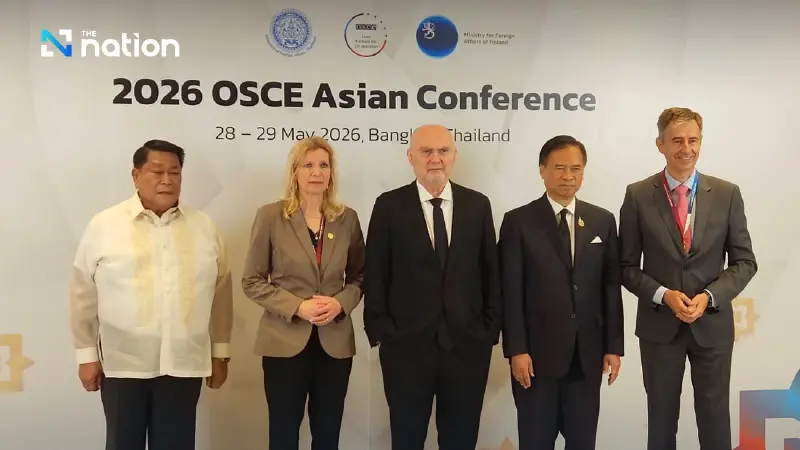


The 2026 OSCE Asian Conference in Bangkok focuses on cyber scams, digital threats and stronger Asia-Europe security cooperation.
The 2026 OSCE Asian Conference in Bangkok is highlighting the need for stronger cooperation between Asia and Europe in tackling online scams, cyber threats and other transnational challenges in the digital era.
The conference is being held at The Sukosol Hotel in Bangkok from Thursday to Friday (May 28-29), under the theme “Countering Transnational Threats in the Digital Era Through Enhanced Co-operation in Asia and the OSCE Region”.
Digital threats take centre stage
Vijavat Isarabhakdi, Vice Minister for Foreign Affairs, said the Organization for Security and Co-operation in Europe (OSCE) played an important role in building trust and confidence through preventive diplomacy, dialogue, and confidence- and security-building measures.
He noted that such work was particularly relevant at a time when the international situation remained highly volatile.
Vijavat said the theme of this year’s conference — countering transnational threats in the digital era — was chosen because the issue is both globally relevant and a national priority for Thailand.
Online scams and cybersecurity threats have become major concerns for Thailand, but the problem extends beyond the country and the wider region, he added, noting that European countries are also facing similar challenges.
“This conference is a good opportunity for us to focus on this issue,” he said.

Bangkok platform to raise OSCE awareness
Vijavat said hosting the conference in Bangkok would also help Thai people gain a better understanding of the OSCE and its work.
The conference sessions cover political and security issues, economic affairs, and social dimensions, bringing together experts from different fields to exchange views and experiences.
The discussions, he explained, would allow countries to compare the challenges they face, learn from those that have made progress in addressing them, and explore how successful approaches could be adapted into shared best practices.
Thailand sees role as ASEAN-OSCE bridge
Asked how Thailand, as an OSCE Asian Partner for Co-operation and an ASEAN member, could use the conference to strengthen cooperation in tackling cyber scams in the region, Vijavat said the OSCE and ASEAN shared similar approaches.
Both organisations seek to build security and confidence through consultation, dialogue and direct engagement, he noted.
He cited the ASEAN Regional Forum as an example of a platform where countries come together to discuss security issues openly. The OSCE operates in a similar way, allowing countries to speak frankly when crises or problems arise, he explained.
Vijavat added that Thailand was pleased to be the only ASEAN country that is an OSCE Asian Partner for Co-operation, and would continue working to bring the two organisations closer together.

OSCE calls for collective response to digital threats
OSCE Secretary General Feridun Sinirlioglu said the conference was taking place at a time of mounting pressure on the international security environment, with global supply chains facing continued disruption, mistrust growing among states, and transnational threats becoming increasingly complex.
Against that backdrop, he stressed that sustained and inclusive multilateral dialogue had become more important than ever.
“This is why we are here in Bangkok,” he said, adding that multilateral dialogue and cooperation were hallmarks of Thai diplomacy and also core principles of the OSCE.
Sinirlioglu said the theme of this year’s conference, “Countering Transnational Threats in the Digital Era”, captured one of the most urgent challenges facing the world today.
Digital transformation has brought regions closer together, he noted, but it has also expanded the reach and sophistication of those seeking to undermine collective security.
He thanked the Thai government for placing the issue on the OSCE agenda, saying participants would use the two-day conference to examine how countries could build a collective response.
“Technologies are evolving faster than the frameworks that govern them,” he said, warning that a widening gap had emerged between what technology can do and how it is managed.
That gap, he added, must be addressed through dialogue, which he described as the most important stabilising force in uncertain times.
The OSCE helps facilitate such dialogue, bridging Europe and Asia and turning discussions into practical cooperation, he said.
“Our security challenges are increasingly interconnected. Our response must be as well,” he said.

Finland backs stronger Asia-OSCE partnership
Outi Holopainen, Vice Minister for Foreign Affairs of Finland, said Finland placed high value on the OSCE Asian partnership, describing it as an important platform for sharing regional experiences and best practices.
She noted that this applied across all three dimensions of the OSCE: the politico-military dimension, the economic and environmental dimension, and the human dimension.
Holopainen said the security situations in the OSCE and Indo-Pacific regions had become increasingly intertwined, making cooperation a shared interest for promoting regional and international peace, stability and prosperity.
“Our regions are at the forefront of some of the most serious challenges facing the world today,” she said, adding that the OSCE Asian Conference provided an opportunity to address those issues over two days of discussions.
She also praised Thailand’s leadership on transnational threats, citing the international conference on the global partnership against online scams held in Bangkok in December 2025.
For Finland, she said, free and independent media, along with media and digital literacy, remained priority themes in the OSCE context.
These issues, she added, were essential to building a well-informed and resilient society, supporting accountability and strengthening communities.
Thailand marks 26 years as OSCE Asian partner
Vijavat said the OSCE is made up largely of countries from the West, including Europe and North America, as well as Central Asia, with 57 participating states in total.
Thailand has been an OSCE Asian Partner for Co-operation for 26 years, he added, noting that the partnership reflects Thailand’s desire to build friendships and strengthen cooperation with countries beyond its own region.
He said Thailand is one of five Asian Partners for Co-operation and the only ASEAN country with that status.
Vijavat added that this was the first time in seven years that the OSCE Asian Conference had been held outside Europe, saying Thailand was privileged to host the event in Bangkok.
