
Thailand Cuts Botulism Drug Cost by 90% in Major Medical Breakthrough
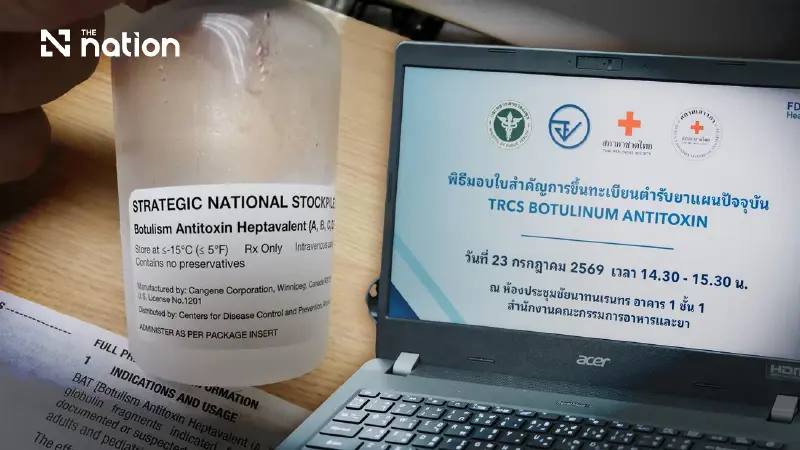


A non-profit Thai scientific coalition has developed a local botulism antitoxin, slashing treatment costs and positioning the nation as a regional hub
- A Thai scientific coalition has developed a local botulism antitoxin, ending the nation's complete reliance on costly foreign imports.
- The new domestic treatment slashes the cost by 90%, reducing the price per dose from approximately 250,000 baht to 25,000 baht.
- The medication, officially registered as TRCS BOTULINUM ANTITOXIN, will be integrated into Thailand's national universal healthcare scheme.
- This breakthrough positions Thailand as a public health hub, aiming to provide supply security for itself and neighboring Southeast Asian countries.
A non-profit Thai scientific coalition has developed a local botulism antitoxin, slashing treatment costs and positioning the nation as a regional hub.
Thai medical researchers have successfully developed a local botulism antitoxin, slashing the cost of life-saving treatment by 90 percent and establishing the country as a vital public health hub for Southeast Asia.
The Thai Food and Drug Administration (FDA) officially registered the treatment, named TRCS BOTULINUM ANTITOXIN, following a joint multi-agency development effort. The drug counteracts severe poisoning caused by botulinum toxin—a lethal nerve agent most commonly associated in the region with improperly preserved food, such as home-canned bamboo shoots.
Prior to this breakthrough, Thailand possessed no domestic supply of the antitoxin and relied entirely on costly foreign imports. The local formulation drops the price from roughly 250,000 baht per imported dose to approximately 25,000 baht, marking a tenfold cost reduction.
Speaking on Tuesday, deputy government spokesperson Ploytalay Laksamee-saengchan confirmed that the non-profit initiative aims to integrate the medication directly into the national universal healthcare scheme.

"This success reflects Thailand's capability to transform academic research into practical, life-saving solutions," Ploytalay said. "Although botulism is rare, it carries a severe mortality rate due to rapid muscle paralysis and respiratory failure. Having immediate access to an antitoxin is critical during acute medical emergencies or potential biosecurity threats."
The milestone was achieved through collaboration between the Thai Red Cross Society, the Queen Saovabha Memorial Institute, the Institute of Biological Products, the National Vaccine Institute, the Government Pharmaceutical Organization (GPO), and the National Health Security Office (NHSO).
By manufacturing the drug locally, health authorities aim to guarantee rapid, equitable access to emergency care for Thai citizens while extending public health support and supply security across neighboring ASEAN nations.
