
Mak’s Chee brings Hong Kong’s famous wonton noodles to Malaysia


Play
KUALA LUMPUR - Nowhere is the fight to be king of wonton noodle fiercer than in Hong Kong, the little island that devours one tonne of the noodle every hour.
Hong Kong is also where you will find the best wonton noodles in the world – they hold the golden standard to measure all other wonton noodles by.
And nowhere in the world – certainly not in France – would the meticulously scrupulous Michelin inspectors award a star to a dingy hole-in-the-wall noodle shop. But in Hong Kong.
This means the noodles there are butt-kicking good. So it is a really good thing that one of these fabled noodle makers had absconded from the island to set up shop in Kuala Lumpur.
“In Hong Kong, there are more noodle shops than 7-Eleven outlets – which occupy every street corner,” said Gary Crestejo, director of the recently opened Mak’s Chee Authentic Wonton in Petaling Jaya, Selangor.
Mak’s Chee is an off-shoot of Hong Kong’s famous Mak’s chain of noodle houses, one of which had garnered a Michelin star at one time.
“At the very top end of the trade, there are some 10 brands vying for the prestige market. And each of them has several outlets all over the island so we are talking about 100 very good wonton noodle shops in Hong Kong.
“When you factor in the other noodle shops that also sell wonton noodles, we are talking about thousands of wonton noodle purveyors in a city of 7.5 million people.
“So I am very happy to be here, and Johnny (the chef) is very happy to be here,” he said at the media launch of the restaurant in the 1 Utama Shopping Centre in Bandar Utama.
Crestejo had done the math: “Of the 30 million people in Malaysia, about 35 per cent are Chinese and in greater Kuala Lumpur (which has a population of over seven million), there are more than 40 per cent Chinese. So we are looking at a three million potential crowd, not including the other ethnic groups who also consume non-halal food, so we believe KL is quite a good market for wonton noodles.
“If you look at the figures, it does make sense for us to come here.”
Numbers just wash over my head like water off a duck’s back but Crestejo, I am also very happy that you are here. At that moment it hit me that I am part of the statistics he is targeting. Hummph.
Not happy to have my head complicated by numbers, I turned to the happy tangle of noodles in front of me. Thin, yellow and wiry, they looked unruly and resistant. Structure was hard-wired into their rubbery DNA.
I surveyed the plates and bowls of noodles with some apprehension – can my expensive new bridge of pearly whites handle this?
I contemplated twirling the noodles around the fork like for pasta but Johnny the chef was hovering not too far away with a huge pot of scalding hot water so I abandoned the silly idea.
Bamboo chopsticks wobbling a little as I dug in, the noodles snapped I imagined with a vibrating “thungggh” as I bit into them, the loose ends springing to life and slapping me in the face.
Ah, wonton meen that even the dentist would approve of! Noodles with integrity that are more than al dente. I was reminded of the critic who raved over the “springy thin noodles that look like they can go though the eye of a needle” when confronted by a bowl of Mak’s noodles.
Made with duck eggs, they had a musky savoury taste and none of the soapy flavour – due to the addition of alkaline – that you find in lesser egg noodles. The noodles were made at their central kitchen using multiple dough flattening techniques for the ultimate springiness.
Hong Kongers really like the elegance of a simple, classic noodle: a small bowl of noodles in a thin, clear soup covering four small prawn wontons (dumplings).
The wontons are strategically placed under the noodles so that the noodles are lifted and do not soak too much in the soup and the wontons remain warm.
This most iconic wonton meen is plain and allows you to focus on the quality and taste of the noodles and wontons – what eating wonton meen is ultimately all about.
As if on cue, Crestejo offered an explanation: “I can truly say that we make the most authentic wonton noodles. Johnny is the grandson-in-law of Mak Woon Chee, who started the family business almost 100 years ago.”
For over 400 years in China, wonton used to be made with a pork filling of 70 per cent lean meat and 30 per cent fat.
“Mak Woon Chee was the one who created prawn wontons. Since he made that prawn wonton, he became very famous. Back in the 1920s, (the rich) Chinese people were riding in their cars to go to his alleyway stall, Chee Kee, in Guangzhou to have this noodle. Even Chiang Kai Sek, founder of Taiwan, became a fan. As it was supposed to be a snack, the portion was kept small but very tasty.”
I should mention that many people have griped about the smallness of the serving portion vis-à-vis the price. I found it adequate. Most importantly, the portion was satisfying. Now it wouldn’t fly me to the moon, but I am happy. To have an authentic Hong Kong street food experience right here in Bandar Utama, is priceless.
Crestejo explained that there is a good reason for the size. “It would take too long to eat a bigger portion by which time the noodles soaking in the soup would be cold and soggy.”
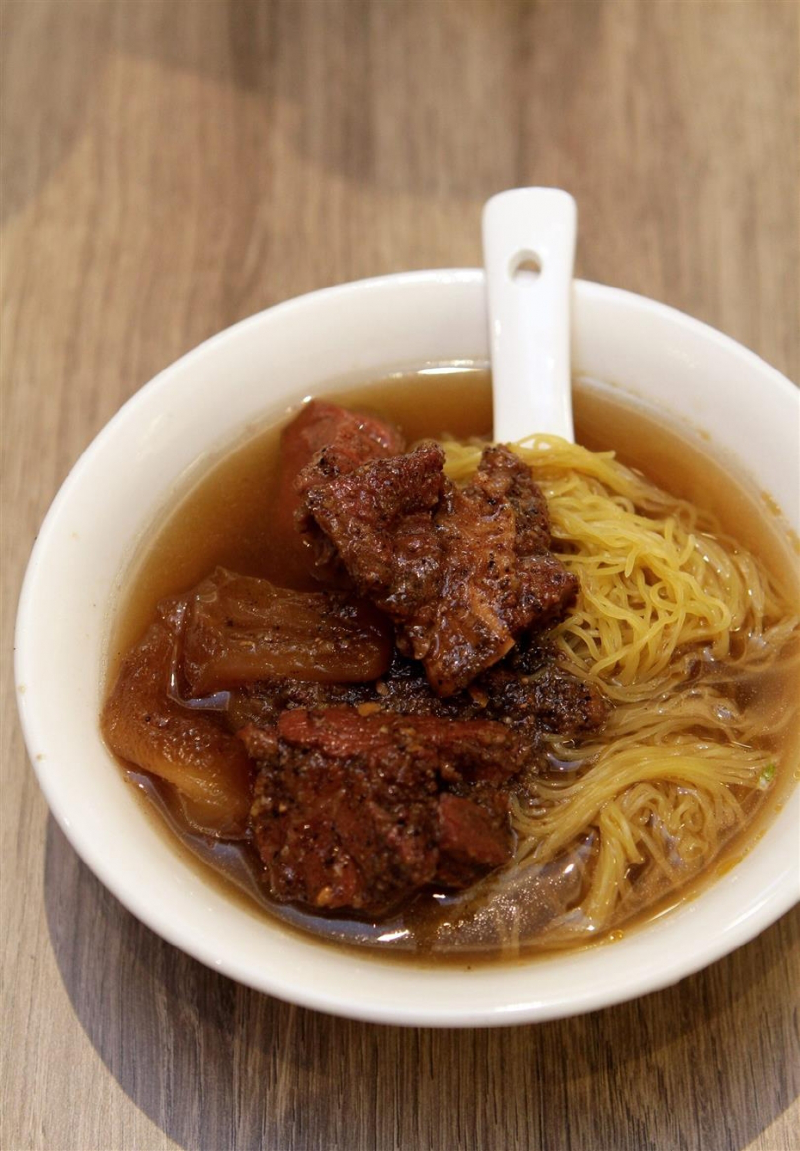
The menu at Mak’s Chee is also small; it is the simplest menu of all the Mak’s outlets. There’s a choice of noodles in sauce or noodles in soup and toppings like the signature “gold fish tail” shaped shrimp wonton, special herb blended dumplings (sui kau), braised beef brisket, sweet and sour pork, shrimp roe and side dish of kai lan.
“For Malaysia, we wanted to concentrate on making a mean noodle and decided to drop the porridge component,” said Crestejo.
“We believe with a good noodle, we don’t have to offer a lot of varieties on the menu. We removed many items because certain ingredients here are not up to our standard so we prefer not to make them.
“Anyway, we believe that people come to Mak’s mainly for the noodles.”
Crestejo is right, of course. It’s nice when a quick, casual diner keeps things simple. That means no stress when it comes to ordering. And it works because every-thing on the menu is good.
Keeping a small inventory also means the stock moves fast and gets refreshed constantly. “This keeps the prawns, noodles and broth fresh – a broth left sitting around too long changes colour and the taste will also be affected,” said Crestejo.
Before opening Mak’s Chee the company spent a year doing R&D, while waiting for the right space to become available, as “everything is different” in Malaysia, from the taste of the soy sauce, flour, egg and prawn, down to even the salt, pepper and water.
“It takes a lot of skill and experience to replicate the same noodle dish with everything being different,” said Crestejo who tried to find local alternatives to keep prices down.
Key ingredients like dried flounder fish which is used for flavouring, and dried prawn roe have to be imported from Hong Kong, as local dried flounder, for instance, are small and do not have that natural sea salt taste.
One happy exception is Malaysian prawn which they find to be better than what they get in Hong Kong.
“Because of the quality of the prawns here, we can even say that the prawn wontons at Mak’s Chee are even better than those in Hong Kong,” said Crestejo.
In Hong Kong, a bowl of noodles usually go for about HK$30 to HK$40 (US$7.40 - US$9.80).
“In Malaysia, you’re paying 12.90 ringgit (US$3.20) for the same bowl of noodles. It’s the cheapest Mak’s noodle in the whole world!” said Crestejo, who revealed plans to expand in Malaysia.
“We’re not thinking about other countries yet. I think it will be a busy enough job to expand in Malaysia.”
