
The machine that Max Busser built


He fled the industrialisation of the watch industry to make art - and no copying, either
Maximilian Busser has come up with a wristwatch called Legacy Machine No 1 that he claims is his autobiography.
Designing watches for other people “was my previous life”, says the owner and chief creative officer of MB&F Horological Lab. That was back when he was chief executive at Harry Winston, a post he held for seven years. “I never in my life expected to be a CEO of anything!”
The watch firm was struggling, but Busser saw it through and learned two things: that he has the capability and that “the bigger the company, the less I enjoy myself”.
Busser realised that watchmakers mastered everything they needed to know between the 1780s and the 1870s. “They had passion, guts and vision. They had no electricity. They did everything by hands. I adore human genius.
“But it’s become such a big industrialised business. It’s lost its soul. Watchmaking isn’t about that, I felt. It’s about creating for your own heart, innovating, experimenting – not about pleasing other people. Watchmaking is an art, and art is selfish. Artists create for themselves.
“So you have to ask is this art or is it just consumer goods?”
Like the new watch he’s just unveiled, MB&F – his initials and “F” for “friends” – is about legacy.
Jarred by the death of his father, Busser saw that he was living someone else’s life and was in danger, when his own end came, of having nothing to be proud of.
“When we look back we have to either be proud of what we did or simply let it go and pass away happily.”
Busser points out that the development of quartz watch components in the 1970s ended the need for mechanical movements, and yet they remain in use “because they’re works of art”.
At the same time, though, he deplores the industry’s insistence on repeatedly copying these works of art – they have to have dials, rounds and hands. “If you go to a watch store today, you’ve got 500 watches that all look the same, and the same as they were in the 1910s!”
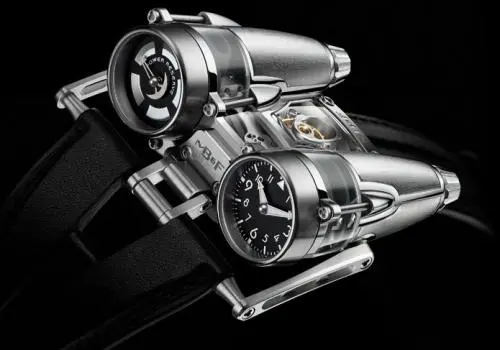
MB&F’s first model was Horological Machine No 1, a blending of the old and new worlds. No 2 – all black except for a clearly visible electric-green rubber gasket – was inspired by the science fiction that Busser enjoyed in his youth. “This timepiece is the space station,” he says. “Each dome has lives.”
HM3 Frog brought out more of the child’s sense of awe and playfulness, incorporating the amphibian’s protruding, all-seeing eyes. Horological Machine No 4 Thunderbolt was inspired by aviation.
Legacy Machine No 1 came from another of Busser’s fantasies. “What if I’d been born in 1867 instead of 1967?” he wondered. “I would want to create three-dimensional machines for the wrist. For my inspiration I had no Star Wars, but I had the Eiffel Tower and Jules Verne!”
>>>
Legacy Machine No 1 has an oscillating, large-diameter balance with a traditional Breguet overcoil suspended from majestic twin arches. The regulating mechanism is in full view, but enigmatically appears to have no connection to the movement.
Looking like a miniature sextant, the world-first vertical power-reserve indicator offers a three-dimensional counterpoint to the graceful arches.
Gazing through the bubble sapphire dome at the micro-mechanical works inside, it’s easy to imagine Jules Verne’s Captain Nemo looking upon the underwater city of Atlantis.
>>>
