
A one-eyed turtle with lots of eyes


Play
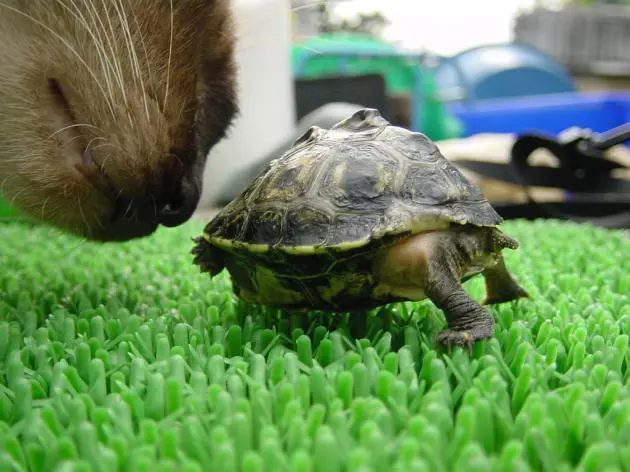
Quite recovered from last week's encounter with an accident-prone cat, the Burmese eyed turtle relaxes in the sun
Remember last week when I wrote about Thong, one unlucky cat, falling into a turtle tub? This tub is home to my Burmese eyed turtle, and long-time readers already met her a few years ago in a photo with Angel, my one-eyed cat.
In the photo, Angel is patting the baby, but now that the turtle is older, she’s big enough to protect herself from playful cats.
Call this turtle by her Latin name “Morenia ocellata”, but she’s also known, apart from “Burmese eyed turtle”, as the “Burmese peacock turtle”.
With those round markings on her back (as you can see in today’s photo), you can understand why people think of eyes or peacocks when they see members of her species.
As her names suggest, she isn’t Thai but Burmese, found in southern Burma. My little turtle must have been smuggled into Thailand and then sold to a pet shop. The owner gave her to me because she, like Angel, is missing an eye.
Turtle experts tell me that almost no Asian turtle comes out of the water to bask and dry out in the sun the way turtles from other parts of the world do. They should come to my house and see how this little turtle pulls herself out of the water and rests on her basking rock from time to time, usually in the first few days when the weather changes.
For such a small turtle (only around 10 cms long), she lives in the largest of the turtle tubs. If I put her in anything smaller, she stops eating, uncomfortable in the restricted space.
Give her the freedom of a big tub!
This species loves water, living in floodplains and slow-moving small rivers. My turtle loves sitting near the water filter I’ve installed to keep her water fresh. This filter collects uneaten food, and she seems to find it relaxing to sit near where the bubbles blow out and simply reach out for a snack.
She’s very shy, though. I've given her a little “house”, where she stays most of the time when she’s not near the water filter or hiding under her food.
When she was young, she would eat a combination of vegetables and shrimp, but a few years later, she turned completely vegetarian with one or two red worms added for seasoning.
In the wild, her species is endangered. According to the IUCN Red List Status (1996), Burmese eyed turtles are “near threatened”, but with so many other turtle species under greater threat, not much is being done to protect this charming turtle.
