
Under the Ramayana's spell


Play
Dance troupes from across Asia put on a magnificent show for the King's birthday
The five-day International Ramayana Festival, ending today at the National Theatre, was packed with viewers, most taking advantage of the free tickets available by e-mail from the Culture Ministry. Those who missed that chance began their evening with a two-hour queue.
The festival, celebrating His Majesty the King’s birthday, featured dance troupes from India and six Southeast Asian countries, each presenting episodes of the classical Hindu tale in their traditional style.
All seven performed briefly at Monday’s opening ceremony and then on Tuesday and Wednesday took turns onstage for 30 to 45 minutes each.
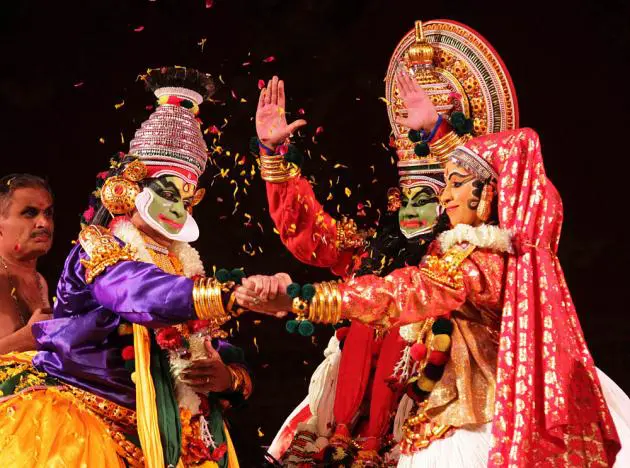
India’s ambassador joined MR Chakarot Chitrabongs onstage for the opening invocation before the Indian troupe Kalamandalam Raman Kutty Kathakali gave a mesmerising demonstration of kathakali dance in its presentation of “The Bow Contest and the Marriage of Sita and Rama”, accompanied by pulsating live music.
This was followed by a delightful rendition of “Catching the Golden Deer” by a troupe from Burma’s Culture Ministry. Viewers couldn’t stop smiling at the deer’s blinking gilded eyelashes.
The Philippines’ Ramon Obusan Folkloric Group offered another interpretation of the same episode, along with “The Slaying of Jatayu”. It was stylistically intriguing and a fine blend of ethnic dances from around the country.
Tuesday evening ended with our own Royal Dance Troupe doing “The Battle Scene”, which inevitably drew loud applause. Elegant and beautiful, it left you wondering how many more times in your life you’d get to enjoy this episode, especially on such a grand occasion.
Wednesday’s programme, shortened by the Lao troupe’s withdrawal, began with the charming “Dashavatar” episode by Singapore’s Bhaskar’s Arts Academy, the only kathakali institution outside India. An English narration detailed Lord Vishnu’s 10 incarnations. Some of the younger performers, though, were well short of mastering the form.
Indonesia’s Sekar Budaya Nusantara Troupe gave a memorable performance of “The Final Battle” and “Sita’s Ordeal”, and Cambodia’s Culture Ministry dancers presented “Ream Leak Chup Leak”, an episode rarely seen here.
The evening would have been more captivating had Thailand been on the same programme so that we could have compared the very similar gestures more closely.
Tuesday and Wednesday evenings were packed to capacity, mostly with people who frequent khon shows at the National Theatre. For their benefit, it would have been more enjoyable had the various troupes’ directors given a brief introductory talk about their respective styles. The programme booklet contained only synopses and quick overviews of the troupes.
Language was also an issue in terms of dialogue and lyrics. English or Thai translations, or both, could have been projected onstage, facilitating comparisons with Thailand’s “Ramakien”. As well, the visiting troupes could perhaps have been persuaded to hold daytime workshops and discussions.
Regardless, the festival was a great success, a perfect fit for this auspicious occasion. We just need to think of sustaining experiences like this, in terms of audience and artist development. Otherwise it’s all gone with the winter wind.
LAST CHANGE
The festival ends today with a royal-command performance featuring all seven troupes. Her Royal Highness Crown Princess Maha Chakri Sirindhorn will join the Ban Plainern Thai Classical Ensemble onstage, playing the ranad ek.
The finale at 8pm is by invitation only and already fully booked, but you can watch the dress rehearsal at 1pm for free if you get to the National Theatre by 11am.
Avoid the traffic by taking the Chao Phraya Express Boat to the Phra Athit pier. It’s a 10-minute walk from there.
Learn more at www.M-Culture.go.th.
