
No one closer than a stranger


In Tokyo, a deeply reassuring display of trust and caring
Takuya Murakawa’s play “Zeitgeber” was one of many works in the recent Festival/Tokyo that grappled with Japan’s triple disasters of last spring.
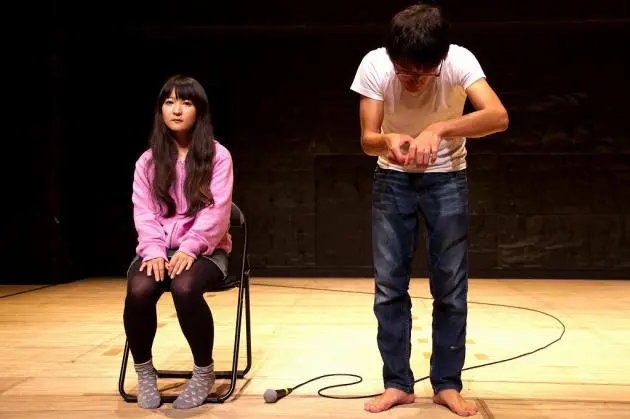
“I don’t know what theatre can or cannot do yet, so I prefer simply ways,” Murakawa wrote in the programme. And, indeed, the stage was bare except for two folding chairs, a microphone and a small stereo set.
“I heard that the children who were the victims of the Great East Japan Earthquake are playing a game of makebelieve about the earthquake,” the author continued. “Some child shouts, ‘Earthquake!’ and then they go under the desk. Another shouts, ‘Tsunami is coming – run!’ and they all climb up on the chairs and desks.”
Murakawa noted that psychologists would say the children are finding their own way to “overcome” the damage from the disaster, but he found their actions more reassuring than overcoming. “And in a play,” he wrote, “the actors and audience probably experience something reassuring.”
Insistent on interactivity with the audience, Murakawa introduced himself from the stage and then asked for a volunteer to join actor Shuzo Kudo. Interestingly, the audience member who volunteered at the show I attended was not Japanese and couldn’t speak the language.
Her Japanese friend had explained to her that the director wanted no limb movement and had declared that, once she had announced her wish three times, the performance would end.
It all went quite smoothly. The volunteer remained paralysed, seated on the chair, completely dependent on Kudo to move her around. The stage became a house in our imagination as he pantomimed cleaning her up and so on.
Her wish was to see a shooting star, but she only proclaimed it twice before Murakawa decided to end the performance, after a little more than an hour.
It was truly intriguing to witness such a relationship onstage, unscripted and unpredictable – we had no idea how or when it would end. Kudo’s repetitive actions were not boring, instead reminding me of people sacrificing their lives to take care of a loved one.
This perception was driven home when Kudo casually took a cigarette from Murakawa, who standing downstage right, and had a smoke while the volunteer remained sitting upstage left.
Kudo’s sincerity in his display of selfless dedication turned a total stranger into someone he truly loved and cared about. The result was further proof that life’s very ordinariness can be astounding onstage – and that human relations form the core of every drama.
I returned to Bangkok, still without a home – I was a victim of the Great Thailand Deluge. I have experienced in times of trouble more care from strangers than I ever thought possible. Yes, these days we can make instant friends on Facebook, but you don’t need a digital social network to encounter a stranger willing to lend a hand.
I’d never heard of Takuya Murakawa before this trip to Tokyo, but after seeing “Zeitgeber”, I check www.MurakawaTakuya.com often to see what he’s up to. I note that he “hopes to widen his activities to areas outside the performing arts”.
The writer was one of the 10 criticsinresidence at Festival/Tokyo.
