
Antoni Tapies, the artist of matter, dies at 88
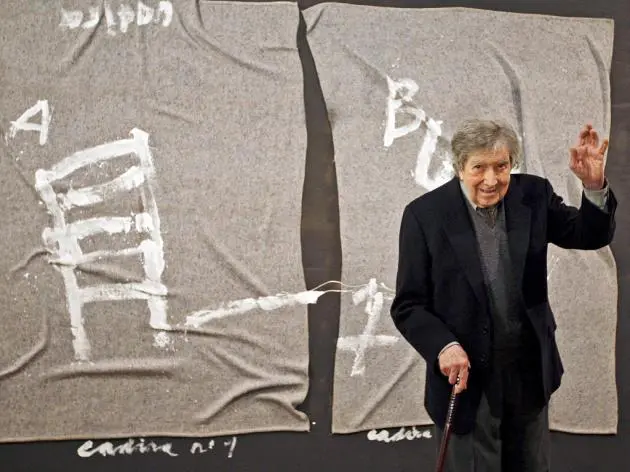


"Perfection cannot come simply from noble ideas, but should go together with a relationship to the earth," Antoni Tapies said in 2009.
The internationally renowned Spanish painter and sculptor, who died in his Barcelona home at the age of 88 years late Monday, was Tuesday being remembered as a man who sought to find a meeting point between spirit and matter.
In Tapies, Spain has lost one of its most important avant-garde artists of the 20th century, who also included the likes of Pablo Picasso, Joan Miro and Salvador Dali.
“Tapies created a language of his own, which allowed us to see reality in a different way,” said Manuel Borja-Villel, director of Madrid's Reina Sofia museum of modern art, which houses several of the artist's works.
Tapies was born into a bourgeois family in Barcelona, capital of the north-eastern Spanish region of Catalonia. He started studying law, but broke off his studies after a few years in order to dedicate himself to art.
In the 1940s, Tapies helped to launch the Dau al Set, a Spanish avant-garde art movement linked to Surrealism and Dadaism. In 1950, he travelled to Paris on a scholarship, where he met Picasso.
In the 1960s and early 70s, Tapies became politically engaged against Spain's dictator Francisco Franco, expressing his protest through his works, and running into occasional trouble with the authorities.
Influenced by Surrealism, the European Arte Povera movement and US Post-Minimalism, Tapies ended up developing a unique style often classified within the school of Informalism.
He incorporated non-traditional materials into his paintings, ranging from clay and dust to rags, waste paper and furniture parts.
Even the humblest objects – ranging from a shoe to armpit hair – could acquire something of the sublime, believed Tapies, who took a great interest in Oriental religion and philosophy.
In the early 1990s, the Catalan National Museum rejected a huge sock which Tapies had designed to decorate it, partly for fear of ridicule. But a smaller sock is now on display at a foundation bearing the artist's name in Barcelona.
Tapies made “shockingly physical” materials take on a “spiritual dimension the roots of which were connected with what is most intimate and ancestral in the human soul,” the daily El Pais wrote.
Tapies' international reputation became established from the 1950s onwards. His works have now been displayed at the world's top museums, ranging from London's Tate Gallery to the Centre Pompidou in Paris and the Museum of Modern Art in New York.
The artist – who also wrote several books on art – won a long string of Spanish and international awards, and was even given a title.
But he remained focused on his art, working indefatigably almost until the day he died, supported by his wife of nearly 60 years.
“His work is an open door to the luminosity of darkness, of what cannot be seen, of what cannot be named,” former Reina Sofia director Jose Guirao wrote in the daily El Mundo.
In 2004, Tapies spoke about his interest in “deeper, more serious colours” partly because he wanted to “feel close to the earth.”
“I have always wanted to get closer to the formations of the universe. Deep down, we are made of earth... and we go back to her.”
