
Step way up to the X100


Play
The top-of-the-line FinePix camera from Fujifilm requires some expertise, but the pictures are amazingly detailed
The Fujifilm FinePix X100 is a range-finder-style compact digital camera with stunning image quality, designed for more advanced users who know how to adjust shooting parameters manually.
The retro-look X100 features a fixed f/2.0 lens, 12-megapixel APS-C sized EXR CMOS imaging sensor and an EXR dual core processor, resulting in an impressive performance in capturing photos and reducing noise.
Best of all, the X100 offers the Hybrid Viewfinder system. Its viewfinder can be easily switched with a lever in front of the camera to be Optical Viewfinder (OVF) or Electronic Viewfinder (EVF).
The OVF makes the X100 famous among enthusiastic photographers. It offers stunning image clarity and rich information display. It displays the image larger than what the camera will capture with a shooting-range frame of what you will capture. The screen also displays other useful information, including exposure compensation, depth of field and a distance index.
And the X100 is a camera that’s better to shoot with its EVF rather than its LCD screen. When using the EVF you will enjoy 100-per-cent coverage on a sharp image display delivered by a 0.47-inch high-definition LCD with 1,440,000 dots of resolution. It also offers various shooting information, like what you will see in the OVF.
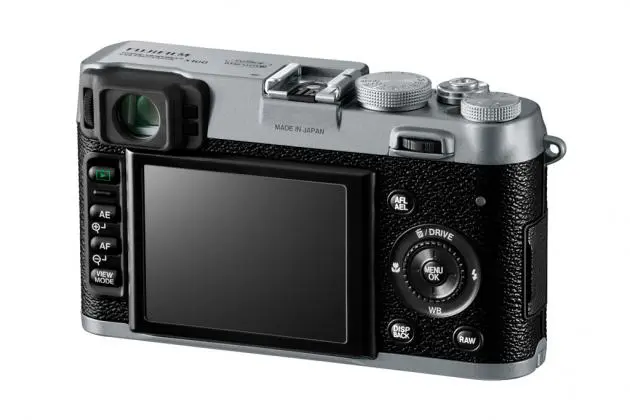
Of course, you can also use its 2.8-inch with approximately. 460,000 dots, TFT colour LCD to frame your shots. The X100 also provides an eye sensor that conveniently switches to a viewfinder mode when you raise your eye to the viewfinder.
Unlike other compact digital cameras, the X100 lacks full automatic and scene modes. The Program mode is the only auto mode available.
It does not have even a mode dial. Instead, it provides a dial for adjusting shutter speed and an aperture ring at the base of its fixed lens. The shutter speed dial and aperture control ring feature full manual control and A (automatic mode).
When you set both the aperture control and shutter speed dial to A, the X100 will be in the Program auto mode.
If you know the basic rule of exposure, you can manually select the settings for both aperture and shutter speed. One of the rules that’s well known among photographers is called the Sunny 16 rule or the Sunny f/16 rule: “On a sunny day, set the aperture to f/16 and shutter speed to the [reciprocal of the] ISO film speed [or ISO setting] for a subject in direct sunlight.”
For example, if you use the ISO 100 sensitivity when shooting on a sunny day, you must set the X100 aperture to f/16 and the shutter speed to 1/100 or 1/125.
Since the X100’s shutter speed and aperture can be changed conveniently, the X100 is perfect for amateurs to use to learn and practise shooting.
If you don’t feel confident enough, set either the shutter speed or aperture to “A” and the camera will do the rest.
If you set the aperture to automatic and adjust the shutter speed on your own, the X100 will show that you’re using shutter-priority. And if you set the shutter speed to automatic and the aperture value on your own, the X100 will be in the aperture-priority mode.
Although the X100 lacks face detection and portrait mode, it does capture beautiful portraits. The 35mm lens (in 35mm photography equivalence) with f/2.0 maximum aperture, plus the EXR CMOS imaging, contribute in capturing professional-looking portraits with fine detail – even indoors.
The image quality of outdoor shots is also outstanding – impressively sharp with good exposure and the colours well saturated.
The APS-C is the size of a large CMOS sensor used in a digital SLR camera, so the X100 manages to capture very fine detail. Fuijfilm says the APS-C imaging sensor is 10 times more sensitive than the standard FinePix sensor.
And the X100’s performance is further enhanced by a dual-core EXR processor, allowing the camera to use EXR sensor mode (High Resolution, High Dynamic Range and High Sensitivity & Low Noise). The fast processing engine lets the X100 go up to 5fps at the full 12-megapixel resolution.
The camera takes just over two seconds to start up and be ready for the first shot. I felt no shutter lag – Fujifilm says it’s less than 1/100 of a second.
My only gripe is that the auto-focus system rarely locked onto my subject at close range in my tests. I could use the manual focus to adjust it, however.
Although there is no separate button or dial for video, the X100 can shoot 720p HD video. You need to press the Drive option on the multi-selector wheel to move to video.
There are also three useful bracketing options under the Drive selector – for Film Simulation, ISO, Exposure and Dynamic Range.
The Fujifilm FinePix X100 retails for Bt32,500.
Key specs
_ Effective pixels: 12.3 million pixels
_ Image sensor: 23.6x15.8mm (APS-C) CMOS with primary-colour filter
_ Lens: Fujinon 23mm, equivalent to 35mm on a 35mm camera, F2
_ Sensitivity: ISO 200 – 12800
_ Shutter speed: 30 to 1/4000 sec. and bulb (maximum 60 minutes)
_ LCD monitor: 2.8-inch, 460,000dots, TFT colour LCD monitor (100 per cent coverage)
_ Movie recording: 1280x720 pixels (24frames/sec.) with stereo sound
_ Digital interface: USB 2.0 High-Speed
_ HD output: HDMI Mini connector
_ Power supply: NP-95 Li-ion battery
_ Dimensions: 126.5x74.4x53.9mm
_ Weight: 445g including battery and memory card
