
BEANS + FLOUR + SUGAR = MAGIC


Play
The Emporium samples the beautiful Japanese desserts called 'wagashi'
Foreigners have made a whole meal of Japan’s traditional arts – the arranged flowers of ikebana, the folded paper of origami, the “gentle persuasion” of judo. Now it’s time for dessert.
The Japanese have been making wagashi for a millennium, using little more than red beans, sugar and flour but then, as always, crafting them in delicate shapes to enliven the visual appeal.
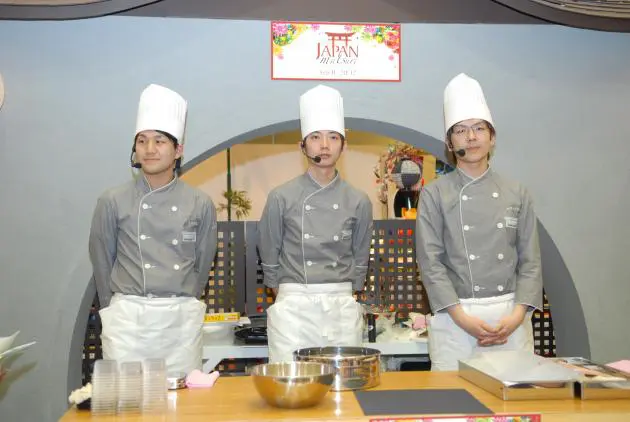
Bangkok gourmets last week watched three young chefs from the Far East show how wagashi is made as part of the Emporium’s Japan Matsuri Festival, which was organised by the Japanese Embassy and Japan Foundation and continues through Sunday.
Looking more like skilled artisans than cooks, Noriyuki Myojin, Keisuke Yoshihashi and Naoya Koizumi meticulously crafted the colourful sweets, which in their homeland vary according to locale and season.
The art form became popular during the Edo Period (1603-1867), especially in Kyoto and Tokyo, where confection shops competed to make the best and sell the most. Today wagashi is the national dessert, served at weddings and tea ceremonies.
Yukimochi is “snow mochi”. Sakuramochi dango is colourful meatballs with different sauces. Monaka is wafers with a filling of red beans, both whole and ground, or peanuts or the petals of cherry blossoms. The unbaked dough of jyo-namagashi is formed into the shape of flowers and fruit.
Noriyuki Myojin specialises in this last sweet because he comes from Mitsuya-Honpo, a district of Hiroshima that’s famed for the beauty and flavour of its jyo-namagashi. Myojin is gifted enough at creating them (he learned from his father) that he won an award last year in a technique competition.
“The original recipes remain unchanged, but the finishing techniques have continued to develop,” he said.
No oil is used to make the dessert, a boon to health, he added, “and, as we all know,
beans are rich in protein”.
Keisuke Yoshihashi runs one of the best-known confectioneries in Kanazawa in Ishikawa Prefecture. He finds the sheer variety of wagashi that can be made from a few ingredients endlessly fascinating.
“I may be a modern person, but I love keeping tradition alive,” he said. “I don’t think it’s necessary to change old into new, but it helps spread the tradition among the younger generation.”
It’s worth noting that all three of the visiting Japanese wagashi experts are only 29.
“This is my first time holding a wagashi workshop outside Japan,” Yoshihashi said, “so it’s kind of making our tradition known internationally.”
Naoya Koizumi is set to inherit a century-old family business, the dessert house Koundo Honten in Ashikaga in Tochigi Prefecture. It’s famous for the sandwich-like koin monaka that have been made there since 1945 – smooth red-bean paste between sweet rice crackers.
Koizumi could only laugh when asked if he ever, even for a moment here and there, gets bored with sweets. His favourite kind is dorayaki, so he has the same taste as Doraemon the cartoon cat.
You have about three days left to see if Koizumi and Doraemon are right about the dorayaki. Try it – and all the other most popular wagashi – over some fine Japanese tea at the Emporium’s Matsuri Festival this weekend.
