
How China won the Opium War


History records the British as the victors, but history isn't finished with the British yet, and has only just returned its gaze to China
The Opium War: Drugs, Dreams and the Making of China
By Julia Lovell
Published by Picador, 2011
Available at Asia Books, Bt556
Reviewed by Paul Dorsey
“A single shelf of a good European library,” British secretary of war Thomas Macaulay declared in 1838, “is worth the whole native literature of India and Arabia.” As drums sounded for forcing the Chinese to let England profit from the opium trade there, he wouldn’t deign to deride Chinese scholarship as well.
This is the moral class that, to defend England’s “dignity”, dragged it to war against China two years later. China’s “offence” was demanding, as per Confucian custom, that foreigners at least pretend it was superior in all things.
The two opium wars, Julia Lovell’s book makes appallingly clear, were anything but a set of quaint skirmishes over trade, as vaguely recalled in the Western popular imagination. They’ve continued to have a debilitating run-on effect to this day.
Lovell lifts the sorry adventure from antiquity to the modern perspective. She’s read newly available Chinese literature about the twin confrontations of 1839 and 1856 – and the diatribes of still-incensed Chinese on the Web – and concludes that this drama has yet to run its course.
Her remarkable book offers a lesson in how history never ends, how repercussions continue to be felt from “forgotten” events of yesteryear.
In 1839 Britain had more pressing concerns elsewhere (including in Syria and Afghanistan), but shied off rather than fighting the French or Russians. Instead, it opted for an easily winnable conflict with China, whose refusal to swap its tea for anything but money had left England with a crippling trade imbalance.
England solved that problem by giving the eager Chinese citizenry some of its opium from India, but the Manchu Qing rulers did their best to stymie the import, isolating foreign merchants outside city walls of Canton.
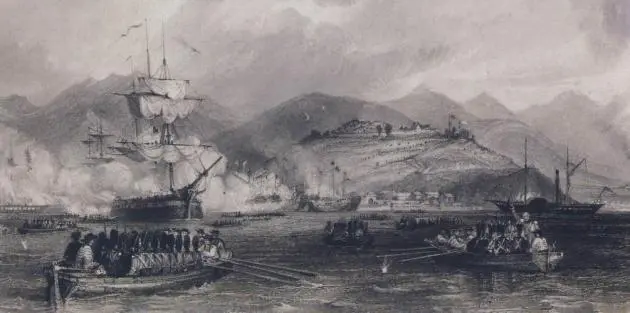
Britain wanted opium ports up and down the Chinese coast and its gunboats made quick work of opening them. Resistance was pathetic. China’s awkwardness, superstition and sheer incompetence was paid for with the blood of thousands of soldiers and civilians.
The Chinese have never forgotten. Today the Opium Wars are almost their Holocaust, evoking cries of “Never again!” They learn in school that their country was throttled in the Opium Wars because its leaders were corrupt and its citizens backward, lazy and all too happy to drift off into a drugged haze. The wars were the beginning of China’s “century of humiliation”, which continued under Japanese heels.
This is the ritual gong that China’s modern leaders have rung to quell every domestic upheaval since the 1920s. Chiang Kai-shek and Mao Zedong in turn warned against internal rebellion because a divided China would be vulnerable to more outside meddling. The opium wars, Lovell writes, became “the key prop for communist one-party rule”.
This view of history was withering in the late 1980s as the country struggled with reform, but just as the Tiananmen massacre threatened to sever the communists’ grip on power, the 150th anniversary of the first Opium War arrived. The propaganda machine went to work, demeaning the rebellious students’ hunger for Westernisation.
Patriotism was restored and has only strengthened since. Today the opium wars represent one of the founding myths of nationalism. No other country can tell China what to do anymore, not about jailed dissidents, Taiwan, Tibet, the Spratleys, climate change or the yuan.
Beijing commands from the back of this nationalism, quelling insurrections at home and repudiating foreign detractors.
Lovell issues a warning: “Both back in the 19th century and now, China’s rulers have been primarily preoccupied with domestic affairs rather than foreign relations. This refusal to look at matters from the perspective of the Chinese state’s own prerogatives helped drive Britain towards war in the 19th century and risks pushing relations towards confrontation in the 21st.”
This review can only hint at the vast scope of Lovell’s important yet entertaining book. Included among many other aspects of the wars and their aftermath:
* The scoundrels who posed as diplomats, such as Charles Eliot and William Napier, and the enduring fortunes, like Hong Kong’s Jardine Matheson, that were built on dealing drugs.
* The doomed attempt by conscionable Britons to quell the opium business, and the Christian missionaries who overrode them.
* The collapse of the British government in a vote against the second war and the “Chinese election” that followed in 1857 – the voters were convinced that the godless Chinese deserved another good thrashing, if only to welcome them into civilised modernity.
* The long, fitful life of the “Yellow Peril” myth, and the dreamy fog through which the cloistered emperor bumbled. If he heard wind of a “nuisance” on the border, he was assured the foreigners had been routed.
* The taking of Hong Kong and what its eventual return in 1999 really meant to Beijing.
Through all of this Lovell manages occasional and even audacious wit, as when she describes a mandarin’s insistence on feeding sugar plums one by one to the British negotiator. Such amusements, though, can never disguise the unwavering sense of tragedy to come.
