
Oh, the bliss of Bohol


The Philippine island is so sweet it ought to stay a secret. (Too late now)
After the mayhem of Manila’s traffic-choked streets and a hot day on the Philippines’ Corregidor Island hearing tales of Japanese atrocities and American hegemony, our media tour group lands just before midday on Bohol.
Famous for the Chocolate Hills, fast-disappearing tarsiers, whales to be watched and adventures to be experienced, this tropical isle to the east of Cebu and the country’s 10th-largest island, and just the right place to get away from the madding crowd and rejuvenate in the embrace of nature.
Where Manila is short of greenery, Bohol – apart from the city of Tagbiliran, its capital – is covered with forest that guarantees fresh air. It’s easy to feel dwarfed by the towering trees that line both sides of the roads everywhere you go. There are also lots of tranquil white sandy beaches.
Bohol’s pristine nature and natural wonders explain why its tourism industry, though still in its infancy, is starting to gain traction. For now, though, the top draw remains the limited number of foreign tourists. In fact, the only genuinely “busy” place on the island seems to be Tagbiliran Airport.
Our guide, former aircraft mechanic Cristopher Boncales, has shown several heads of state and other VIPs around the island, including Christie Kenny, who was the US ambassador to the Philippines before being posted to Thailand.
If Samui and Phuket feel overdeveloped to the point of being run down, you’re more likely to find your idea of heaven on Bohol, which is exactly their opposite. Just keep in mind that the hotel builders are coming, blueprints in hand.
For now, the 1.3 million people of Bohol seem more devoted to religion than beer bars, judging from the biblical passages quoted on most of the 3,000 tricycles-for-hire that ply the streets of the capital. Through the little signs, your taxi-cyclist is likely to silently remind you that “God is Love”, admonish you to “Turn Away from Sin” and declare, “The Lord is the Strength of My Life.”
Not quite the devotion you hear from Bangkok’s taxi-motorbike mobs. “And they’re thrifty and wise spenders, too,” says Boncales. “Plus, the crime rate is close to zero, which makes Tagbiliran the most peaceful city in the Philippines.”
Beyond the urban centre, Bohol’s quiet is truly a blessing. I met three non-native residents separately who plan to spend the rest of their lives here: Filipina Victoria Wallace, owner of the Bohol Bee Farm; Patricia, another Filipina, who operates the Botanical Garden; and Italian Giuseppe, who runs the island’s only “authentic Italian” restaurant.
Wallace showed us around the Bee Farm, which has a boutique hotel, a restaurant and a handicrafts centre as well as growing organic vegetables and bees.
Wallace used to be a nurse in New York, one of the millions of Filipinos who work overseas and contribute greatly to the country’s GDP. She came home when her American husband died in the late 1980s and bought some Bohol property with dreams of a simple life.
She grew vegetables and made bread to sell to families with foreign spouses, then let other people grow produce on her farm. Eleven years ago the Bohol Bee Farm became a “hidden” sanctuary of agricultural development – and a lucrative enterprise, with more than 200 on staff, most of them women.
Located atop a cliff on neighbouring Panglao Island – which is considered part of Bohol – the farm is all about organic food, eating healthy and empowering women.
“Bohol makes me feel humble and spiritually rich at the same time,” Wallace said. “I keep telling these women that life is about choice – you need to listen to the voice inside.”
She almost single-handedly created the local trend in organic food, while at the same time creating sources of income for the women here. They mind the bees and run the kitchen of the restaurant by the sea.
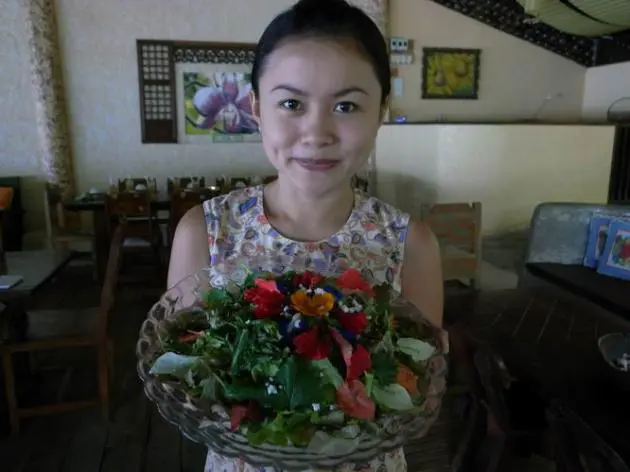
Wallace treated us to a sumptuous organic lunch featuring a salad of edible flowers, brown rice, honey-glazed chicken, spare ribs, the famous cab-cab with pesto and green tomatoes, steamed fish, and squash bread with homemade pesto and honey spread.
It was all delicious, even if nothing was spicy (spiciness isn’t a trait of Philippine food). The flower salad is absolutely a must-try dish if you go. We finished with mango ice cream, an item that that locals complain is too expensive.
Thanks to those hard-working bees, everything seemed associated with honey one way of another. The farm shop sells different kinds of honeyed breads and other honey-oriented products. One of the top sellers is natural coconut honey – it smells like coconut but tastes like honey.
Wallace is building more bungalows and has just opened the boutique hotel on her property, so it didn’t look to me like she was wallowing in “simple pleasures” any longer. But, certainly, a bigger bee farm means more jobs for women.
The writer travelled as a guest of the Philippines Department of Tourism and Philippines Airlines.
Bee here now
The Bohol Bee Farm is at Dao, Dauis, Panglao Island, Bohol. Call (+6338) 510 1822 or (+63917) 710 1062 or e-mail [email protected].
Philippines Airlines flies daily to and from Manila to Bohol. Find out more at www.PhilippineAirlines.com.
