
Impact of 'Guernica' is still felt
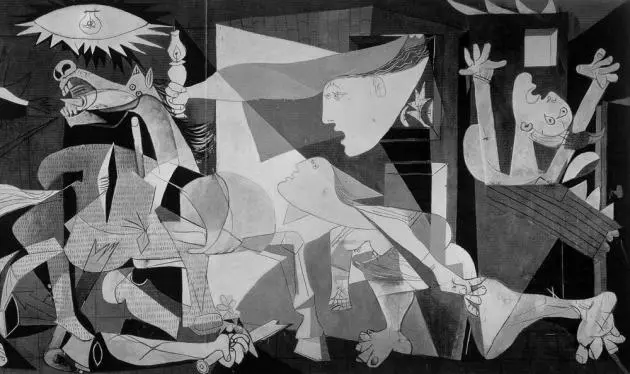


Art lovers note the 75th anniversary today of Picasso's harrowing |anti-war painting
As Pablo Picasso’s iconic anti-war painting “Guernica” marks its 75th anniversary today, its artistic power remains intact. Just ask Daniel Casares.
“My surprise was such and the sensation of all my feelings getting stirred up inside that I was stunned,” says the flamenco guitarist who is performing today in Madrid in one of many tributes marking the anniversary.
Picasso was a painter capable of “breaking with all the artistic preconceptions”, says film director Carlos Saura, who is preparing a movie about how “Guernica” came about. It’s called “33 Days”, for the length of time Picasso spent on the work. Antonio Banderas will portray the painter and Gwyneth Paltrow his lover Dora Maar.
The painting – depicting the 1937 bombing of the Basque Spanish town Guernica by Hitler’s air force – has been analysed, copied by artists and reproduced on souvenirs.
Some aficionados say the 3.5-by-7.8-metre painting in black, white and grey is far from Picasso’s best work. They criticise its composition and say its lack of colour makes it look like a sketch.
“Guernica” nevertheless remains one of the world’s most highly valued and most influential paintings. About a million people come to see it every year at Madrid’s Reina Sofia Museum of Modern Art.
“Guernica” was commissioned for the Paris Universal Exposition in 1937 by Spain’s republican government, which was engaged in a bitter civil war against the right-wing nationalists of General Francisco Franco.
It depicts the bombing of Guernica, the ancestral home of Spain’s Basques, which was levelled by German aircraft in support of Franco on April 26, 1937. The attack, which sparked international outrage, killed up to 1,800 civilians.
The canvas, depicting tormented and distorted human and animal figures, became a universal cry against the folly of war.
Picasso, living in Paris at the time, was in a creative crisis, says Saura. “The bombing of was the stimulus he needed to begin painting” after a long period of “doubts and hesitation”.
At age 57, “he is an incredible draftsman, very agile. He tackles the canvas and all the outlines pour forth in less than a month,” points out artist Jose Ramon Amondarain, who has reproduced Picasso’s creative process on eight canvases to mark the anniversary.
Despite an initially cool reception at the Universal Exposition, “Guernica” was soon being sent to numerous exhibitions, initially to collect funds for the republican side in the war and later just because of its fame.
It travelled to Scandinavia, Britain, Brazil and the United States. It was rolled and unrolled about 100 times, until the canvas cracked and the paint flaked.
It was finally decided that “Guernica” could travel no more. Franco won the civil war and Picasso did not want his work in Spain as long as the country was under the dictator’s rule. In 1958 it was placed in New York’s Museum of Modern Art.
The painting finally came home to Spain in 1981, six years after Franco’s death and eight years after Picasso’s.
Its condition was thoroughly analysed in 1998. A robot is currently producing millions of digital images in the most exhaustive analysis so far, says a Reina Sofia spokeswoman. The images are expected to reveal how Picasso worked and the changes he made.
The Spanish government and the Reina Sofia are adamant that “Guernica” will never be moved again. Their attitude has annoyed others wanting to house the masterpiece.
“It deserves to be at the Prado,” said Miguel Zugaza, director of that art museum.
And Basque nationalists keep insisting “Guernica” should be displayed in the town it was named after, or elsewhere in the region.
But “independent experts have confirmed that the painting is in a delicate state and advised against moving it”, says the Reina Sofia spokeswoman. The welfare of “Guernica” comes first.
