
Ikea writes a Postscript


Play
The Swedish furniture giant celebrates 60 years of design with a new Ps collection that revisits some of its great ideas
Inspired by history and designed for today is concept behind the Ps Collection 2012 of Swedish home furnishing maker Ikea, just launched at its Mega Bangna store.
First introduced in 1995, Ps collections are launched every three years and for this, the seventh series, 19 designers are looking back at Ikea’s 60 years of design history and reinventing past products in innovative and sustainable ways.
“Ps, meaning Post Scriptum, doesn’t focus on traditional Scandinavian design. Instead, we offer designs for different types of people, in real homes and for real use. The design of our old products has been reinvented to meet new needs and to suit the changes in lifestyle with the maximum use of materials but still emphasising space saving,” says communication and interior design manager EJ Middelhoven.
The results of that design flurry are 46 products varying from chairs, tables, lamps and bowls to textiles and pictures. Every item still maintains the Ikea style, meaning it’s functional, affordable, flat-packed and easily assembled, but there’s plenty of attention paid to sustainable and renewable materials.
Inspired by a tubular steel sofa of the early 70’s, designer, Nike Karlsson has come up with a three-seat sofa with recyclable pocket springs as a substitute for the former metal springs, which were difficult to recycle.
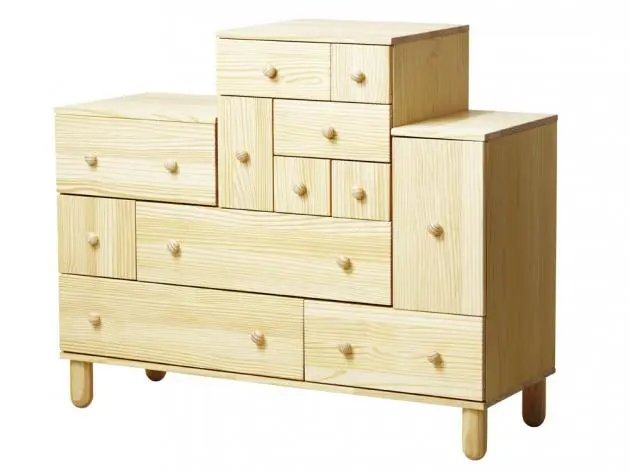
Solid wood has been shunned in favour of fast-growing pine and bamboo, which are used as the main materials for this collection for a lightweight but hardwood effect. To bring out the best of pine, Ehlen Johansson designs a chest of five drawers with an add-on six-drawer chest. The drawers are painted red inside to give an attractive contrast to the exterior’s visible wood grain.
Praised for its strong, durable and renewable features, a ’70’s table gets a makeover from designer Henrik Preutz and evolves into three side tables with bamboo structures, plastic table tops and metal shelves. Bamboo is layer-glued to become hard and resemble teak for Jon Karlsson’s dining table that flirts with the ’50’s style. Sarah Fager also uses bamboo and renewable PET plastic for her four-drawer set that not only allows us see what’s inside the drawers, but is easy to recycle.
Maria Vinka’s textiles are always covered with polka dots to promote energy and joy. Her cushion and quilt covers and pillowcases are made of linens that are strong and durable, yet soft and breathable.
“Linen is produced from the extracted fibre of fast-growing flax plants, which grow in large fields in cooler climates where artificial irrigation and pesticides are rarely used,” says Middelhoven.
The new material of wood plastic composite consisting of recyclable polypropylene and wood fibres from sawmill waste is also used in many products. Among them is a chair with armrests designed by Marcus Arvonen who says using wood fibre makes plastic products less expensive, stronger, more rigid and gives a warmer feel. It’s claimed that the wood plastic composite is more environmentally friendly and requires less maintenance than other alternatives to solid wood.
The advances in LED technology that consists of small light diodes help make lamps smaller and slimmer. And the LED also makes it possible to fold the wall lamp, designed by Johanna Jelinek, against the wall when you’re not using it. It also fits in every room and in every corner where light is needed. The bulbs last about 20 years and consume up to 85 per cent less energy than traditional incandescent ones.
BOX IT UP AND CARRY IT HOME
Ikea is at the Mega Bangna shopping complex at Bangna-Trat Road Kilometre 8. It’s open daily from 10 to 10. Call (02) 708 7999 or visit www.Ikea.co.th.
